The evolution of modern science has taken a monumental leap forward as the zuckerberg biohealth ai initiative steps into uncharted territory. Mark Zuckerberg, alongside his wife, Dr. Priscilla Chan, has embarked on a staggering prestige project that mirrors the philanthropic health endeavors of billionaires like Bill Gates and Warren Buffet. Through the Chan Zuckerberg Biohub, the couple has established an incredibly ambitious long-term mission: to cure, manage, and prevent all human diseases by the end of the century. By merging massive computing power with microscopic biological data, this initiative aims to redefine the future of medicine.
The $500 Million Investment in AI-Powered Biology
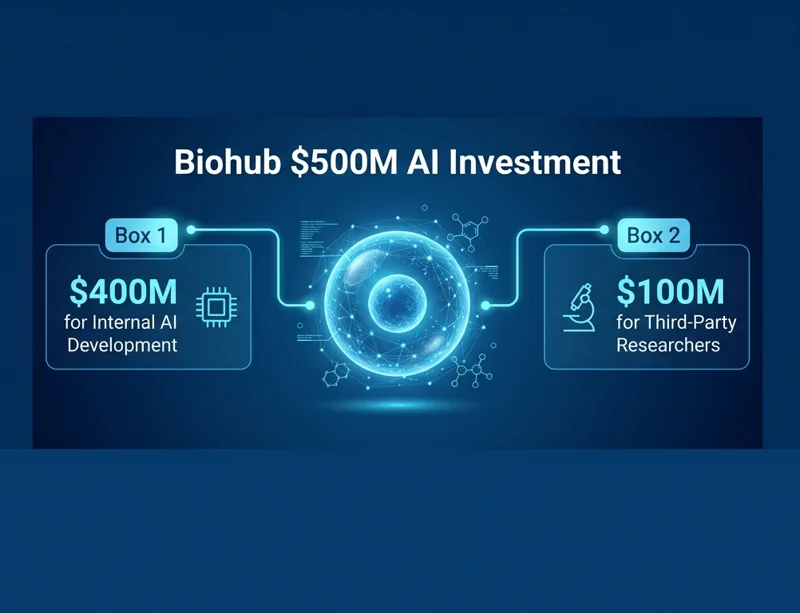
To turn this science-fiction concept into reality, the Chan Zuckerberg Biohub recently announced a massive $500 million investment directed entirely at AI-powered biology. Over the next five years, this funding will be used to construct a massive computing infrastructure designed to understand the human body at a molecular scale. Rather than relying solely on traditional petri dishes and clinical trials, the goal is to build a digital twin of human biology that can simulate how a disease spreads, how a virus mutates, and how a new drug interacts with a specific cell.
| Funding Allocation Category | Amount Allocated | Primary Purpose |
|---|---|---|
| Internal AI Development | $400 Million | Building high-performance computing clusters and algorithms. |
| Third-Party Researchers | $100 Million | Grants for external scientists and bioscience institutions. |
The core of this half-a-billion-dollar strategy is the development of human cell predictive models. By mapping how billions of cells interact within a living organism, medical researchers hope to predict the onset of diseases long before symptoms appear. Alex Rives, the head of science at the Biohub, noted that building artificial intelligence capable of representing the full complexity of biology requires orders of magnitude more data than what currently exists in the scientific community.
“To build artificial intelligence that can accurately represent the full complexity of biology and accelerate scientific research, we need orders of magnitude more data than exists today.”
Revolutionizing Bioscience Medical Research
This initiative promises to unlock incredible advancements in bioscience medical research. Currently, developing a new pharmaceutical drug can take over a decade and cost billions of dollars, largely due to the trial-and-error nature of human testing. If the Chan Zuckerberg Biohub successfully creates accurate predictive models, researchers could simulate clinical trials digitally in a matter of hours.
| Research Phase | Traditional Methods | AI-Simulated Methods |
|---|---|---|
| Drug Discovery | Years of physical lab testing | Rapid algorithmic pattern matching |
| Cellular Observation | Microscopic physical analysis | Digital mapping from molecular to tissue level |
Despite the immense potential for humanity, the massive influx of private money into public health science raises questions about the privatization of medical breakthroughs. If a private AI model discovers the cure for a deadly disease, how will that data be shared? While the Biohub claims it operates with an open-source ethos, the control of such profound biological data by a tech billionaire remains a contentious talking point among ethicists.
The Meta Federal Corporate Tax Rate Controversy
The grandeur of Zuckerberg’s health ambitions cannot be discussed without addressing the glaring financial ironies surrounding his empire. This new philanthropic campaign comes at the exact moment Meta’s financial practices are under intense scrutiny. According to reports from the Institute on Taxation and Economic Policy, Meta paid the lowest federal income tax rate on record in 2025.
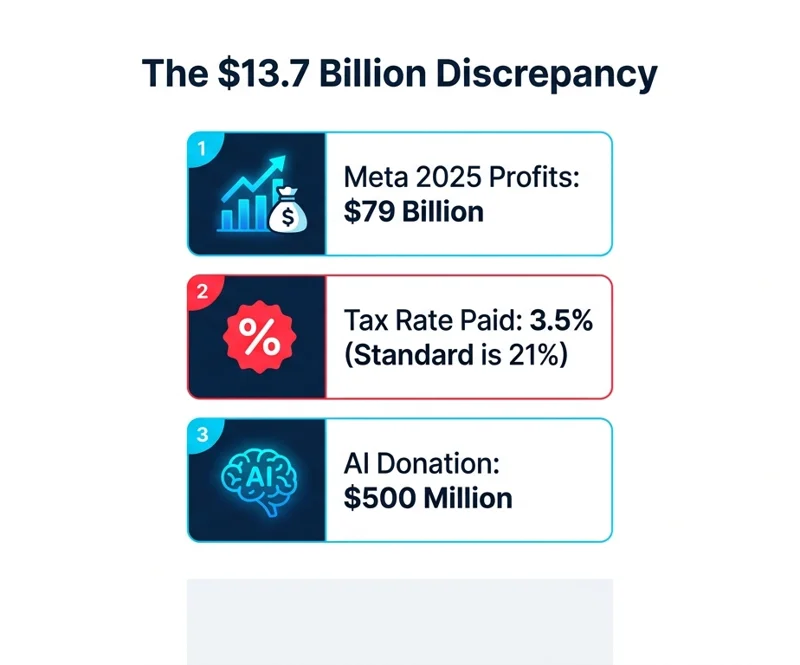
While the company celebrated its best financial year ever, bringing in a staggering $79 billion in profits across 2025, the Meta federal corporate tax rate paid was reportedly just a little over 3.5 percent of its total revenue. This sits in stark contrast to the standard federal corporate tax rate of 21 percent. Critics are quick to point out the math: the discrepancy amounts to approximately $13.7 billion in uncollected taxes.
| Financial Metric (2025) | Reported Figure |
|---|---|
| Meta Total Profits | $79 Billion |
| Standard Federal Corporate Tax Rate | 21% |
| Actual Tax Rate Paid | ~3.5% |
| Estimated Uncollected Revenue | $13.7 Billion |
While $500 million for biological AI is a massive sum, it pales in comparison to the $13.7 billion that could have funded federal health insurance and nutrition programs for millions of low-income citizens.
This dynamic has sparked a fierce debate about how society funds scientific advancement. On one hand, private foundations like the Chan Zuckerberg Biohub can move with agility, funding experimental AI models that government agencies might find too risky. On the other hand, relying on billionaire philanthropy to solve global health crises while massive corporations avoid fair tax contributions leaves essential government safety nets—like the Food and Nutrition Service—underfunded.
Frequently Asked Questions
What is the primary goal of the Chan Zuckerberg Biohub?
The organization’s stated mission is to cure, prevent, and manage all human diseases by the end of the century through advanced technology and research.
How much money is being invested in this new AI biology project?
The Biohub recently announced a $500 million investment to fund a five-year plan for developing advanced biological AI models.
What are human cell predictive models?
They are highly complex digital simulations that use AI to predict how human cells will behave, interact, and react to diseases or new medications.
How is the $500 million being distributed?
Approximately $400 million will go toward the Biohub’s internal AI development, while the remaining $100 million will fund third-party scientists and researchers.
Why is Mark Zuckerberg facing criticism despite this donation?
Critics point out that while he is donating $500 million, his company, Meta, avoided paying approximately $13.7 billion in federal taxes in 2025 by paying only a 3.5% effective tax rate.
How could AI accelerate drug discovery?
AI can process massive biological datasets to simulate clinical trials and molecular interactions digitally, saving years of traditional lab work and billions in research costs.
Who is leading the science division of the Chan Zuckerberg Biohub?
Alex Rives currently serves as the head of science, overseeing the massive data collection and AI algorithm development required for this project.
Disclaimer: This article is for informational purposes only. The tax figures and financial estimates referenced are based on reports from independent economic policy organizations and do not constitute professional financial or medical advice.