The entire tech industry is currently obsessing over the samsung-display flex chroma pixel sensor oled announcements that have just completely redefined what our mobile devices can do. Unveiled at the highly anticipated SID Display Week 2026 in Los Angeles, Samsung Display has proven once again why it remains the undisputed king of screen innovation. From pushing color boundaries to turning the actual screen of your phone into a highly advanced medical-grade monitor, the future of smartphones has officially arrived. If you thought the Galaxy S26 Ultra was the peak of mobile technology, these new panels are about to completely change your perspective.
The Dawn of the Flex Chroma Pixel OLED
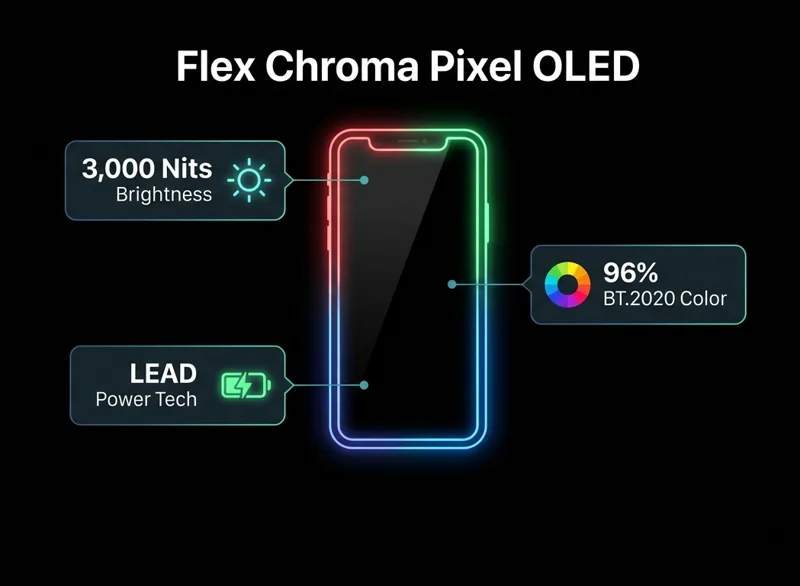
For years, smartphone manufacturers have been locked in a fierce battle to produce the brightest, most vibrant screens possible. Samsung has effectively ended that competition with the introduction of its new Flex Chroma Pixel OLED technology. This cutting-edge panel is designed to push color and luminosity far beyond the current limitations of mobile hardware. The most jaw-dropping specification? This display can hit a blinding 3,000 nits of peak brightness when placed in high-brightness mode. This ensures that even under the harshest direct sunlight, the screen remains flawlessly readable, looking as vibrant as it would in a pitch-black room.
But brightness is only half the story. The Flex Chroma Pixel OLED covers an astonishing 96% of the BT.2020 color space. To put this into perspective, the International Telecommunication Union set the BT.2020 standard to define the absolute ultrawide color ranges required for next-generation modern displays. By covering 96% of these BT.2020 color space displays, Samsung’s new panel can reproduce richer, deeper, and more breathtakingly accurate colors than practically any other smartphone screen on the market today. Normally, pushing a screen to these extremes results in massive battery drain and a shortened panel lifespan. However, Samsung has utilized proprietary new organic materials and its in-house LEAD technology to keep power consumption incredibly low while maximizing durability.
“By achieving 3,000 nits and mastering the BT.2020 standard, the Flex Chroma Pixel OLED effectively bridges the gap between professional cinema monitors and the smartphone in your pocket.”
| Display Feature | Standard Flagship OLED | Flex Chroma Pixel OLED |
|---|---|---|
| Peak Brightness | 1,500 – 2,000 Nits | 3,000 Nits |
| Color Accuracy Range | DCI-P3 Focus | 96% of BT.2020 |
| Power Efficiency Tech | Standard LTPO | In-house LEAD Technology |
Sensor OLED: The Ultimate Smartphone Health Sensor Technology
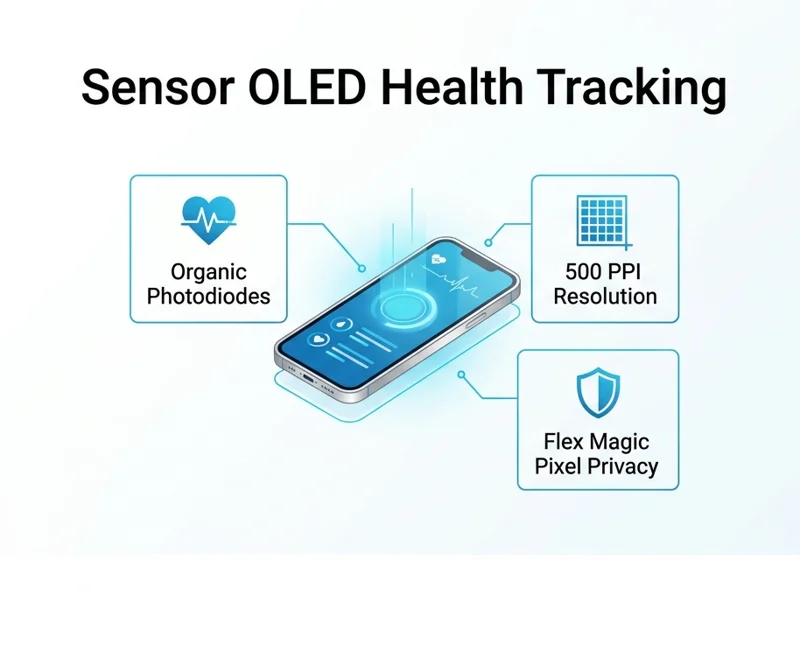
While a brighter screen is always welcome, the true showstopper at SID Display Week 2026 was the unveiling of the “Sensor OLED.” Measuring at a standard smartphone size of 6.8 inches, this panel does not just display your favorite apps and videos—it actively monitors your cardiovascular health. Samsung has successfully embedded organic photodiodes directly into the display layer itself. These microscopic sensors utilize the light emitted by the screen to measure the blood flow in your fingers when you touch the glass. This means your smartphone can now accurately track your heart rate and measure your blood pressure without requiring you to buy a separate smartwatch or fitness band.
Fitting this level of advanced smartphone health sensor technology into a screen is notoriously difficult. Historically, adding sensors meant sacrificing image sharpness. Yet, Samsung managed to pack all these organic photodiodes into the panel while perfectly maintaining a crisp 500 PPI (Pixels Per Inch) resolution. This is a monumental engineering feat, ensuring that users get flagship-tier visual fidelity alongside clinical-grade biometric tracking.
“The Sensor OLED eliminates the need for external wearables, transforming the smartphone display itself into an all-in-one, high-resolution biometric health hub.”
Flex Magic Pixel Privacy: Guarding Your Health Data
Of course, having your blood pressure and heart rate displayed on a massive 6.8-inch screen raises immediate privacy concerns. You do not want the person sitting next to you on the train reading your medical vitals. To combat this, Samsung integrated its brilliant Flex Magic Pixel privacy technology directly into the Sensor OLED. Building upon the Privacy Display feature originally popularized by the Galaxy S26 Ultra, this technology allows the screen to manipulate viewing angles dynamically.
When you are checking your health metrics, the Flex Magic Pixel privacy tech ensures that the sensitive data is only visible to the person looking at the screen straight-on. To anyone viewing the phone from a side angle, the health data becomes completely obscured, while the rest of the non-sensitive content on the screen remains perfectly visible. While these technologies are currently in the showcase phase and not yet shipping on consumer devices, they provide an incredibly exciting roadmap for the future of mobile technology.
| Technology | Primary Function | Consumer Benefit |
|---|---|---|
| Organic Photodiodes | Measures blood flow via screen light | Tracks heart rate & blood pressure |
| 500 PPI Integration | Maintains high pixel density | No loss of screen sharpness or quality |
| Flex Magic Pixel | Restricts side-viewing angles dynamically | Protects private medical information |
Frequently Asked Questions
What makes the Flex Chroma Pixel OLED so special?
It can achieve an incredibly bright 3,000 nits while covering 96% of the BT.2020 color space, offering unmatched outdoor visibility and richer, deeper colors.
What does BT.2020 mean for smartphone displays?
BT.2020 is a standard set by the International Telecommunication Union that defines an ultrawide color range, ensuring the display shows highly accurate and lifelike colors.
How does the Sensor OLED track my blood pressure?
It uses organic photodiodes embedded directly into the screen layer that utilize the display’s own light to measure blood flow in your fingers when you touch the glass.
Will adding health sensors make the screen look blurry?
No. Samsung engineered the Sensor OLED to maintain a flagship-level 500 PPI resolution, so the screen remains incredibly sharp despite the added health sensors.
Do I still need a smartwatch if my phone has Sensor OLED?
The Sensor OLED is designed to perform many of the same cardiovascular tracking functions as a smartwatch, potentially eliminating the need for a separate wearable for basic heart rate and blood pressure checks.
How does Samsung protect my health data on such a large screen?
Samsung uses Flex Magic Pixel privacy technology, which restricts the viewing angle for sensitive information. This ensures your vitals are only visible when looking directly at the phone, hiding them from side views.
When will I be able to buy a phone with these new OLED displays?
While Samsung unveiled these displays at SID Display Week 2026, they are currently concept technologies. However, they strongly indicate what features will be included in future flagship Samsung Galaxy devices in the coming years.
Disclaimer: This article is for informational purposes only. The technologies discussed, including the Sensor OLED and Flex Chroma Pixel OLED, are based on prototype showcases from SID Display Week 2026 and may undergo changes before reaching consumer markets. Always consult a medical professional for accurate health diagnoses.