
The cybersecurity community’s most urgent warning this week is clear: WordPress Core wp2shell RCE flaws get public exploits patch now. Over 500 million websites running the world’s most popular content management system are currently at massive risk. If you manage a site, immediate action is required to prevent a full system compromise.
Security researchers recently discovered critical vulnerabilities that allow attackers to seize complete control of default installations. Because the WordPress Core wp2shell RCE flaws get public exploits patch now, the window for safe patching is rapidly closing. Hackers are already deploying these attacks in the wild.
The Anatomy of the Attack: WordPress Core wp2shell RCE flaws get public exploits patch now
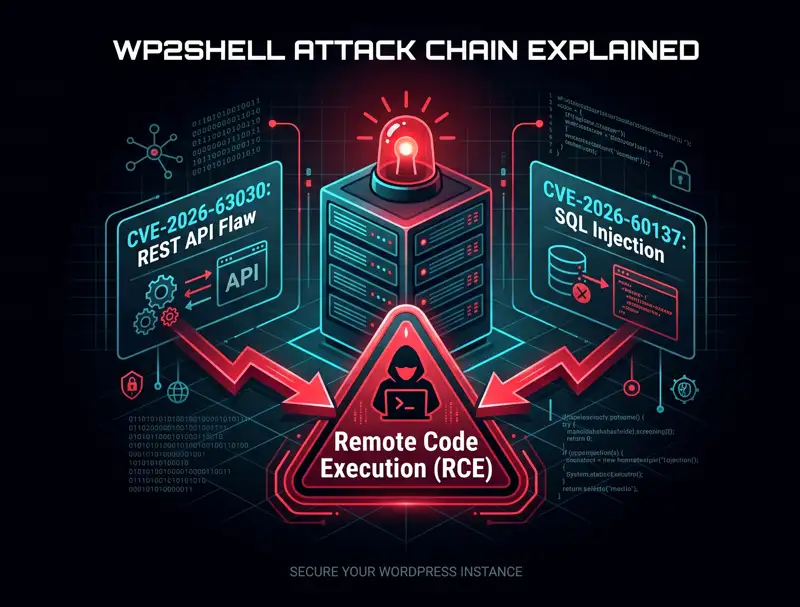
This massive security crisis stems from a pre-authentication remote code execution (RCE) attack chain known as wp2shell. Unauthenticated attackers can exploit these flaws against standard installations. They do not even need active plugins or administrator privileges to take over your server.
The core message for IT teams is that WordPress Core wp2shell RCE flaws get public exploits patch now before your data is stolen. The exploit relies on chaining two distinct vulnerabilities together. When combined, they bypass all standard authentication protocols.
| Vulnerability ID | Flaw Type | Role in Attack Chain |
|---|---|---|
| CVE-2026-63030 | REST API batch-route confusion | Enables remote code execution |
| CVE-2026-60137 | SQL injection (author__not_in) | Extracts database information |
This is not a theoretical threat. Threat actors are actively using these exact methods. The undeniable reality is that WordPress Core wp2shell RCE flaws get public exploits patch now, and failing to update guarantees exposure.
“The attack has no preconditions and can be exploited by an anonymous user in a stock install of WordPress with no plugins.”
Version Risks: Why WordPress Core wp2shell RCE flaws get public exploits patch now
The REST API vulnerability was introduced recently, creating a dangerous combination with the existing SQL injection flaw. As public proof-of-concept codes hit GitHub, the alert level has reached maximum severity. Administrators must realize that WordPress Core wp2shell RCE flaws get public exploits patch now to prevent malicious plugins from being silently uploaded to their directories.
For more detailed technical advisories on foundational security practices, administrators should always refer to the official WordPress news portal. However, the immediate priority remains applying the newest core updates.
Immediate Mitigation: WordPress Core wp2shell RCE flaws get public exploits patch now
The platform’s security team has taken the unprecedented step of forcing automatic security updates for supported installations. This highlights exactly why WordPress Core wp2shell RCE flaws get public exploits patch now. If your auto-updates are disabled, you are currently an open target.
To fully secure your digital infrastructure, you must upgrade your software immediately. The attack chain has been definitively neutralized in the latest patches. Delaying this process is not an option.
| Software Branch | Vulnerable Versions | Safe Patched Version |
|---|---|---|
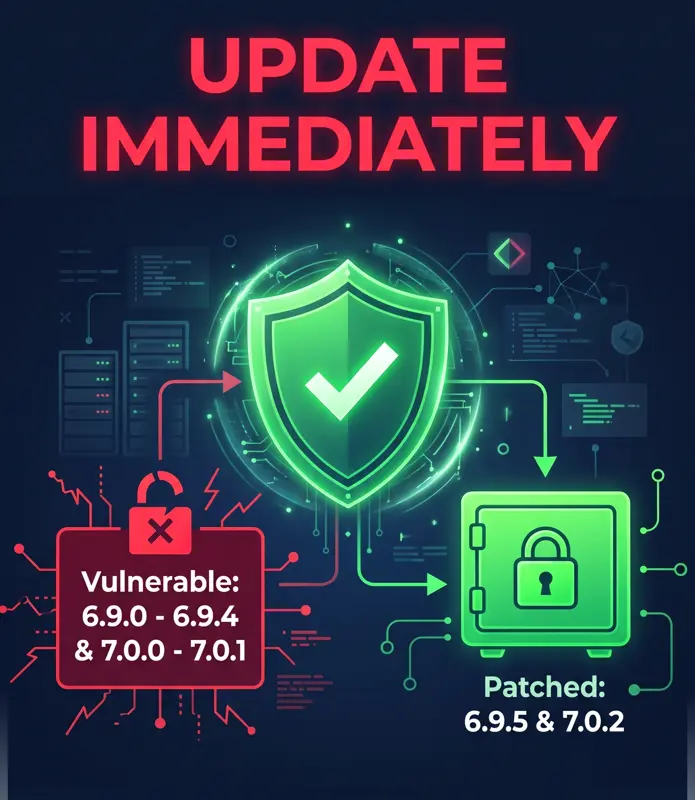
| Version 6.9.x | 6.9.0 through 6.9.4 | Update to 6.9.5 |
| Version 7.0.x | 7.0.0 through 7.0.1 | Update to 7.0.2 |
If you cannot update right away, temporary mitigations exist. Security firms recommend blocking anonymous access to the REST API. Cloudflare has also deployed Web Application Firewall (WAF) protections across all plans to intercept these specific payloads.
“The watchTowr team is already seeing PoC exploits in circulation, and we are beginning to see the first signs of in-the-wild exploitation.”
WAF Defenses and Why WordPress Core wp2shell RCE flaws get public exploits patch now
While WAF protections are helpful, they are merely band-aids. The core directive remains: WordPress Core wp2shell RCE flaws get public exploits patch now. Relying solely on a firewall while running a vulnerable core version leaves your system susceptible to bypass techniques.
Act immediately. Check your admin dashboard, verify your current version, and apply the forced updates. The survival of your website’s data depends entirely on your speed of response to this wp2shell crisis.
Frequently Asked Questions
What exactly is the wp2shell vulnerability?
It is a critical attack chain combining two flaws (CVE-2026-63030 and CVE-2026-60137) that allows unauthenticated attackers to execute remote code on your server.
Does the WordPress Core wp2shell RCE flaws get public exploits patch now alert apply to sites without plugins?
Yes. This vulnerability affects default, stock installations even if you have zero active plugins installed.
Which versions of the software are affected by the full RCE chain?
The complete pre-authentication remote code execution chain impacts versions 6.9.0 through 6.9.4, and 7.0.0 through 7.0.1.
How do I fix the wp2shell vulnerability on my website?
You must immediately update your core software to safe versions, specifically 6.9.5 or 7.0.2, depending on your current branch.
What if I cannot update my site immediately?
As a temporary measure, you should block anonymous access to the REST API or configure your Web Application Firewall (WAF) to block /wp-json/batch/v1 traffic.
Are attackers actively using these exploits?
Yes. Security firms have confirmed that public proof-of-concept exploits are available and active in-the-wild exploitation has already begun.
Did the development team release automatic updates for this?
Due to the extreme severity of the flaws, the official security team has enabled forced automatic security updates for supported installations.
Disclaimer: This article is for informational purposes only. System administrators should verify all security protocols and updates directly through official vendor documentation.