
When discussing corporate history, the KFC 1991 rebranding stands out as one of the most talked-about events in the industry.
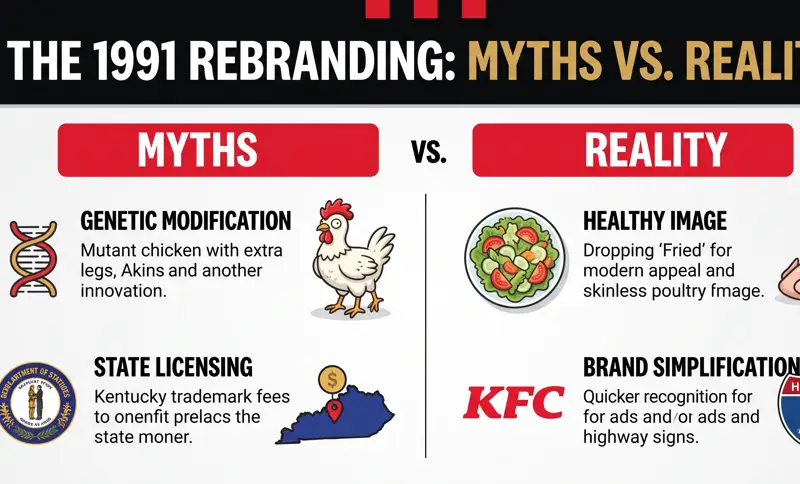
Kentucky Fried Chicken officially shortened its name to KFC in 1991, sparking decades of wild rumors.
From bizarre mutant chicken theories to government trademark disputes, the public imagination ran wild.
However, the truth behind this monumental fast food marketing strategy is rooted in simple business logic.
This article explores the corporate strategy behind the KFC 1991 rebranding and how it navigated healthy fast food trends.
Debunking the Myths Surrounding the KFC 1991 Rebranding
One of the most persistent myths regarding the KFC 1991 rebranding involves the Commonwealth of Kentucky.
A widespread urban legend falsely claimed that the state trademarked its name to force licensing fees.
Another wild rumor suggested the company was breeding extra-large, genetically modified organisms.
This mutant chicken urban legend claimed the chain could no longer legally call its product “chicken.”
“The mutant chicken rumors resulted in Chinese courts finding several companies liable for spreading false claims that damaged the brand’s reputation.”
In fact, the company won defamation lawsuits against tech firms spreading these lies, as reported by Reuters.
These myths overshadowed the genuine fast food marketing strategy that drove the change.
| Rumor / Myth | The Reality of KFC 1991 Rebranding |
|---|---|
| Kentucky state trademarked the name. | False. The state did not force licensing fees. |
| Mutant, multi-legged chickens were used. | False. Lawsuits were won against these defamatory claims. |
| They could not legally use the word “chicken.” | False. It was a strategic choice to modernize the brand. |
The True Fast Food Marketing Strategy Behind the Name Change
The updated name was largely intended to distance the restaurant chain from unhealthy connotations.
During the era of the KFC 1991 rebranding, the word “fried” became an obstacle for growth.
The company was struggling with declining earnings and shifting healthy fast food trends.
Adapting to Healthy Fast Food Trends with the KFC 1991 Rebranding
Around this period, the chain introduced skinless poultry options, attempting to appeal to health-conscious consumers.
Products initially called “Lite’n Crispy” were tested to revitalize their market share.
Executives acknowledged that fried poultry on the bone was not growing as fast as the broader industry segment.
The primary goal of the KFC 1991 rebranding was to position the company with a more contemporary image.
“We want to position the company to a more contemporary image. Fried is not a contemporary image.”
Preserving the Colonel Sanders Legacy in a Modern Era
Despite the name change, maintaining the Colonel Sanders legacy remained a top priority.
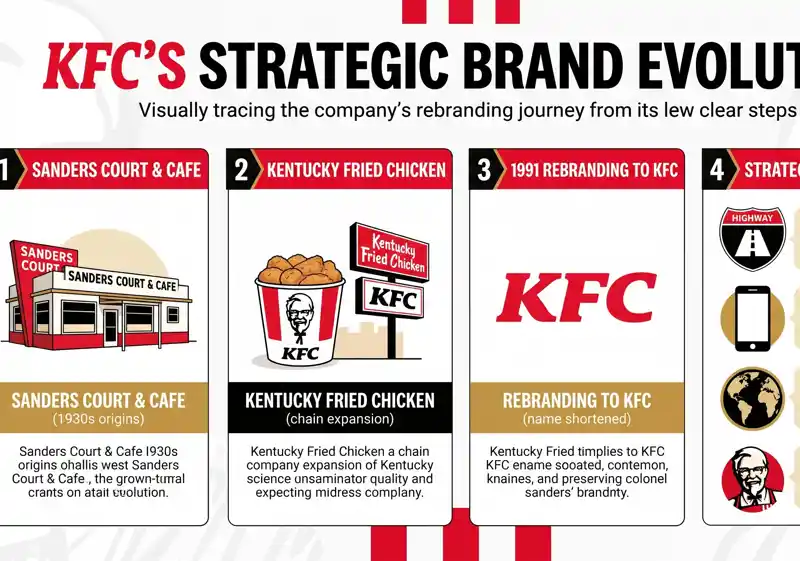
The founder, Harland Sanders, opened his original roadside service station in 1930.
While the KFC 1991 rebranding changed the letters, the iconic face of the Colonel stayed at the forefront.
This era saw many large corporations taking branding, fonts, and logos very seriously.
Shortening the name saved essential space in advertising, making a faster, stronger impression.
| Branding Element | Strategic Purpose |
|---|---|
| Three-Letter Acronym (KFC) | Quicker visual recognition on highway signs and digital media. |
| Dropping the word “Fried” | Aligning with emerging healthy fast food trends. |
| Retaining the Colonel’s Face | Preserving trust and the Colonel Sanders legacy. |
The Global Impact of the KFC 1991 Rebranding
Today, the company boasts the widest global footprint of any quick-service restaurant brand.
The streamlined logo helps attract younger audiences across different cultures and languages.
By relying on a universally recognizable acronym, they easily captured attention in noisy urban environments.
The KFC 1991 rebranding remains a textbook example of successful corporate adaptation and visual evolution.
It successfully balanced the rich Colonel Sanders legacy with the necessary shift toward modern consumer habits.
Frequently Asked Questions
What was the main reason for the KFC 1991 rebranding?
The KFC 1991 rebranding was executed to modernize the brand’s image, remove the unhealthy stigma of the word “fried,” and create a shorter, more recognizable logo for global advertising.
Did the state of Kentucky force the name change?
No. The rumor that the state trademarked its name and demanded licensing fees is completely false.
Is the mutant chicken urban legend true?
Absolutely not. The company never bred genetically modified, multi-legged organisms. They even won lawsuits against entities spreading this defamation.
How did healthy fast food trends influence the KFC 1991 rebranding?
In the late 80s and early 90s, consumers became more health-conscious. Dropping “fried” from the prominent logo was a strategic move to adapt to these healthy fast food trends.
Did they change their recipe during the KFC 1991 rebranding?
The Original Recipe remained the same, but the company did introduce new items like skinless options to appeal to changing dietary habits.
Why is the Colonel Sanders legacy still important to the brand?
The Colonel Sanders legacy represents the brand’s authentic southern-style origins, providing a sense of heritage and trust that grounds their modern identity.
Why are three-letter acronyms better for fast food marketing strategy?
Shorter acronyms take up less space on signage, are processed faster by passing drivers, and are universally recognizable across different languages.
Disclaimer: This article is for informational purposes only and does not constitute official corporate statements.