John Ternus just gave the best defense yet for Vision Pro during a recent sit-down interview with French media outlet Clique TV.
As the new Apple CEO, Ternus faced tough questions regarding the commercial performance of the company’s ambitious spatial computing headset.
While the device remains a technological marvel with a deeply loyal fanbase, its high price and niche appeal make it an oddity in the current Apple hardware lineup.
However, instead of shying away from the criticism, the CEO offered a profound perspective on the long-term trajectory of the platform.
By comparing the current state of spatial computing to the revolutionary, yet slow, rollout of the original personal computers, he reshaped the narrative surrounding the headset.
Understanding Why John Ternus just gave the best defense yet for Vision Pro
When asked by Clique TV’s Mouloud Achour if the device was a test, a flop, or the first step into the future, the response was incredibly telling.
Many remember that former CEO Tim Cook previously described the headset’s underwhelming sales by categorizing it strictly as an “early adopter product.”
While accurate, that explanation left many investors and consumers wondering about the ultimate endgame for such an expensive piece of hardware.
This is exactly why analysts are saying John Ternus just gave the best defense yet for Vision Pro.
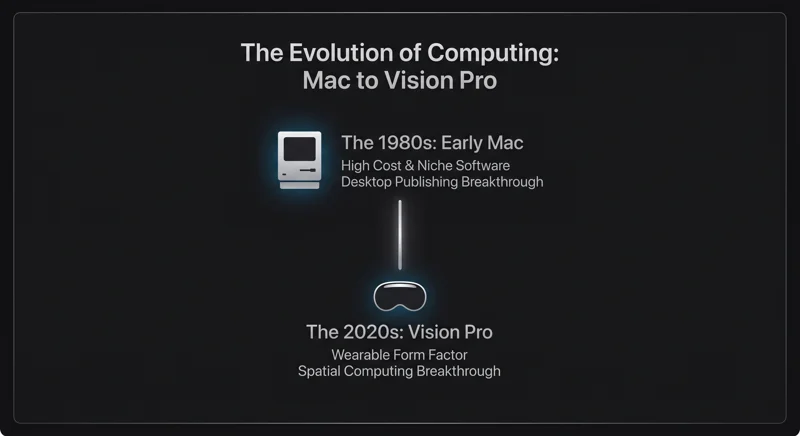
He bypassed the standard corporate talking points to draw a direct historical parallel to the earliest days of the Mac.
“Vision Pro to me is an amazing device. It’s an absolutely amazing device. But I think of it as like the early days of computers.”
In those early days, personal computers were massively expensive and possessed extremely limited mainstream use cases.
Yet, early adopters found specific professional niches, such as desktop publishing, that eventually transformed entire global industries.
To follow the latest official announcements regarding Apple hardware, you can always visit the Apple Newsroom.
| Historical Era | Device | Initial Hurdle | Breakthrough Industry |
|---|---|---|---|
| 1980s | Early Mac Computers | High Cost, Niche Software | Desktop Publishing |
| 2020s | Apple Vision Pro | High Cost, Wearable Form Factor | Medical and Film Production |
Enterprise Use Cases: How John Ternus just gave the best defense yet for Vision Pro
The most compelling part of the interview was the specific real-world applications that are already validating the hardware’s existence.
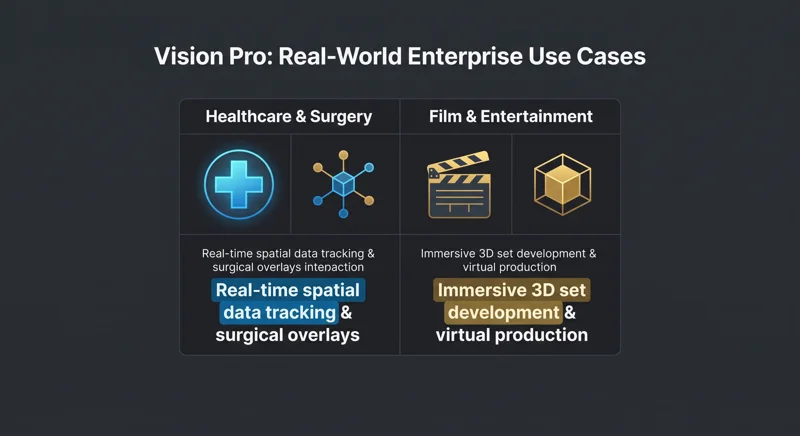
Ternus noted that surgeons are increasingly utilizing the headset inside active operating rooms.
It proves to be a fundamentally superior tool for displaying vital medical data compared to traditional 2D monitors pushed into the corner of a surgical suite.
Similarly, professionals in film production are heavily leaning on spatial computing for advanced set development and pre-visualization.
These specialized applications highlight exactly how John Ternus just gave the best defense yet for Vision Pro.
“Surgeons are starting to use it in surgery because it’s just a fundamentally better tool for them than a monitor that’s kind of sitting over here.”
The consumer market may take several more years to adopt lightweight, spatial computing glasses.
However, the enterprise foundation is currently being built by professionals who are willing to pay top dollar for a device that unlocks possibilities never before possible.
| Current Market Segment | Primary Application | Future Growth Potential |
|---|---|---|
| Healthcare & Surgery | Real-time spatial data tracking | High (Standardized training tools) |
| Film & Entertainment | Immersive 3D set development | High (Virtual production stages) |
| General Consumer | Media consumption & spatial video | Moderate (Pending price reductions) |
The Future Outlook: John Ternus just gave the best defense yet for Vision Pro
Ultimately, the realization of full-fledged spatial computing is a long journey, not an overnight success story.
The tech community is already seeing a bustling accessory market grow around the device, including aluminum dock stands, Spigen travel cases, and specialized battery holders.
Even audio integrations, like the newly discounted $199 AirPods Pro 3, are designed to enhance the immersive spatial experience.
As the technology miniaturizes and production costs decrease, the groundwork laid by today’s early adopters will prove invaluable.
This long-term vision is why tech analysts universally agree that John Ternus just gave the best defense yet for Vision Pro.
Frequently Asked Questions
Who is the current CEO of Apple in this interview?
John Ternus is the new CEO of Apple, having recently taken over leadership responsibilities.
Why do experts say John Ternus just gave the best defense yet for Vision Pro?
He successfully shifted the narrative away from slow consumer sales by comparing the headset to the highly transformative early days of the Mac computer.
How did Tim Cook previously describe the Vision Pro?
Former CEO Tim Cook primarily defended the headset’s sales by referring to it as an “early adopter product.”
What network hosted the interview with John Ternus?
The in-depth interview was hosted by the French media outlet Clique TV, conducted by Mouloud Achour.
Are there any professional industries currently using the Vision Pro?
Yes, Ternus highlighted that the medical field is using it for surgical procedures and the film industry is using it for 3D set development.
Why is the Vision Pro better for surgeons than traditional monitors?
It provides spatial, directly integrated visual data overlays, which is far superior to looking away at a 2D monitor sitting in the corner of the room.
Is the Vision Pro currently considered a commercial success?
In terms of sheer volume, it is not as commercially successful as the iPhone or Mac, but it has secured a vital, loyal base of enterprise and enthusiast users.
Disclaimer: This article is for informational purposes only. Quotes and market analyses are based on recent media interviews and current industry trends.