Welcome to our definitive fitbit air review, where we explore the most hyped wearable product release of 2026.
The wearable technology landscape is shifting dramatically, moving away from distraction-heavy smartwatches. Consumers are increasingly demanding simplicity, and Google has answered with a back-to-basics approach. This fitbit air review will determine if this minimalist device translates to long-term desirability or if it is just a passing trend. Over the past two weeks, we have rigorously tested this device against industry titans like Samsung, Apple, and Oura. Let us dive deep into the hardware, the software, and the innovative AI integration that makes this device unique.
The $100 Minimalist Wearable: A Deep Dive Fitbit Air Review
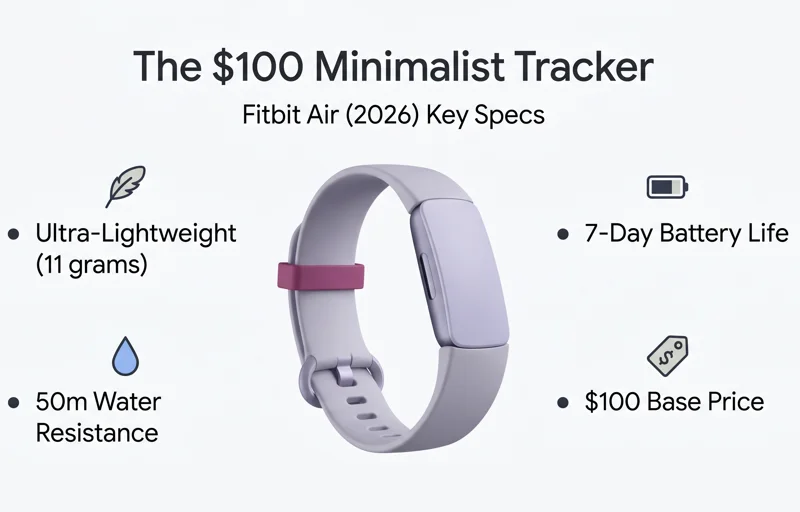
When conducting a thorough fitbit air review, the first thing you notice is the complete absence of a screen. This is a deliberate design choice that transforms the device into a low-distraction wearable. The central module contains a sophisticated sensor array but relies entirely on your smartphone for data visualization. Priced at just $100, the hardware is accessible and offers reasonable long-term costs compared to competitors. You can purchase it directly from the Google Store, Amazon, or Best Buy.
Fitbit Air Review: Design and Aesthetics
The standard package includes a Performance Loop Band made from recycled polyester and stretchy yarn. At 18mm wide with a metal clasp and hook-and-loop fastening, it is highly adjustable. The central module weighs an incredibly light 11 grams, making it virtually disappear on your wrist. For context in this fitbit air review, the Samsung Galaxy Watch 8 weighs 46 grams. It is available in four distinct colors: Obsidian, Lavender, Berry, and Fog, perfectly matching the Google Pixel 10a.
| Feature | Fitbit Air | Oura Ring 4 |
|---|---|---|
| Form Factor | Screenless Wristband | Smart Ring |
| Weight | 11 grams | 7 grams |
| Base Price | $100 | Premium Pricing |
The Fitbit Air is a return to the early days of fitness tracking hardware, stripping away the noise to focus purely on data.
Is It a Viable Oura Ring 4 Alternative? (Fitbit Air Review)
Many readers looking for a fitbit air review want to know if it can replace their smart ring. Like a smart ring, the simple design makes it ideal to wear on the opposite wrist of a mechanical watch. It does not deliver notifications and avoids unnecessary wrist vibrations, keeping distractions to an absolute minimum. You can, however, set a subtle vibrating alarm to wake you up gently. It represents a fantastic Oura Ring 4 alternative for those who prefer wrist-based tracking over finger-based hardware.
Fitbit Air Review: Evaluating Comfort and Durability
Comfort is a critical metric in any comprehensive fitbit air review. Because it is so lightweight, it is a genuine 24-hour-a-day wearable. It is completely unnoticeable when you use it to track sleep overnight. The fabric band dries quickly if it gets wet, and it features a water resistance rating of 50 meters.
The Power (and Flaws) of Google’s AI Coach: Fitbit Air Review Insights
No fitbit air review is complete without analyzing the primary software driving the experience. The device requires the Google Health app, which has officially replaced both the legacy Fitbit app and Google Fit. While the app is free to use, unlocking the full potential requires a subscription. The centerpiece of this ecosystem is the Google Health AI Coach, powered by Gemini technology.
The app’s main screen is dedicated to key data points like steps, readiness, sleep, and cardio goals. Scrolling reveals manual logging options for hydration and meals, alongside current heart rate metrics. The Fitness tab houses both user-created workout plans and pre-made Fitbit routines. Meanwhile, the Health tab provides deep dives into Vitals: breathing rate, blood oxygen, and HRV.
| Subscription Tier | Monthly Cost | Key Features |
|---|---|---|
| Google Health Free | $0 | Basic tracking, manual logging |
| Premium (AI Coach) | $10 | AI insights, custom plans |
| Google AI Pro Bundle | $20 | Premium + Storage + YouTube Lite |
Data is almost secondary to the Google Health app’s primary feature: the highly conversational and insightful AI Coach.
Interacting with the Google Health AI Coach
During this fitbit air review, the AI Coach proved to be surprisingly effective for casual exercisers. It uses natural language processing, allowing you to type or use your voice to discuss data. For instance, asking about resting heart rate prompts the AI to summarize data and provide a detailed, graphed reply. It creates custom workout plans tailored to maintaining a current regime without aggressively pushing you to overexert. However, it exhibits standard AI quirks: it is very verbose and occasionally contradicts itself.
Fitbit Air Review: Syncing and App Performance
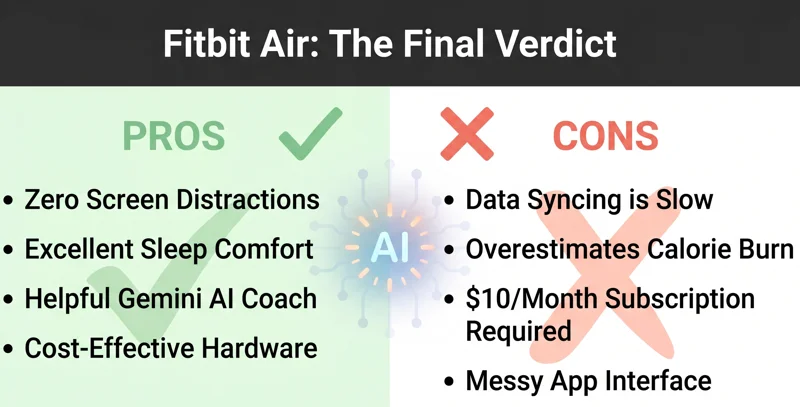
A notable flaw uncovered in this fitbit air review is the slow data synchronization. Sleep data, exercise logs, and AI Coach updates take an frustratingly long time to populate. Furthermore, the Google Health app is messy; finding specific data points often requires tapping through hidden menus. The integration has frustrated legacy users, resulting in a low 3.7-star rating on the Play Store.
Tracking Accuracy: A Crucial Fitbit Air Review Component
Any reliable fitbit air review must put the health sensors to the test. Equipped with an optical heart rate monitor, 3-axis accelerometer, and temperature sensor, it gathers a wealth of data. During workouts, average heart rate aligns well with the Oura Ring and Whoop MG. However, we noticed that it significantly overestimates calorie burn during intense activities.
Fitbit Air Review: Sleep Tracking Discrepancies
Sleep tracking highlighted the biggest data discrepancies in our fitbit air review process. It consistently reports a resting heart rate during sleep about seven bpm higher than the Oura Ring. It is also generally harsher with its overall sleep score calculations. While it may still be calibrating, these over-counted metrics could skew your long-term fitness goals.
| Metric | Fitbit Air Performance | Comparison Notes |
|---|---|---|
| Heart Rate (Workout) | Highly Accurate | Matches Whoop and Oura |
| Calorie Burn | Overestimated | Higher than competitors |
| Resting HR (Sleep) | Elevated (+7 bpm) | Harsher sleep scoring overall |
While not a medical device, the Fitbit Air provides a solid baseline for beginners, even if some data runs slightly high.
Fitbit Air Battery Life: A Major Selling Point
One of the brightest highlights of our fitbit air review is the exceptional battery performance. Without a power-hungry screen, the fitbit air battery life easily reaches the claimed seven days. The app sends a convenient notification when you have approximately 24 hours of charge remaining. Charging takes about 90 minutes from a dead battery to a full hundred percent.
Charging Mechanics in our Fitbit Air Review
The device uses a proprietary magnetic charging puck that attaches securely to the back module. You do not need to remove the tracker from the band to charge it, which adds to the convenience. However, losing this proprietary charger means you cannot use standard cables, and a replacement costs $25.
Evaluating the Fitbit Premium Subscription Cost in our Fitbit Air Review
Cost analysis is a vital part of this fitbit air review, especially regarding recurring fees. To access the AI Coach, you face a Fitbit Premium subscription cost of $10 monthly or $100 annually. Without this subscription, the device functions as a very basic, screenless fitness tracker. Despite the recurring fee, the low initial hardware cost makes it financially viable over a two-year span.
| Device Setup | Hardware Cost | 2-Year Total (with Sub) |
|---|---|---|
| Fitbit Air | $100 | $300 (Annual sub pricing) |
| Competitor Ring | $300+ | $440+ |
| Premium Smartwatch | $400+ | $400+ (No sub required) |
Even factoring in the Fitbit Premium subscription cost, the Air remains a highly cost-effective entry into 24/7 fitness tracking.
Final Verdict: Concluding our 2026 Fitbit Air Review
To conclude this comprehensive fitbit air review, we must address the target audience. Hardcore sportspeople might find the Google Health data too hidden and the AI advice too basic. However, for beginners and casual exercisers looking for a screenless fitness tracker, it is outstanding. The AI Coach acts as a motivational companion rather than a strict taskmaster. Ultimately, the fitbit air review reveals a wear-and-forget device that seamlessly integrates into daily life without overwhelming the user.
7 Frequently Asked Questions (Fitbit Air Review FAQs)
إخلاء مسؤولية: هذا المقال للأغراض المعلوماتية فقط، ونحن لسنا جهة تابعة لأي مؤسسة مالية أو حكومية مذكورة.