The tech world is officially adjusting its expectations as the apple vision pro m5 flop becomes the defining hardware narrative of 2026. Apple has reportedly halted all future development on its spatial computing headset following the disastrous reception of the M5-refreshed model released late last year. Despite the company’s attempts to breathe new life into the platform with upgraded silicon and minor ergonomic tweaks, consumer interest remained practically nonexistent, forcing executives to redistribute the entire Vision Pro development team.
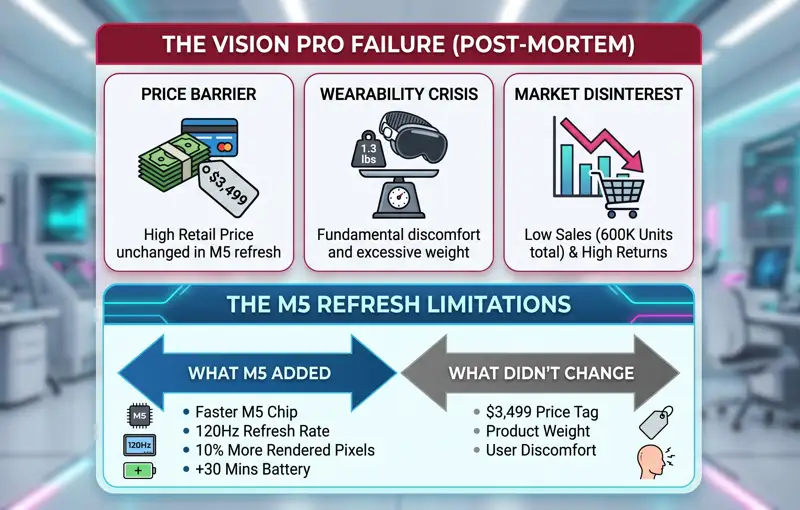
For a product that was supposed to usher in the next era of personal computing, the rapid demise of the Vision Pro is a stark reminder that even tech giants are not immune to market realities. The exorbitant $3,499 price tag, combined with fundamental wearability issues, created an insurmountable barrier to mainstream adoption. According to a recent MacRumors report, Apple has essentially given up on virtual reality in its current form.
The Anatomy of the M5 Hardware Refresh Failure
In October 2025, Apple launched a revised version of the Vision Pro. The update swapped out the M2 chip for a much faster M5 processor and included a new Dual Knit Band designed to better distribute the headset’s burdensome 1.3-pound weight. The M5 upgrade delivered a 120Hz refresh rate, a 10 percent increase in rendered pixels, and an extra 30 minutes of battery life. However, these technical improvements were completely overshadowed by what did not change: the price.
“The M5 chip brought undeniable power, but it could not solve the fundamental reality that consumers are entirely unwilling to strap a heavy, $3,499 computer to their faces.”
Because Apple refused to lower the retail price, the minor spec bumps did absolutely nothing to attract new buyers. Early adopters had already purchased the original model, and the mainstream market was still locked out by the massive financial investment required.
| Specification | Original Vision Pro (M2) | Vision Pro Refresh (M5) |
|---|---|---|
| Processor | Apple M2 | Apple M5 |
| Refresh Rate | 90Hz / 96Hz | 120Hz |
| Headband | Solo Knit / Dual Loop | New Dual Knit Band |
| Retail Price | $3,499 | $3,499 |
Dismal Sales and Unprecedented Returns
The writing has been on the wall for some time. Across its entire lifespan, Apple only managed to sell approximately 600,000 Vision Pro units globally. Even more alarming for the company was the unprecedented return rate. Insider sources revealed that the headset suffered the highest percentage of returns of any modern Apple device. Users consistently cited discomfort, severe eye strain, and a lack of compelling software applications as their primary reasons for returning the device within the 14-day window.
Team Reallocation and the Death of “Vision Air”
Faced with these grim metrics, Apple made the tough call to pull the plug. The dedicated Vision Pro engineering and software teams have been quietly dismantled and redistributed across the Apple Park campus. Notably, many of these engineers are now working under Mike Rockwell—former chief of the Vision Pro project—who took over leadership of the Siri AI team in early 2025.
“The redistribution of the Vision Pro team signals a hard pivot away from isolated spatial computing and toward ambient, AI-driven experiences.”
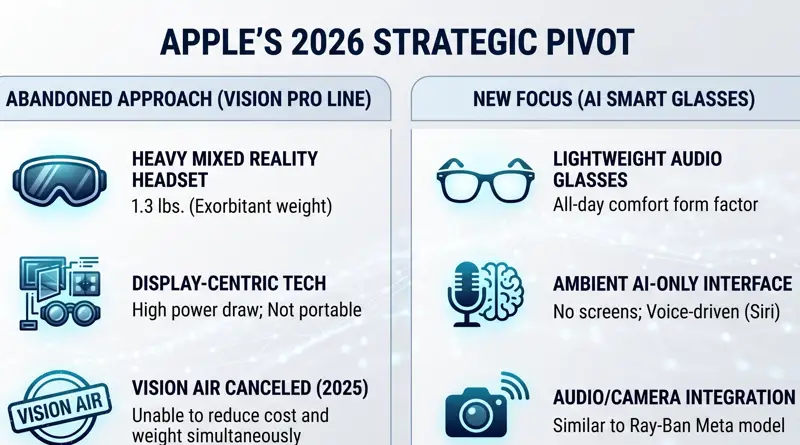
Furthermore, the heavily rumored “Vision Air”—a cheaper, lighter alternative that was supposed to save the product line—was officially canceled last year. The engineering hurdles required to produce a budget-friendly mixed-reality headset simply proved too massive.
| Apple Spatial Project | Current Status (2026) | Reasoning |
|---|---|---|
| Vision Pro (M5) | Development Halted | Poor sales, high price, ergonomic failures |
| Vision Air (Budget Model) | Canceled in 2025 | Inability to reduce cost and weight simultaneously |
| VisionOS Development | Maintenance Mode | Only essential security patches moving forward |
The Pivot to AI Smart Glasses
So, where does Apple go from here? Instead of pouring billions more into heavy, display-heavy virtual reality headsets, Apple is accelerating its timeline for lightweight smart glasses. Taking a page directly from the success of the Ray-Ban Meta smart glasses, Apple’s upcoming wearable will reportedly forgo integrated visual displays entirely.
This new project will rely entirely on audio feedback, cameras, and an advanced Siri integration powered by Apple Intelligence. The high-fidelity micro-OLED technology developed for the Vision Pro requires far too much power to be housed in a standard glasses frame, meaning Apple had to abandon that visual tech to achieve an all-day wearable device.
“Apple’s future in wearables isn’t about blocking out the world with screens; it’s about seamlessly integrating advanced AI into frames you can actually wear all day.”
| Feature Comparison | Apple Vision Pro | Future Apple Smart Glasses |
|---|---|---|
| Form Factor | Heavy Ski Goggles (1.3 lbs) | Standard Eyeglass Frames |
| Display | Dual 4K Micro-OLED | None (Audio/AI Only) |
| Primary Interface | Eye and Hand Tracking | Voice (Siri) and Touch |
Conclusion
While the Vision Pro may go down in history as one of Apple’s most spectacular commercial missteps, the underlying research will likely fuel their AI and audio initiatives for years to come. For now, the dream of spatial computing is on indefinite hold until the laws of physics and battery technology allow for a comfortable, affordable experience.
Frequently Asked Questions
Has Apple completely discontinued the Vision Pro?
Apple has not removed the device from store shelves. They are continuing to sell the existing M5 inventory, but all future hardware development on the product line has been halted.
Why did the M5 Vision Pro fail?
Despite a faster chip and a slightly better headband, the M5 model failed because Apple kept the massive $3,499 price tag and the device remained uncomfortably heavy for long-term use.
What happened to the cheaper Apple Vision Air?
Apple officially canceled the budget-friendly “Vision Air” project last year after realizing they could not significantly lower the cost without ruining the core mixed-reality experience.
How many Vision Pro headsets did Apple actually sell?
According to industry reports, Apple sold roughly 600,000 total units since the product’s initial launch, falling vastly short of original market projections.
What is the Vision Pro team doing now?
The engineers and developers have been redistributed to other departments within Apple. Many have joined the Siri team to focus on AI advancements.
Will Apple make another VR headset?
There are currently no plans for another VR headset. However, sources suggest the product line could be revived in the distant future if battery and display technology radically improves.
What is Apple building instead of the Vision Pro?
Apple is shifting its focus to lightweight, AI-powered smart glasses similar to the Ray-Ban Meta glasses, which will feature audio and camera capabilities but no built-in visual displays.
Disclaimer: This article is for informational purposes only. Product status, internal corporate decisions, and future hardware plans are based on industry reporting and insider leaks as of 2026.