Apple unveils new accessibility features, and updates powered by Apple Intelligence, fundamentally transforming how users interact with their devices in 2026.
This groundbreaking announcement highlights a pivotal moment in technology. The integration of advanced artificial intelligence into everyday software allows for a level of personalized assistance that was previously impossible.
For individuals relying on these tools, the introduction of Apple Intelligence means more than just a software update. It represents a massive leap forward in digital equity, inclusion, and sheer usability.
By leveraging on-device processing, these new capabilities maintain the strict privacy standards users expect. No personal data needs to be sent to the cloud to analyze an image or transcribe a private conversation.
Let us dive deep into the specific ways these AI-powered accessibility tools are changing the landscape for iPhone, iPad, Mac, and Vision Pro users.
How Apple unveils new accessibility features, and updates powered by Apple Intelligence
When Apple unveils new accessibility features, and updates powered by Apple Intelligence, the focus immediately shifts to their core screen reading and magnification tools.
VoiceOver has long been the gold standard for screen readers. However, navigating complex visual data has historically been a challenge for blind and low-vision users.
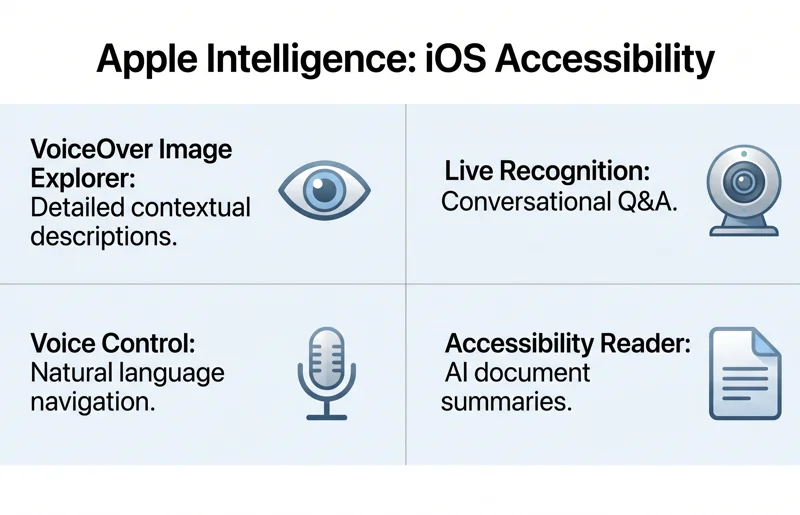
With the integration of the new AI models, VoiceOver now includes an Image Explorer. This feature provides incredibly detailed, system-wide descriptions of visual content.
Whether you are looking at a scanned medical bill, a family photograph, or a complex chart on a website, Apple Intelligence processes the visual data and translates it into comprehensive audio.
Furthermore, Live Recognition updates allow users to press the Action button on their iPhone to query their surroundings using the camera viewfinder.
VoiceOver enhancements: Apple unveils new accessibility features, and updates powered by Apple Intelligence
Users are no longer restricted to static descriptions. They can now ask conversational follow-up questions to get precisely the visual information they need.
If the AI describes a room, the user can ask, “Is there a free chair near the window?” and receive an accurate, real-time response.
This level of iOS natural language navigation bridges the gap between basic visual recognition and true contextual understanding.
| Feature | Previous Capability | Apple Intelligence Update |
|---|---|---|
| VoiceOver Image Explorer | Basic object and text recognition. | Contextual, conversational descriptions of complex scenes and documents. |
| Live Recognition | Identified static objects in view. | Allows natural language Q&A about the camera’s viewfinder. |
| Magnifier | Manual zoom and contrast adjustments. | Voice-controlled interface adjustments and smart contextual zoom. |
Similarly, Magnifier uses these same AI capabilities to bring high-contrast, assistive exploration to users with low vision.
Magnifier works seamlessly with the Action button, meaning immediate assistance is always just one physical press away.
Users can command the app using spoken requests like “turn on flashlight” or “zoom in on the text,” streamlining the entire experience.
“The integration of artificial intelligence into accessibility tools fundamentally changes the landscape of personal technology, moving from simple assistance to active collaboration.”
Physical motor disabilities often make navigating touchscreens via precise taps incredibly difficult or impossible.
Voice Control has been a lifeline, but it historically required users to memorize exact, rigid commands or navigate via a complex grid system.
This changes drastically as Apple unveils new accessibility features, and updates powered by Apple Intelligence, bringing true natural language processing to device control.
Users can now navigate their iPhone and iPad simply by describing what they see on the screen.
Instead of saying “Tap button 4,” a user can say “Tap the guide about the best restaurants” or “Open the purple folder.”
Intelligent Accessibility Reader
This iOS natural language navigation drastically reduces the cognitive load required to use a mobile device via voice.
It also provides a brilliant workaround for third-party apps that fail to properly label their buttons for standard screen readers.
The AI visually analyzes the screen layout on the fly, interpreting user intent based on the visual context of the application.
Reading evolved: Apple unveils new accessibility features, and updates powered by Apple Intelligence
For users with dyslexia or cognitive disabilities, the updated Accessibility Reader is an absolute game-changer.
Apple Intelligence allows the Reader to handle significantly more complex source materials, such as multi-column scientific articles and heavy web pages.
It can instantly generate on-demand summaries, giving users an overview of the content before they commit to reading the entire text.
Built-in, on-device translation means users can read complex texts in their native language while retaining the original document’s custom formatting.
| Accessibility Tool | Target Audience | Key 2026 Enhancement |
|---|---|---|
| Voice Control | Motor and physical disabilities | Natural language screen element description (“say what you see”). |
| Accessibility Reader | Cognitive disabilities, Dyslexia | AI summaries and complex multi-column document parsing. |
| Generated Subtitles | Deaf and hard of hearing | System-wide, on-device transcription for personal and uncaptioned video. |
Vision Pro and Media: Apple unveils new accessibility features, and updates powered by Apple Intelligence
While software updates for iOS are vital, the hardware integrations announced in 2026 are nothing short of revolutionary.
The spotlight shines brightly on the Vision Pro wheelchair control, an innovation that redefines independent mobility.
For individuals with conditions like ALS, driving a power wheelchair with a traditional physical joystick is often completely impossible.
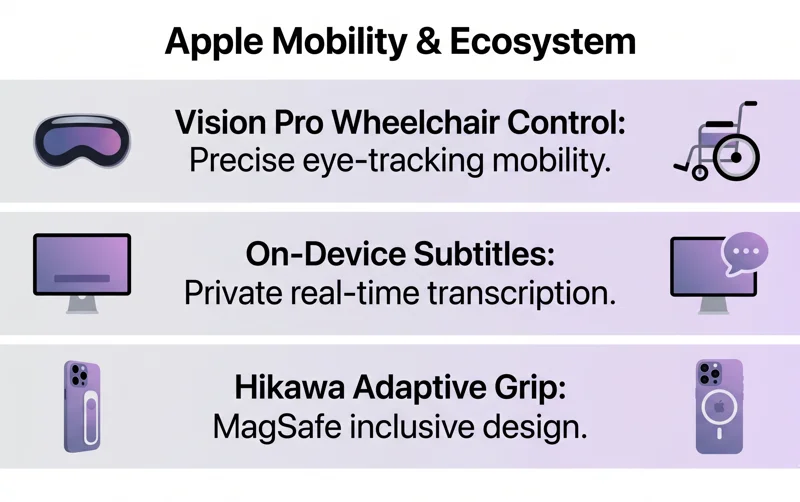
By leveraging the ultra-precise eye-tracking system built into the Apple Vision Pro, users can now control their wheelchairs using only their eyes.
This feature requires minimal recalibration and functions flawlessly across various indoor and outdoor lighting conditions.
On-Device Generated Subtitles
Apple is launching this Vision Pro wheelchair control system in collaboration with Tolt and LUCI alternative drive systems.
This development proves that spatial computing is not just for entertainment; it is a profound medical and assistive technology tool.
“With eye-tracking wheelchair controls on Vision Pro, true independence becomes an achievable reality for individuals with severe mobility constraints.”
Beyond mobility, media consumption receives a massive upgrade as Apple unveils new accessibility features, and updates powered by Apple Intelligence.
While commercial streaming services usually provide closed captions, personal videos and social media clips often do not.
To solve this, Apple has introduced on-device generated subtitles across its entire ecosystem.
This means any video played on an iPhone, iPad, Mac, or Apple TV can have highly accurate subtitles generated locally in real-time.
Hardware design as Apple unveils new accessibility features, and updates powered by Apple Intelligence
Because the speech recognition is processed entirely on-device via the neural engine, user privacy is completely protected.
Users do not have to worry about their private family videos being uploaded to a server just to get a text transcription.
The appearance of these on-device generated subtitles is highly customizable, ensuring maximum readability for all visual preferences.
| Accessory / Feature | Function | Compatibility |
|---|---|---|
| Wheelchair Eye-Tracking | Controls alternative drive systems via precise optical sensors. | Apple Vision Pro (with Tolt & LUCI). |
| Hikawa Grip & Stand | Adaptive physical support for varied grip strengths. | All MagSafe compatible iPhones. |
| Vehicle Motion Cues | Reduces passenger motion sickness via visual screen anchors. | visionOS / Apple Vision Pro. |
Ecosystem Expansion: Apple unveils new accessibility features, and updates powered by Apple Intelligence
Apple’s commitment to accessibility extends into the physical world with the introduction of the Hikawa Grip & Stand.
Designed by Bailey Hikawa in collaboration with users possessing varying grip and mobility constraints, this MagSafe accessory is a masterpiece of inclusive design.
It allows users to hold their iPhone comfortably in whatever way works best for their unique physical needs.
Furthermore, visionOS receives Vehicle Motion Cues, a brilliant software solution to combat motion sickness when using the headset in moving vehicles.
Hearing aid connectivity has also been drastically improved, ensuring that “Made for iPhone” hearing devices hand off seamlessly between a Mac, iPad, and iPhone.
To read more about the corporate strategy behind these updates, you can explore the official Apple accessibility news.
As Apple unveils new accessibility features, and updates powered by Apple Intelligence, the message is clear: technology should empower everyone, without exception.
Frequently Asked Questions (FAQs)
What does the new VoiceOver Image Explorer do?
Powered by Apple Intelligence, it provides highly detailed, conversational descriptions of system-wide images, allowing blind users to ask specific questions about visual content.
Voice Control now lets users describe what they see on screen (like “tap the purple button”) rather than memorizing exact technical labels, making navigation vastly easier.
What is the Vision Pro wheelchair control feature?
It is a groundbreaking feature that uses the precision eye-tracking of the Apple Vision Pro to allow users to drive compatible power wheelchairs using only their eye movements.
Are the new auto-generated subtitles private?
Yes. The speech recognition required for on-device generated subtitles processes entirely on your hardware, meaning no audio data is sent to the cloud.
What is the Accessibility Reader?
It is an adapted reading experience for users with cognitive disabilities or dyslexia. The new update allows it to summarize complex texts and handle multi-column formats seamlessly.
What is the Hikawa Grip & Stand?
It is a specially designed MagSafe accessory created with accessibility in mind, providing an adaptive grip for individuals who have limited hand strength or mobility.
Do these Apple Intelligence features require an internet connection?
Because Apple prioritizes privacy, the core of these new AI-powered accessibility features relies on powerful on-device processing, minimizing the need for constant cloud connectivity.
Disclaimer: This article is for informational purposes only. Features, availability, and compatibility of Apple products and services are subject to change based on official releases and regional rollout schedules.