This is why MediaTek needed to release a fourth G99 into the highly competitive mobile processor market this year.
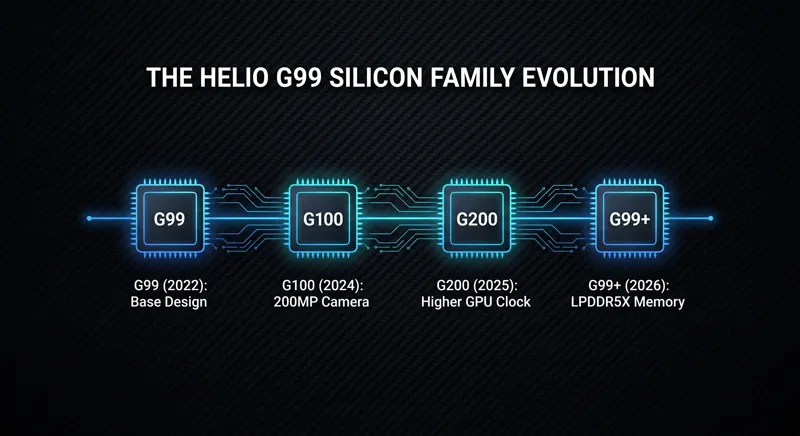
Tech enthusiasts and smartphone manufacturers were recently surprised by the quiet launch of the Helio G99+.
Many consumers immediately wondered about the actual performance upgrades, but the truth lies hidden within the global memory supply chain.
If you are curious about the lack of processing improvements, this is why MediaTek needed to release a fourth G99.
The Supply Chain Shift: This is why MediaTek needed to release a fourth G99
The new Helio G99+ keeps the original CPU, GPU, and TSMC N6 process node completely untouched.
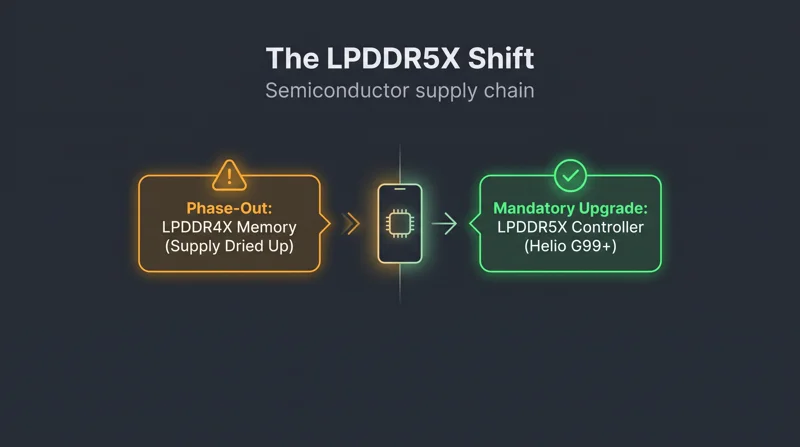
The only significant hardware modification across the entire silicon is the swap to support modern LPDDR5X RAM.
Major DRAM manufacturers, particularly Samsung, are aggressively winding down their older LPDDR4X production lines.
With LPDDR4X supply drying up industry-wide, this is why MediaTek needed to release a fourth G99 to keep their budget platform alive.
“Upgrading the memory controller to LPDDR5X was not a performance luxury; it was a mandatory engineering move to avoid an industry-wide component shortage.”
Hardware Breakdown: This is why MediaTek needed to release a fourth G99
Samsung had already confirmed in early 2026 that it permanently stopped taking new orders for legacy LPDDR4X memory.
By May of this year, industry reports indicated that Samsung completed the production phase-out well ahead of its original 2027 schedule.
For more official details on mobile processor advancements, you can visit the official MediaTek website.
Without available memory chips to pair with their older SoCs, this is why MediaTek needed to release a fourth G99.
| MediaTek Chip Model | Release Year | Primary Hardware Upgrade | Supported Memory Type |
|---|---|---|---|
| Helio G99 | 2022 | Base Original Design | LPDDR4X |
| Helio G100 | 2024 | 200 MP Camera Support | LPDDR4X |
| Helio G200 | 2025 | Higher GPU Clock (1.1 GHz) | LPDDR4X |
| Helio G99+ | 2026 | New Memory Controller | LPDDR5X (Up to 5,500 MT/s) |
Cost Efficiency: This is why MediaTek needed to release a fourth G99
This release marks the fourth distinct System-on-Chip (SoC) MediaTek has built on the exact same base silicon since May 2022.
Brand-new mask production and validation testing for the TSMC N6 process cost tens of millions of dollars.
By reusing the identical core IP across four different SKUs, the company drastically reduces its manufacturing and testing bills.
When you look closely at the financial savings, this is why MediaTek needed to release a fourth G99 instead of designing a completely new chip from scratch.
“Reusing identical CPU and GPU architecture allows silicon vendors to bypass massive TSMC validation costs while seamlessly adapting to shifting memory standards.”
Only the new physical layer (PHY) and the memory controller require fresh validation, speeding up the time to market.
| Hardware Component | Helio G99 Status | Helio G99+ Status |
|---|---|---|
| CPU Cluster | 2x Cortex-A76 + 6x Cortex-A55 | Unchanged |
| GPU Architecture | Arm Mali-G57 MC2 | Unchanged |
| Process Node | TSMC N6 (6 nm) | Unchanged |
| Memory Support | Legacy LPDDR4X | Upgraded to LPDDR5X |
What Comes Next? This is why MediaTek needed to release a fourth G99
Given the mandatory memory controller upgrade, the mobile tech industry might see even more revisions soon.
Because the G100 and G200 were also built around the dying LPDDR4X standard, those chips will face the exact same supply chain issues.
Industry analysts agree that this is why MediaTek needed to release a fourth G99, setting a precedent that will likely lead to a G100+ and G200+ in the near future.
Frequently Asked Questions
This is why MediaTek needed to release a fourth G99, but what exactly changed in the actual hardware?
The only meaningful change is the memory controller, which now supports newer, faster, and widely available LPDDR5X RAM instead of the phased-out LPDDR4X standard.
Did the CPU or GPU get faster in the new Helio G99+?
No, the CPU cluster, GPU architecture, and overall clock speeds remain absolutely identical to the original G99 released back in 2022.
Why is LPDDR4X RAM no longer being used by chipmakers?
Major DRAM vendors, notably Samsung, have discontinued LPDDR4X production to transition their manufacturing lines to newer, more efficient memory nodes.
Does the Helio G99+ support better cameras than the original?
The G99+ retains the original 108 MP main camera support, unlike the G100 and G200 which were upgraded to support massive 200 MP sensors.
What manufacturing process does the Helio G99+ utilize?
It continues to use the highly reliable and cost-effective TSMC N6 (6 nm) process node.
Why didn’t MediaTek just design a brand-new budget chip from scratch?
Designing and validating a brand-new mask on the TSMC process costs tens of millions of dollars, so reusing core IP saves massive amounts of money and development time.
Will there be more upgraded plus-model chips like the G99+?
Because of the LPDDR4X sunset affecting the entire industry, experts predict we will soon see a G100+ and G200+ featuring the exact same LPDDR5X memory controller upgrades.
Disclaimer: This article is for informational purposes only. Semiconductor manufacturing timelines, hardware specifications, and supply chain reports are based on industry data available as of 2026 and are subject to change by the respective manufacturers.