This adversarial pattern can prevent surveillance cameras from detecting you, creating a digital cloak of invisibility for everyday citizens in 2026. Developed by cybersecurity researcher Bill Swearingen through his noRecognition project, these computer-generated graphics scramble the algorithmic detection powering modern security networks. After over 31 million simulation tests, the breakthrough promises a practical way for individuals to opt-out of mass automated tracking in public spaces.
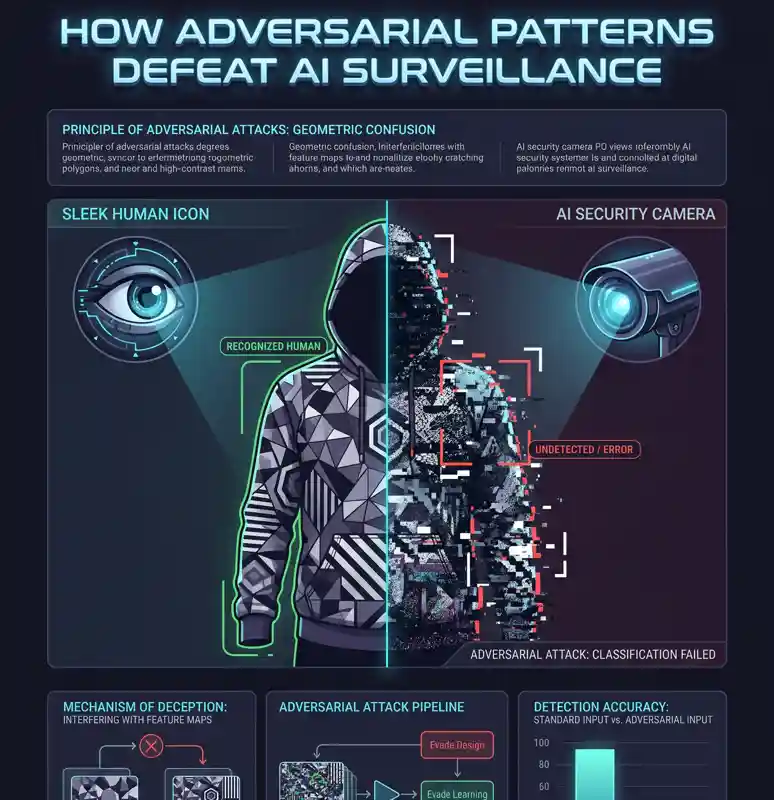
Mass surveillance across major cities has evolved rapidly over recent years. Street cameras are no longer passive recording tools; they are equipped with artificial intelligence capable of tracking license plates, identifying faces, and indexing human movement in real time. Swearingen’s initiative provides a direct countermeasure against these pervasive systems without interfering with physical video footage.
How This adversarial pattern can prevent surveillance cameras from detecting you
It is crucial to understand that these designs do not block the camera lens or render video footage invisible to human eyes. Instead, the mathematical structure of the visual design confuses AI detection algorithms. When an automated camera scans an object wrapped in the graphic, the detection system fails to register the presence of a vehicle, face, or person entirely.
By effectively breaking the detection trigger, the individual avoids being flagged or logged into centralized law enforcement databases. Swearingen emphasizes that privacy remains an essential human right in an increasingly digitized society.
“Privacy is a fundamental right. These patterns allow everyday people to opt-out of being tracked by automated algorithmic surveillance.” – Bill Swearingen
The patterns have successfully defeated 11 of the most popular open-source detection algorithms currently deployed across the United States. This includes software powering Flock license plate readers, Axon body cameras, and facial recognition systems running Clearview AI software.
| Surveillance Platform | Standard AI Capability | Pattern Impact |
|---|---|---|
| Flock Safety Cameras | Automated License Plate Recognition (ALPR) | Prevents vehicle detection triggers |
| Axon Body Cameras | Facial and person detection AI | Scrambles object classification |
| Clearview AI Systems | Mass facial recognition indexing | Blocks facial identification alerts |
The Machine Learning Model Behind How This adversarial pattern can prevent surveillance cameras from detecting you
Creating a graphic capable of deceiving multiple AI vision models simultaneously required sophisticated engineering. Swearingen developed a custom reinforcement learning system that essentially taught itself “how to paint.” The model runs continuous simulations, generating new visual variations every minute.
Whenever an algorithm successfully detects a generated image, the reinforcement learning model adjusts its parameters and tries again. Over time, the system discovers perfect mathematical recipes that bypass all target algorithms at once, ensuring high reliability across diverse camera hardware.
Real-World Testing: This adversarial pattern can prevent surveillance cameras from detecting you
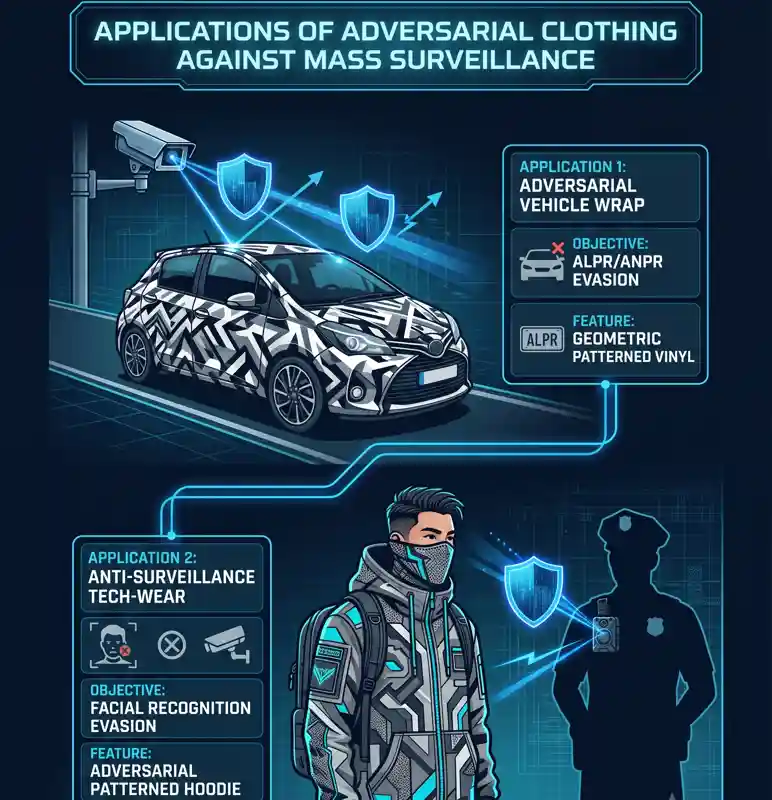
Theory became reality during a public demonstration at the Def Con cybersecurity conference in Las Vegas. Partnering with automotive media team Donut Media, Swearingen wrapped a 2009 Toyota Yaris completely in one of his newest computer-generated patterns. The test proved that a car driving past a live Flock security camera remained undetected by the system’s AI.
With successful field tests completed, the noRecognition project is now moving toward commercial availability. Swearingen launched a crowdsourcing campaign to fund the production of consumer apparel, including t-shirts, hoodies, and custom vehicle vinyl wraps.
“Every failure improves my model, and so the patterns keep getting better and better over time.”
The project ensures that the printed graphics maintain a fashionable aesthetic while preserving high-resolution mathematical precision from a distance. To stay updated on cybersecurity developments and official testing media, visit TechCrunch Cyber News.
| Apparel / Material Type | Primary Defense Function | Deployment Status |
|---|---|---|
| Adversarial Hoodies & Shirts | Blocks human and facial recognition algorithms | Crowdsourcing pre-order stage |
| Vehicle Vinyl Wraps | Defeats license plate and car classification readers | Demonstrated at Def Con |
| Custom Fabric Prints | Multi-algorithm scrambling for personal items | Active development phase |
Frequently Asked Questions
Is it true that This adversarial pattern can prevent surveillance cameras from detecting you?
Yes, live tests show that these specialized computer-generated patterns scramble AI vision algorithms, preventing cameras from triggering detection alerts for faces, people, or vehicles.
Does this pattern make me invisible on normal video cameras?
No. Humans watching the video feed can still clearly see you. The pattern only deceives automated AI detection software that scans footage for faces, bodies, and license plates.
Who created the noRecognition project?
The project was created by cybersecurity professional Bill Swearingen, co-founder of the SecKC cybersecurity meet-up.
What camera algorithms has the pattern defeated?
It has successfully bypassed 11 major detection algorithms, including software used by Flock license plate readers, Axon body cameras, and Clearview AI.
Has this technology been tested in real-world conditions?
Yes, it was publicly demonstrated at Def Con in Las Vegas, where a vehicle wrapped in the pattern successfully avoided detection by a live Flock camera.
Will these patterns be available for public purchase?
Yes, a crowdsourcing campaign is underway to produce everyday apparel like hoodies, t-shirts, and vehicle wraps featuring the adversarial patterns.
How does the AI model keep the patterns effective?
The creator uses a reinforcement learning system that constantly trains against updated camera algorithms, generating stronger patterns whenever a detection failure occurs.
Disclaimer: This article is for informational purposes only and reports on technological developments in cybersecurity and public privacy tools as of 2026.