
Silver nanocatalysts switch reaction sites between power generation and hydrogen production, establishing a groundbreaking new design principle for the renewable energy sector in 2026. For the first time, scientific researchers have confirmed that the exact same catalyst operates entirely differently depending on the operating mode of the energy cell. This dynamic behavior solves a major hurdle in optimizing next-generation solid oxide cells for both residential and industrial applications.
Solid oxide cells are advanced energy devices that rely on the transport of oxygen ions. They can either function to generate electricity or split water molecules to produce hydrogen. Until recently, it was unclear exactly how metal catalysts contributed to these complex reactions. Because actual electrodes have structurally complicated designs, isolating the exact chemical mechanisms remained incredibly difficult.
How Silver nanocatalysts switch reaction sites between power generation and hydrogen production
To solve the mystery of these reactions, a joint research team developed a precisely controlled model electrode system. Instead of using a standard, complex electrode, they arranged uniformly sized metal nanoparticles in ordered arrays. They tested various metals, including cobalt, palladium, and platinum, but found that silver exhibited the strongest catalytic enhancement.
By systematically changing the size and spacing of these silver nanoparticles on a thin-film perovskite oxide electrode, the researchers made a stunning discovery. They definitively proved that Silver nanocatalysts switch reaction sites between power generation and hydrogen production based on the specific oxygen reaction taking place at that moment.
“This research is significant because it quantitatively evaluates the performance of nanocatalysts while also identifying their actual reaction sites and operating mechanisms in real time.”
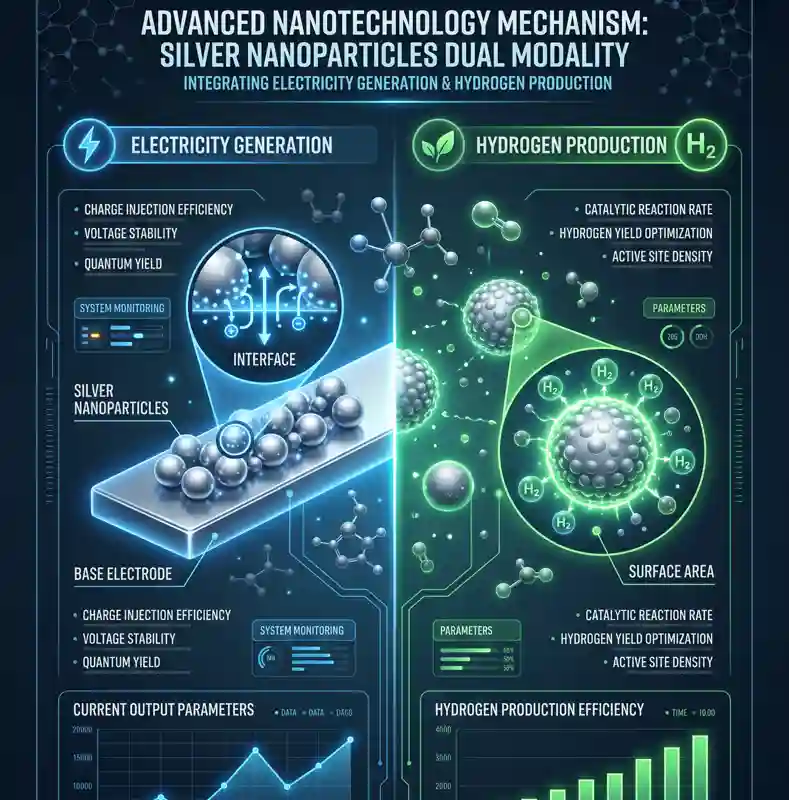
During the oxygen reduction reaction, which occurs when the cell is generating electricity, the reaction rate scales with the length of the interface. This means the boundary where the silver nanoparticle meets the electrode is the primary reaction site. Here, the silver helps facilitate electron transfer to the oxygen.
The Mechanism: Silver nanocatalysts switch reaction sites between power generation and hydrogen production
Conversely, during the oxygen evolution reaction, which occurs during water splitting for green hydrogen production, the mechanics change completely. The reaction rate increases based on the total surface area of the silver nanoparticle. In this mode, the surface itself becomes the key reaction site, promoting the combination of oxygen atoms into molecules.
This dual-action behavior proves that nanocatalysts are not just passive additives that speed up reactions. Because Silver nanocatalysts switch reaction sites between power generation and hydrogen production, engineers must now look at catalyst design through a completely new lens.
| Operating Mode | Reaction Type | Primary Reaction Site |
|---|---|---|
| Electricity Generation | Oxygen Reduction Reaction | Catalyst-Electrode Interface |
| Hydrogen Production | Oxygen Evolution Reaction | Nanocatalyst Surface Area |
Impact of How Silver nanocatalysts switch reaction sites between power generation and hydrogen production
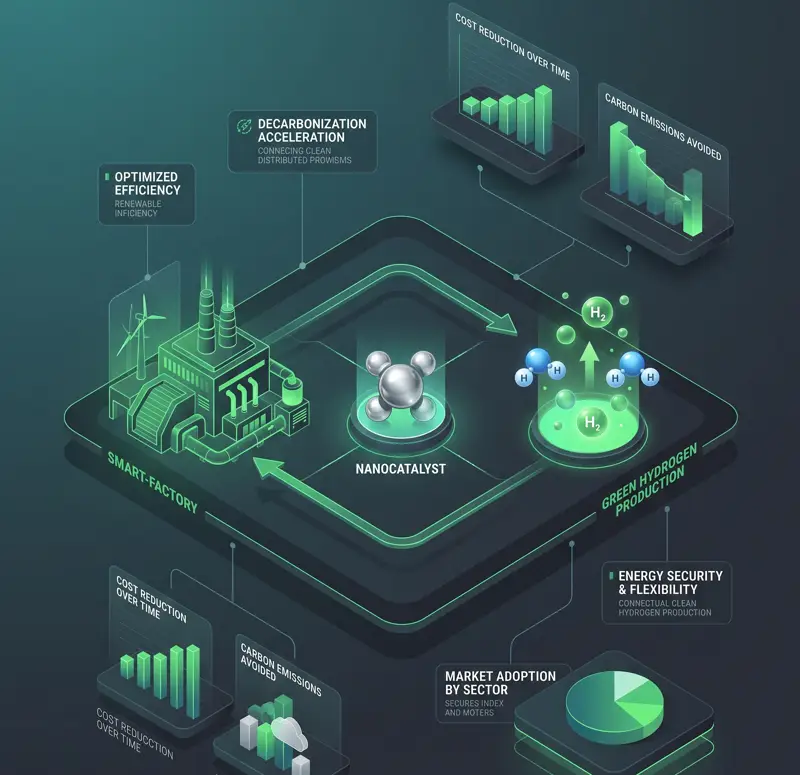
The fact that Silver nanocatalysts switch reaction sites between power generation and hydrogen production has massive implications for reversible energy systems. Reversible solid oxide cells are highly sought after because they can perform both critical functions in a single, unified system. This makes energy storage and clean power generation incredibly efficient for smart factories and modern buildings.
To maximize efficiency, future air electrodes for solid oxide fuel cells and electrolysis cells must be optimized differently. Engineers will now have to optimize both the catalyst surface area and the catalyst-electrode interface separately to ensure peak performance in both operational modes.
“By understanding how these particles adapt their active sites, we introduce a new design principle for improving the performance of next-generation solid oxide cells across the board.”
This breakthrough is heavily detailed in major scientific publications, including the highly respected Energy & Environmental Science journal, where it was featured as an Outside Back Cover article. The findings accelerate the path toward commercializing affordable and highly efficient green energy technologies.
| Technology Concept | Relevance to Discovery |
|---|---|
| Solid oxide fuel cells | Utilizes the interface for maximum clean power generation. |
| Green hydrogen production | Utilizes the catalyst surface area for efficient water electrolysis. |
| Reversible energy systems | Benefits from dual optimization of both interface and surface area. |
FAQs About Why Silver nanocatalysts switch reaction sites between power generation and hydrogen production
What does it mean when Silver nanocatalysts switch reaction sites between power generation and hydrogen production?
It means the active area of the silver particle where the chemical reaction takes place shifts from the particle’s base interface to its outer surface depending on what the cell is currently doing.
Why is silver the preferred metal for this process?
During rigorous testing against cobalt, palladium, and platinum, silver exhibited the strongest catalytic enhancement for these specific oxygen reactions.
What is a solid oxide cell?
It is a next-generation energy device that uses oxygen ion transport to either generate electrical power or split water molecules to create hydrogen.
Where is the primary reaction site during electricity generation?
During the oxygen reduction reaction (electricity generation), the primary reaction site is the interface length between the silver nanoparticles and the electrode.
Where is the primary reaction site during hydrogen production?
During the oxygen evolution reaction (hydrogen production), the key reaction site is the actual surface area of the silver nanoparticles.
How does this discovery help green energy?
By knowing exactly where the reactions happen, engineers can optimize the design of reversible energy systems, making clean power generation and green hydrogen production much cheaper and more efficient.
How did researchers figure this out?
They developed a highly controlled model electrode with uniformly sized and spaced nanoparticles, allowing them to precisely track the catalytic roles using synchrotron-based analysis.
Disclaimer: This article is for informational purposes only and is based on scientific research findings published in 2026 regarding nanocatalyst behavior in solid oxide cells.