The gaming community has been in a state of absolute uproar recently, but having the sony 30 day playstation check in explained directly by official representatives has finally put those massive preservation fears to rest. Entering 2026, a sudden panic swept across social media when players discovered a mysterious 30-day timer attached to their newly purchased digital PlayStation 4 and PlayStation 5 games. The immediate fear was that if a console remained offline for more than a month, the entire digital library would become entirely unplayable. Fortunately, this is not the case.
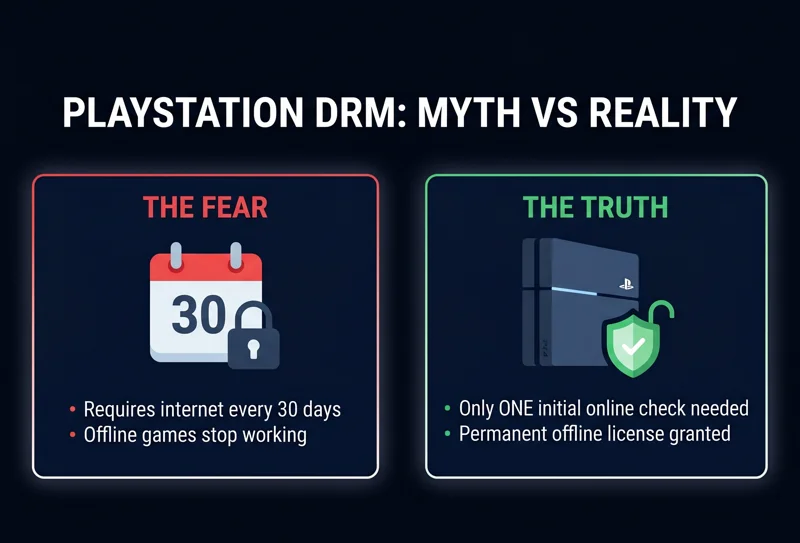
Game preservationists and casual players alike can breathe a sigh of relief. The reality of this Digital Rights Management (DRM) update is far less draconian than initially feared. It is not a continuous, punishing requirement to stay connected to the internet, but rather a temporary, one-time security measure implemented to protect the storefront ecosystem.
The 30-Day DRM Panic Resolved
The controversy ignited when a prominent YouTuber noticed the 30-day timer and shared the findings with the public. Gamers immediately began stress-testing their PS4 and PS5 hardware. They removed internal batteries and disconnected their systems from the internet to simulate a long-term offline scenario. Shockingly, even setting the console as the “primary” system—a standard method used to retain offline rights to digital media—did not seem to override this newly discovered countdown timer.
“The initial discovery of the 30-day timer sent shockwaves through the community, conjuring dark memories of the disastrous always-online DRM policies of the past.”
However, further extensive community testing revealed a crucial breakthrough. Players discovered that the 30-day timer was not permanent. After a specific period, the timer would vanish, replaced by a standard perpetual license. This meant the game could, in fact, be played completely offline indefinitely, just like older digital purchases.
| Aspect | Initial Community Fear | Actual Sony Policy (2026) |
|---|---|---|
| Offline Playability | Lost after 30 days offline | Perpetual access after initial check |
| Check-In Frequency | Required every 30 days | Required only once after purchase |
| Game Preservation | Severely threatened | Completely safe for long-term |
Sony’s Official Explanation and The Refund Theory
To quell the rising backlash, a Sony representative officially clarified the situation, confirming the findings of the community. According to the company, players can continue to access and play their purchased games as usual. The new system simply requires a one-time online check-in after the digital purchase is made to confirm the game’s license. Once that single handshake with the server occurs, no further check-ins are ever needed to keep playing that title offline.
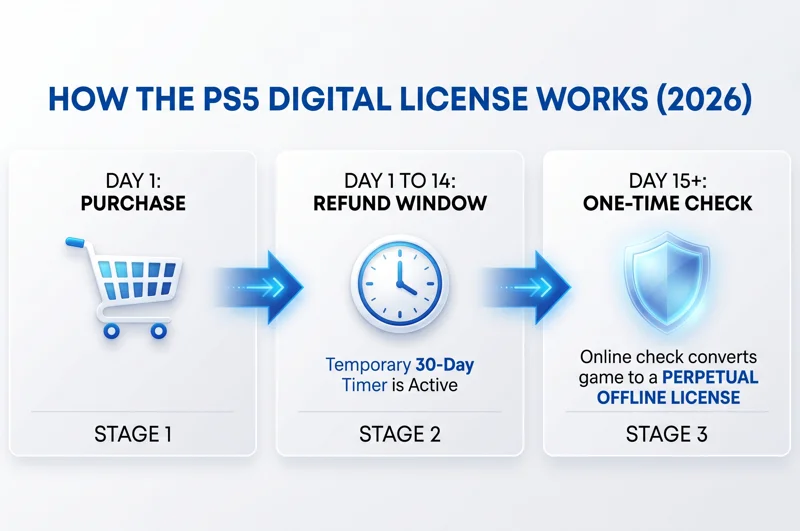
So, why did Sony implement this confusing 30-day timer in the first place? The prevailing, highly credible theory ties directly to the PlayStation Store’s refund policy. Currently, PlayStation users have a 14-day window to request a refund for digitally purchased games, provided they have not started downloading or streaming the content. Some clever users may have found an exploit in this system by purchasing a game, downloading it, immediately disconnecting the console from the internet, and then requesting a refund from a separate device.
| Timeline Stage | License Status | Refund Eligibility |
|---|---|---|
| Days 1 to 14 | Temporary 30-Day Timer Active | Eligible (if unplayed/undownloaded) |
| Day 15+ (Online Check) | Converts to Perpetual License | No longer eligible for standard refund |
| Long-Term Offline | Permanent Offline Access | Not applicable |
“By requiring a digital handshake after the 14-day refund window closes, Sony effectively patches a storefront exploit without permanently punishing legitimate offline players.”
Echoes of the Past
It is easy to understand why the gaming community reacted with such hostility. Long-time gamers immediately flashed back to the disastrous 2013 reveal of the Xbox One, which initially proposed a mandatory 24-hour online check-in. The backlash to that announcement was so severe that it shifted the entire console generation’s momentum. Sony is acutely aware of this history, which is why their rapid clarification was vital to maintaining consumer trust. For more details on official network policies, users can always check the PlayStation Network Status page.
| DRM Controversy | Proposed Check-In Requirement | Ultimate Outcome |
|---|---|---|
| Xbox One (2013) | Mandatory every 24 hours | Canceled before launch due to extreme backlash |
| PlayStation 5 (2026) | One-time check after purchase | Retained, confirmed as an anti-exploit security measure |
Ultimately, this update is a minor hurdle for new purchases rather than a fundamental threat to digital ownership. As long as you connect your console to the internet briefly after buying a game, your library remains safe, secure, and ready for offline enjoyment for years to come.
Frequently Asked Questions
Do I need to connect my PS5 to the internet every 30 days to play my games?
No. Sony confirmed that you only need to complete a single online check-in after purchasing a digital game. Once that is done, you have a perpetual license to play it offline.
What happens during the initial 30-day timer window?
During this window, the game is playable, but it is waiting for the refund period to pass. Once you connect to the internet after about 15 days, the timer disappears.
Does this DRM update affect physical disc games?
No, this specific DRM check-in and timer system applies exclusively to digital games purchased through the PlayStation Store.
Why did Sony add this timer to digital games?
While not explicitly stated by Sony, the community and industry experts strongly believe it is to prevent users from exploiting the 14-day digital refund policy by staying offline.
If the PlayStation Network servers shut down permanently, will I lose my games?
Based on this clarification, as long as your console has already completed the one-time check-in and secured the perpetual license, your downloaded games will remain playable offline.
Does making my console my “Primary” system bypass the initial timer?
Setting your console as primary allows for offline play, but it does not bypass the need for that first online check-in to convert the temporary license into a permanent one.
Are old digital purchases from years ago affected by this new rule?
No, this system is attached to newly-purchased digital games. Your existing library of older titles that have already been verified online are completely unaffected.
Disclaimer: This article is for informational purposes only. Digital rights management policies, refund rules, and network requirements are determined by Sony Interactive Entertainment and are subject to change without notice.