
The tech world was hit with a major shockwave this week as multiple reliable leaks confirmed that apple likely abandoned ipad ultra plans, effectively killing the highly anticipated 20-inch foldable tablet project. For years, rumors have circulated about a massive, ultra-premium device designed to bridge the gap between the iPad and the Mac. However, following disastrous sales performances across the tablet division and insurmountable engineering hurdles, Apple executives have reportedly pulled the plug on the ambitious hardware.
This cancellation represents a significant shift in Apple’s hardware strategy for 2026. The tech giant is now sharply pivoting its focus toward more viable, highly demanded “Ultra” products, recognizing that the tablet market may have reached an absolute price ceiling that consumers are simply unwilling to cross.
The Fall of the iPad Ultra: Crushed by the M4 iPad Pro
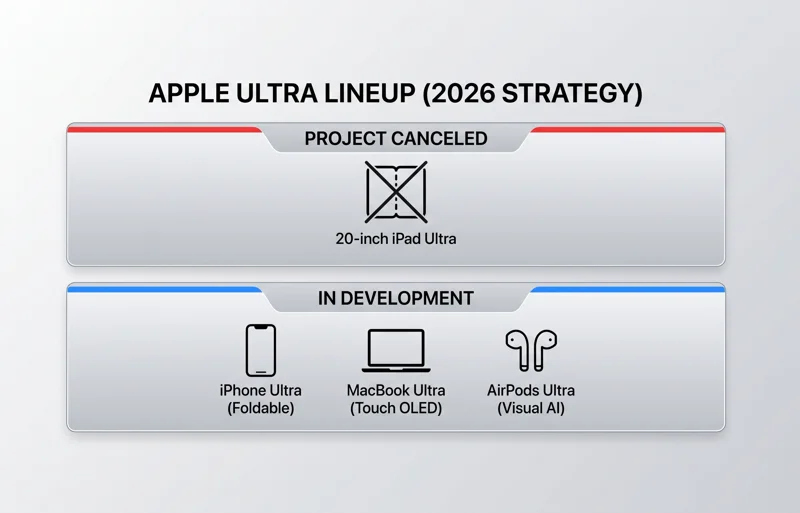
The primary catalyst for the death of the foldable tablet traces back to the incredibly poor market performance of the current iPad Pro lineup. The news of the cancellation first gained traction from a prominent industry leaker known as “Instant Digital,” who explicitly excluded the iPad from Apple’s upcoming “Ultra” product pipeline. This pipeline includes an OLED MacBook Ultra and a foldable iPhone Ultra, but the tablet category has been left out in the cold.
The writing has been on the wall since late 2024. Despite featuring the incredibly powerful M4 chip and a stunning OLED display, the latest iPad Pro failed to resonate with consumers. Market analysts, including display expert Ross Young, had to drastically slash their full-year shipment forecasts from an optimistic 10 million units down to a mere 6.7 million.
“Apple has finally accepted a hard truth: consumers overwhelmingly view tablets as secondary devices and refuse to pay laptop-tier prices for iPadOS limitations.”
The core issue is pricing. With the 11-inch model starting at $999 and the 13-inch model commanding $1,299, the iPad Pro alienated mainstream buyers. Tablet revenue has suffered a consecutive three-year decline, making up barely 6.73% of Apple’s total revenue in 2025. Introducing an even more expensive “Ultra” tier into a struggling product category became an unjustifiable financial risk.
| M4 iPad Pro Model | Starting Retail Price | Q3/Q4 Shipment Drop (Est.) |
|---|---|---|
| 11-inch M4 iPad Pro | $999 | Down 50% |
| 13-inch M4 iPad Pro | $1,299 | Down 90% |
Prototype Nightmares: Weight, Cost, and Confusion
Beyond terrible market metrics, the physical device itself was plagued by engineering nightmares. According to reports cited by MacRumors, Apple had been actively developing a massive 20-inch foldable display in partnership with Samsung. The project, reportedly championed by Hardware Engineering chief John Ternus, was originally targeted for a 2028 release before slipping to 2029, and finally facing outright cancellation.
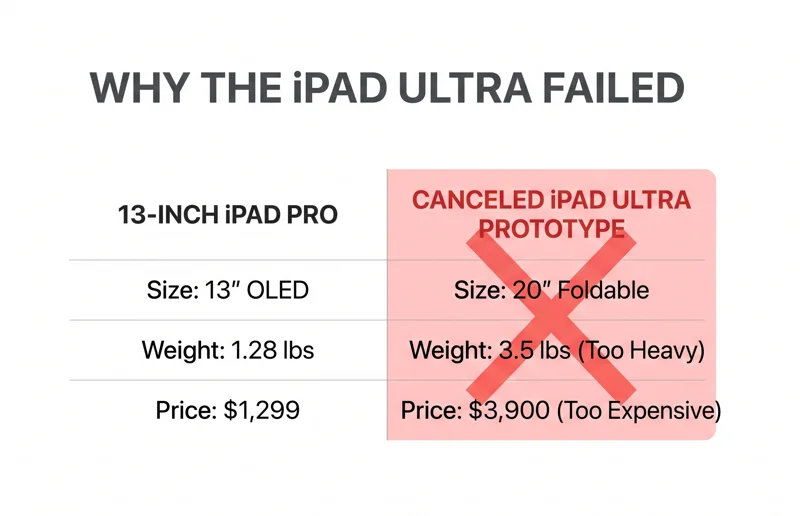
The prototypes were simply unmanageable. Internal leaks revealed that the 20-inch foldable weighed an astounding 3.5 pounds. To put that into perspective, it was heavier than a 14-inch MacBook Pro and almost three times the weight of the current 13-inch iPad Pro. Furthermore, to maintain Apple’s strict profit margins on new display technology, the retail price was estimated to land around an astronomical $3,900.
“A 3.5-pound tablet costing nearly $4,000 completely destroys the fundamental promise of the iPad: extreme portability and accessible touch computing.”
Internally, there was also massive confusion regarding product identity. Apple has famously maintained a strict separation between the Mac and the iPad. This 20-inch foldable blurred the lines so heavily that engineers debated whether to call it a gigantic iPad or an all-display MacBook. Ultimately, the engineering challenges of hiding the screen crease, managing the extreme weight, and justifying the price tag proved fatal.
| Device Specification | 13-inch iPad Pro (M4) | Canceled iPad Ultra Prototype |
|---|---|---|
| Display Size | 13 inches (Rigid OLED) | 20 inches (Foldable OLED) |
| Estimated Weight | 1.28 pounds | ~3.5 pounds |
| Retail Pricing | Starting at $1,299 | Estimated up to $3,900 |
The Future Belongs to the iPhone Ultra and MacBook Ultra
While the foldable tablet is dead, Apple’s “Ultra” ambitions are very much alive. The company is actively shifting its developmental resources toward devices with proven consumer demand. In 2026, we expect to see the official unveiling of the foldable iPhone Ultra, estimated to cost around $2,000, alongside new AirPods Ultra featuring visual intelligence cameras. Furthermore, a touch-enabled MacBook Ultra is reportedly in the works, signaling that Apple would rather put touchscreens on Macs than force the iPad to become a $4,000 laptop replacement.
Frequently Asked Questions
Did Apple officially cancel the iPad Ultra?
While Apple rarely confirms internal cancellations publicly, prominent industry analysts and supply chain leakers have universally reported that the project has been scrapped entirely.
Why did the foldable iPad project fail?
The project was abandoned due to a combination of weak iPad Pro sales, engineering issues with device weight, and an estimated retail price of $3,900 that consumers would likely reject.
How big was the planned foldable iPad display?
Leaks indicated that the device featured a massive 20-inch foldable OLED screen supplied by Samsung.
How heavy was the iPad Ultra prototype?
The prototype reportedly weighed around 3.5 pounds, making it significantly heavier than a standard 14-inch MacBook Pro.
Are iPad Pro sales really that bad?
Yes, the tablet category has seen revenue declines for three consecutive years, with analysts drastically cutting shipment forecasts for the high-end M4 iPad Pro models.
What Apple “Ultra” products are still releasing?
Apple is currently focusing on the Apple Watch Ultra, a rumored foldable iPhone Ultra, a touch-enabled MacBook Ultra, and high-end AirPods Ultra.
Will Apple ever release a foldable device?
Yes, despite canceling the tablet, Apple is heavily investing in a foldable iPhone Ultra, which poses less of a weight and pricing barrier for mainstream consumers.
Disclaimer: This article is for informational purposes only. The information regarding unreleased Apple products, internal prototypes, and corporate hardware strategies is based on industry rumors, supply chain leaks, and analyst forecasts.