The recent sentiment echoed by the replit ceo dumb to study computer science money google has sparked massive debates across the tech industry in 2026. For over a decade, pursuing a computer science degree was viewed as the ultimate golden ticket—a guaranteed path to lucrative software engineering careers and a comfortable life in Silicon Valley. However, as artificial intelligence continues to reshape the landscape of software development, top executives are sounding the alarm: chasing a tech degree purely for extrinsic financial rewards is no longer a viable long-term strategy.
The Passion Deficit: Why Extrinsic Motivation Fails in Tech
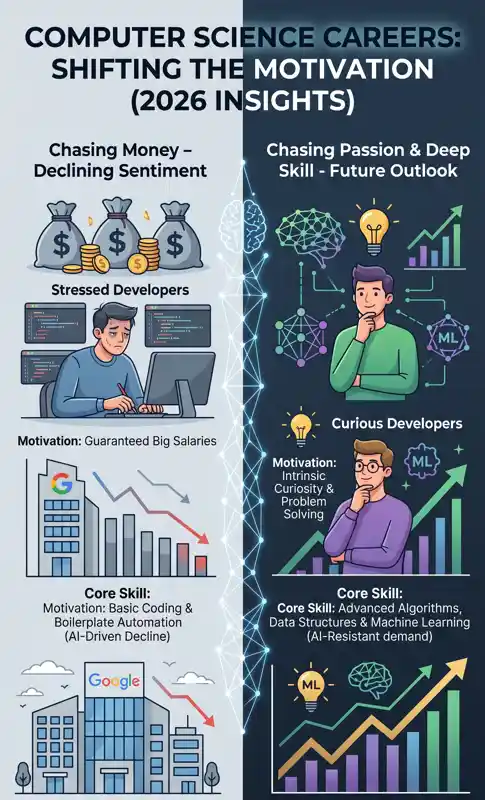
During a recent episode of the popular “20VC” podcast, Amjad Masad, the co-founder and CEO of Replit, delivered a stark warning to students and young professionals. He argued that the influx of individuals entering the computer science field solely for high tech industry salaries has diluted the passion that once drove the industry forward. In the early 2000s, students flocked to tech because they were genuinely fascinated by computers. Today, universities are overflowing with students hoping to secure a massive paycheck at tech behemoths.
“If you don’t feel like you’re drawn to it like a fly drawn to a light, then don’t go into it because someone told you you’re going to make a boatload of money working for Google.”
Masad’s perspective is deeply informed by his own company’s evolution. Replit, which started in 2016 as a simple integrated coding environment, has rapidly pivoted into an AI-agent-led application builder. Today, it competes fiercely with heavyweights like Microsoft’s GitHub, Cursor, and emerging “vibe-coding” tools like Lovable. Because AI coding tools can now automate massive chunks of routine programming, the barrier to entry for basic coding has plummeted. Consequently, simply knowing how to write syntax is no longer enough to command top-tier compensation.
| Coding Era | Primary Motivation | Skill Focus |
|---|---|---|
| Early 2000s | Intrinsic Passion | Understanding hardware and low-level systems |
| 2010s – 2022 | Financial Gain (Big Tech) | Web frameworks, LeetCode, basic app development |
| 2026 (AI Era) | Deep Problem Solving | Systems design, ML fundamentals, AI orchestration |
The Enduring Value of Computer Science Fundamentals
While Masad discourages the money-chasing mindset, he is far from declaring the computer science degree dead. In fact, he emphasizes that the fundamental “underpinnings” of computer science—such as complex data structures, algorithmic efficiency, and machine learning fundamentals—will remain largely immune to AI replacement. For a broader look at how these roles are officially categorized and compensated, you can review data from the Bureau of Labor Statistics.
Other prominent tech leaders firmly agree that a rigorous CS education is still deeply valuable, provided the student approaches it with the right mindset. Max Levchin, venture capitalist and Affirm CEO, recently noted that writing truly elegant and scientifically correct code remains an art form. He expressed skepticism that Large Language Models (LLMs) will ever natively deliver perfectly crafted, complex systems without human oversight rooted in deep CS knowledge.
“Many people think a CS degree is just programming or something… There’s a lot more to coding than writing the code. Computer science is a wonderful major to learn systems thinking.”
This sentiment was echoed by AI pioneer Geoffrey Hinton, who clarified that while AI is undoubtedly replacing tedious coding tasks, the true value of a computer science degree value lies in teaching students how to think systematically. Systems thinking enables engineers to design robust, scalable architectures—something an AI cannot do autonomously from scratch without expert human guidance.
| Task Type | AI Capability (2026) | Human Engineer Requirement |
|---|---|---|
| Boilerplate Code | Excellent (Fully Automated) | Minimal / Review Only |
| Debugging Syntax | High | Moderate Context Provision |
| Systems Architecture | Low to Moderate | Critical / Deep CS Knowledge Required |
Adapting to Software Engineering Careers in 2026
For those genuinely fascinated by technology, the path forward is incredibly exciting. Masad points out that the real opportunities now lie in diving deep into machine learning and AI research at major labs or innovative startups. The industry doesn’t need more developers who can write basic React components; it needs thinkers who can orchestrate AI agents, ensure data security, and optimize complex algorithms that run the AI models themselves.
If you are a student considering a tech major today, the advice from Silicon Valley’s elite is clear: do not look at Google’s entry-level salary bands as your primary motivator. The landscape is shifting too rapidly. Instead, cultivate a genuine curiosity for how machines “think” and how complex systems operate. By focusing on the scientific and architectural elements of the field, you position yourself not just as a code-monkey, but as an indispensable systems architect in an increasingly automated world.
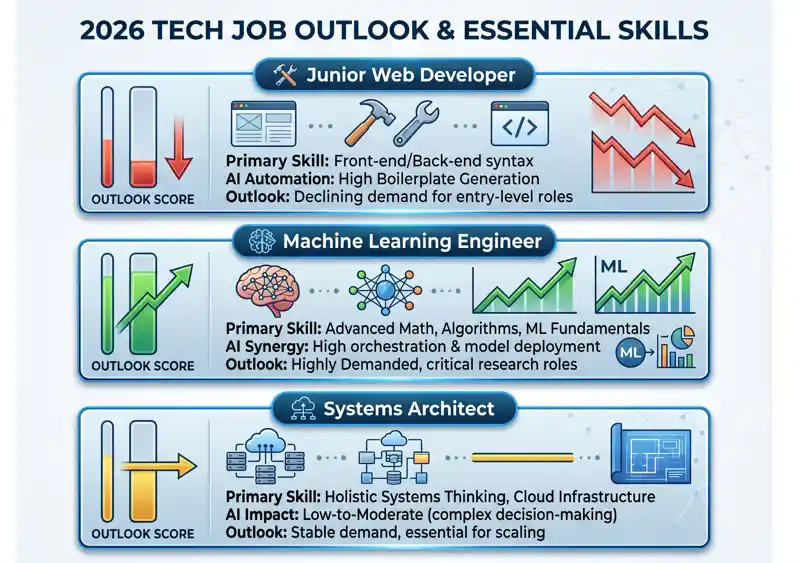
| Career Path | Future Outlook | Required Skillset Focus |
|---|---|---|
| Junior Web Developer | Declining | Transition to AI Prompting / Orchestration |
| Machine Learning Engineer | Highly Demanded | Advanced Math, Algorithms, Data Structures |
| Systems Architect | Stable & Lucrative | Holistic Systems Thinking, Cloud Infrastructure |
Frequently Asked Questions
Why did the Replit CEO advise against studying CS just for money?
Amjad Masad believes that the rise of AI makes basic coding less lucrative. Without a genuine, intrinsic passion for the subject, workers will struggle to stay competitive and fulfilled in a rapidly changing industry.
Will AI replace software engineering careers completely?
No. While AI is automating routine coding tasks and boilerplate generation, it cannot replace the complex systems thinking, architectural design, and deep algorithmic knowledge required to build large-scale software.
Is a computer science degree still valuable in 2026?
Yes. Tech leaders emphasize that a CS degree teaches fundamental systems thinking and problem-solving skills that remain highly relevant, even as the specific tools used to write code evolve.
What are AI coding tools like Replit and Cursor doing to the job market?
These tools are significantly lowering the barrier to entry for building applications, meaning companies no longer need to hire as many entry-level coders for simple tasks. Instead, they seek engineers who can manage and integrate these AI tools.
What should CS students focus on today instead of basic programming?
Students should focus on machine learning fundamentals, complex algorithms, data structures, and systems architecture, as these are harder for AI to replicate.
Did Geoffrey Hinton say coding is dead?
No. Hinton stated that while AI replaces some coding tasks, a CS major is actually about learning “systems thinking,” which remains an incredibly valuable skill.
Can I still get a job at Google if I study CS?
Absolutely, but the expectations have shifted. Top tech companies are looking for passionate engineers who deeply understand the underlying science of computing, rather than those just looking for high salaries.
Disclaimer: This article is for informational purposes only…