When examining the wreckage of the early 2020s digital asset boom, economists and gaming historians frequently highlight exactly how legacy became a costly crypto bust for players and a business win for peter molyneux. In 2026, the landscape of the video game industry has shifted dramatically away from blockchain integration, largely due to the catastrophic failures of highly publicized Web3 titles. This comprehensive 2500-word guide dissects the intricate web of promises, speculative economics, and unprecedented financial losses surrounding the Peter Molyneux crypto game known as Legacy. It serves as a definitive autopsy of a play-to-earn game failure and a stark warning about the unregulated nature of digital gaming investments.
The Rise and Fall of a Crypto Dream: Building the Mirage
To fully grasp the magnitude of the Legacy game crypto losses, one must first understand the historical weight of the figures involved. Peter Molyneux is not a newcomer to the gaming industry; he is a veteran designer renowned for creating the “god game” genre with legendary titles such as Populous, Dungeon Keeper, Black and White, and the critically acclaimed Fable franchise. However, Molyneux also carried a well-documented reputation for making grandiose, over-ambitious promises during development cycles—promises that frequently failed to materialize in the final retail products. When Molyneux and his development studio, 22cans, announced a partnership with Gala Games to produce a blockchain-powered economic simulator, the industry watched with a mixture of immense anticipation and deep skepticism.
The core concept of Legacy was presented as an industrialist’s ultimate fantasy. Players would purchase digital land, build small manufacturing towns, harvest raw materials, and design bespoke consumer products ranging from simple hamburgers to intricate mechanical bicycles. The revolutionary hook, however, was the integration of Gala Games NFT gaming mechanics. This was pitched not just as a game, but as a legitimate income stream. Players were told they could participate in a bustling digital economy where their in-game business acumen would translate directly into real-world cryptocurrency profits. This was the defining promise of the “play-to-earn” (P2E) model.
“I want to focus and make Legacy the defining game of blockchain gaming—because that’s the sort of ridiculously optimistic person that I am—and a defining game of any of the games that I’ve created before.”
This pitch occurred at the absolute zenith of the cryptocurrency bull run in December 2021. During the extravagant “Galaverse” convention in Las Vegas, Molyneux stood before an audience of freshly minted crypto-millionaires and declared that every mechanic in Legacy was tailor-made for the blockchain environment. The fervor was palpable. Driven by the fear of missing out (FOMO) and the intoxicating allure of decentralized finance, gamers and speculative investors rushed to purchase digital land deeds before a single line of gameplay code had been publicly tested.
| Historical Era | Molyneux Project Focus | Market Reception & Delivery |
|---|---|---|
| 1989 – 2001 | Populous, Dungeon Keeper, Black & White | Critically acclaimed, defined the god-game genre. |
| 2004 – 2010 | Fable Franchise | Massive commercial success, but plagued by over-promising. |
| 2012 – 2014 | Curiosity, Godus | Crowdfunded controversies, unfulfilled multiplayer promises. |
| 2021 – 2023 | Legacy (Web3 Blockchain) | Massive initial capital raise followed by total economic collapse. |
| 2024 – 2026 | Masters of Albion | Return to traditional PC gaming, funded by Legacy’s crypto profits. |
The $54 Million Land Grab and the Gala Ecosystem
To understand how Legacy managed to secure roughly $54 million in upfront funding, one must look at the ecosystem created by its publisher, Gala Games. Founded in 2019 by Zynga co-founder Eric Schiermeyer and crypto entrepreneur Wright Thurston, Gala Games positioned itself as the premier destination for Web3 gaming. Their primary asset was the GALA token, which initially traded for fractions of a penny.
The turning point for Gala Games came with the implementation of play-to-earn features in a simple agricultural simulator called Town Star. Players could purchase NFT farming units to generate the game’s specific TOWN token. As new players flooded the game during the pandemic lockdowns, the influx of fresh capital drove the prices of TOWN and GALA to astronomical highs. Early adopters who had purchased “founder nodes” to support the network suddenly found their daily token distributions valued at tens of thousands of dollars. This created a massive, highly liquid community of crypto “degens” flush with seemingly free capital.
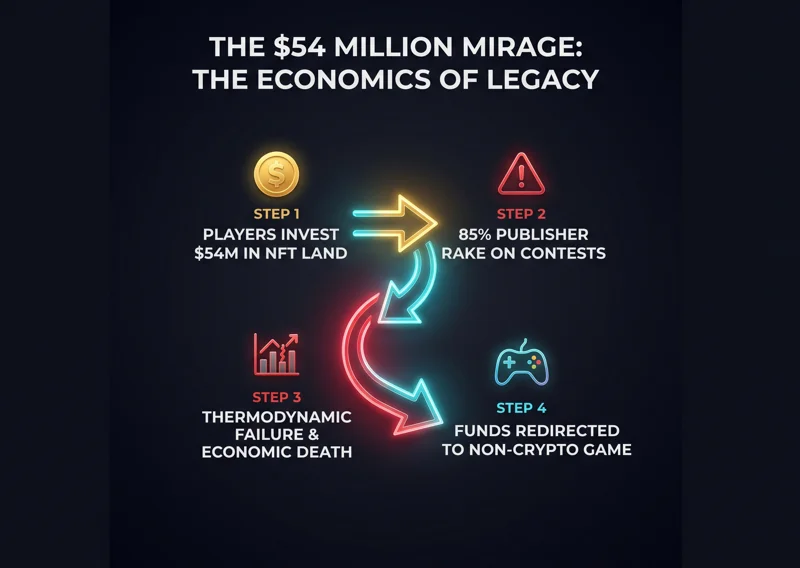
When Gala Games opened the initial land sale for Legacy in late 2021, they offered just 4,661 NFT plots. The community, riding the high of the Town Star bull run, devoured the inventory within days. Players reasoned that if a basic farming simulator could generate life-changing wealth, an advanced economic simulation helmed by a legendary game designer would be the investment of a lifetime. Many buyers reinvested their existing GALA profits, while others poured in fresh fiat currency, entirely convinced they were purchasing a highly lucrative digital asset.
“I knew in my heart that it couldn’t logically continue this way. I didn’t quit my job—but while it was happening, it was a very powerful drug.”
These buyers were told that owning Legacy land would allow them to establish in-game business empires. They could play the game directly to earn the coveted “LegacyCoin,” or they could act as digital landlords, loaning their deeds out to free-to-play users in exchange for a percentage of their earnings. It was a sophisticated pitch that perfectly mirrored real-world real estate speculation, transplanted into a vibrant digital metaverse.
| Gala Games Asset | Role in the Ecosystem | Impact on Legacy Launch |
|---|---|---|
| Founder Nodes | Network support licenses yielding daily GALA drops. | Created a class of wealthy early adopters eager to reinvest. |
| GALA Token | The primary utility token across the Gala network. | Used as the primary currency to purchase Legacy NFT land. |
| Town Star NFTs | Assets for Gala’s first major play-to-earn success. | Proved the P2E concept to the community, establishing trust. |
| Legacy Land Deeds | Exclusive NFT plots required to access high-tier earning. | Generated the $54M upfront funding pool for 22cans. |
Where Did the Millions Go?: The Reality of the Launch
The gap between Peter Molyneux’s ambitious marketing and the actual software delivered to players is a recurring theme in gaming history, but the Web3 gaming economy collapse amplified the consequences from mere disappointment to devastating financial loss. By the time Legacy finally launched in October 2023, the broader cryptocurrency market had significantly cooled, and the product delivered by 22cans was universally recognized as a shell of its former promises.
The Broken Mechanics of a Minimal Viable Product
Instead of the deep, morally complex economic engine promised at Galaverse, players logging into Legacy found a simplistic, repetitive clicker game heavily reminiscent of predatory mobile titles. The core gameplay loop involved waiting for artificial timers to expire, endlessly clicking to convert crops into raw ingredients, and shifting those ingredients into rudimentary factories. The highly touted design tools, which were supposed to allow players to invent “any conceivable product,” were severely restricted, offering only a handful of generic templates.
However, the disappointment regarding the gameplay was completely overshadowed by the realization that the play-to-earn economic engine was fundamentally broken. The original vision of a unique “LegacyCoin” driving a player-to-player market had been quietly abandoned during development. In its place, Gala Games implemented a convoluted and highly restrictive economy designed around “Gems” and competitive design contests. To earn money, players had to use Gems—which were either painstakingly earned in-game or purchased directly with fiat or crypto—to enter continuous daily design competitions.
Winning these competitions awarded “Legacy Tickets,” which were then automatically converted back into the GALA token using an arcane, fluctuating mathematical formula. Players quickly realized that winning was not just difficult; it was mathematically structured to drain their wallets. This marked the beginning of the end for the Legacy economy.
“The problem with that payout is it literally makes it completely impossible, due to very well understood thermodynamic principles, for anyone to get more out than what they’ve put into it.”
The 85 Percent Rake and Thermodynamic Failure
The true scandal of the Peter Molyneux crypto game lay hidden deep within the game’s “litepaper”—the technical document outlining its tokenomics. Players who took the time to analyze the fine print discovered that the total prize pool for the daily in-game events was capped at a minuscule 15 percent of the GALA spent on purchasing in-game Gems. This meant that Gala Games was retaining a staggering 85 percent of all new liquidity entering the competition ecosystem.
In traditional gambling terms, the percentage of money the house keeps from a pot is known as a “rake.” A standard casino poker room might take a 3 to 5 percent rake to remain profitable while keeping the game enticing for players. An 85 percent rake is not a game; it is an aggressive capital extraction mechanism. It made it mathematically impossible for the player base as a whole to turn a profit. For every dollar spent by the community to participate in the promised “play-to-earn” ecosystem, 85 cents were immediately siphoned off by the publisher.
Former Gala Games executives even admitted in later interviews that this structure violated the basic thermodynamic principles of game economies. In any closed economic system, if the outflow (publisher profits) massively exceeds the inflow (new player investments), the system will collapse. When players realized they were paying massive entry fees for a chance to win back a fraction of their own money, participation plummeted. Within two weeks of the October 2023 launch, the Legacy economy was entirely dead.
| Economic Component | Intended Function (Marketing) | Actual Reality (Launch) |
|---|---|---|
| In-Game Currency | Unique LegacyCoin traded freely by players. | Gems purchased via Gala, restricted to contest entries. |
| Earning Mechanism | Passive income from running efficient virtual factories. | Cutthroat design competitions requiring constant fee payments. |
| Prize Pool Structure | A vibrant, player-driven trading ecosystem. | Capped at 15% of total entry fees; 85% retained by publisher. |
| NFT Land Deeds ($54M) | Appreciating assets generating high daily yields. | Stranded, illiquid assets with virtually zero earning potential. |
Players as Unwitting Seed Investors
The realization of these economic truths led to a massive wave of player outrage. Users who had spent thousands, and in some cases tens of thousands, of dollars on digital land deeds were left holding worthless assets. One user, identified in community forums as Victor, reported spending $10,000 on a high-tier “Legacy Conglomerate” plot, only to earn less than $100 over the game’s brief lifespan. Another user reported earnings of just $9.84 after investing thousands into the initial NFT sale.
As the anger boiled over, the harsh realities of the Web3 business model became glaringly apparent. Players had not purchased a game; they had acted as unregulated venture capitalists. They provided the upfront seed funding necessary to develop the software, assuming 100 percent of the financial risk. However, unlike traditional seed investors, they possessed zero equity in 22cans or Gala Games, and held no legal recourse when the project failed to deliver on its marketing promises.
For individuals seeking guidance on avoiding similar digital asset traps, consumer protection organizations frequently publish warnings. You can read more about investment risks and digital asset regulations via the U.S. Securities and Exchange Commission, which actively monitors the volatile intersection of cryptocurrency and consumer products.
“They are trying to raise money to fund the project and then build it after. Basically, we are seed investors.”
A Business Win for Peter Molyneux: Funding Masters of Albion
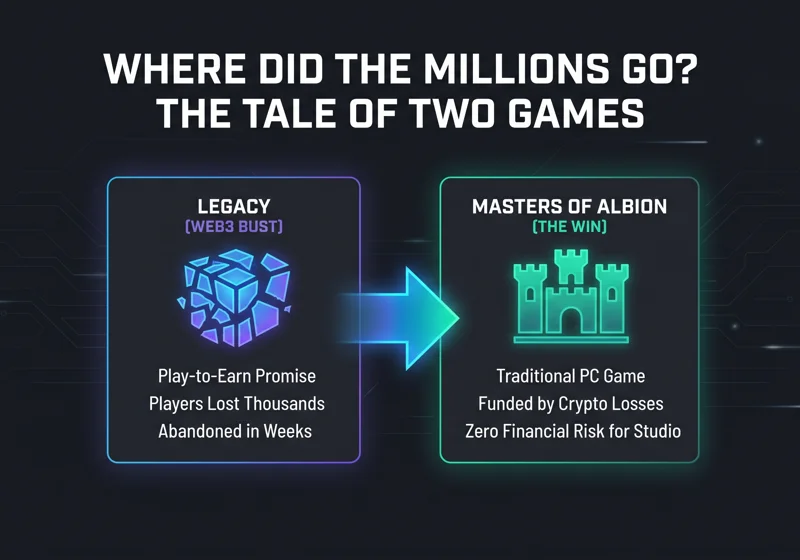
While the player base suffered devastating losses, the narrative on the corporate side was entirely different. Gala Games executives eventually confirmed that Legacy was paid for upfront. Gala had provided a massive “minimum guarantee” to Peter Molyneux and his studio, 22cans, to secure their involvement. The $54 million generated from the frantic NFT land sales went directly toward covering this corporate guarantee. From a business perspective, the game was a financial triumph before a single line of code was finalized.
The final, bitter twist for the players who lost their investments came in 2024. Having secured a massive financial runway from the failed crypto experiment, Molyneux pivoted sharply away from the blockchain space. In a series of interviews, he admitted that the play-to-earn model did not work financially or in gameplay terms. Furthermore, he revealed exactly what he was doing with the capital generated by the Legacy debacle.
Molyneux stated that the profits from the crypto game allowed him to reunite with veteran developers from his glory days, including Russell Shaw, Mark Healey, and Ian Wright. He used the funds extracted from Web3 speculators to hire these industry legends away from their current jobs to build Masters of Albion—a completely traditional, non-crypto god game. He effectively utilized a predatory, unregulated crypto scheme to crowdsource the development of his dream traditional video game, assuming zero financial risk for his studio.
| Stakeholder Group | Financial Input | Ultimate Outcome (2026) |
|---|---|---|
| Retail Players / Speculators | ~$54 Million in NFT purchases + In-game Gem fees. | Total financial loss; stuck with worthless digital deeds to a dead game. |
| Gala Games (Publisher) | Marketing and platform infrastructure. | Retained 85% of all contest entry fees; covered developer guarantees. |
| Peter Molyneux & 22cans | Game design and initial development labor. | Secured massive upfront profits; funded development of “Masters of Albion”. |
This blatant redirection of funds enraged the remnants of the Legacy community. Players who were down thousands of dollars were now being asked to pay standard retail prices—around $25 for early access—to play Masters of Albion, a game functionally subsidized by their losses. Molyneux’s legacy, once defined by boundary-pushing game mechanics, is now permanently intertwined with one of the most glaring wealth transfers of the Web3 era.
The Fatal Flaw of Web3 Gaming
Looking back from 2026, the failure of Legacy highlights the fundamental, inescapable flaw of the entire play-to-earn gaming sector. For a virtual economy to remain stable and allow players to extract real-world value, there must be a massive underlying base of “pay-to-play” users—individuals who spend money purely for the joy of the game, with zero expectation of financial return. This is how traditional virtual economies, such as those found in massive multiplayer online games, have survived for decades without the blockchain.
However, Web3 games like Legacy were marketed almost exclusively as investment vehicles. They attracted a user base composed entirely of speculators. When every single player in the ecosystem expects to extract more value than they input, and the publisher simultaneously skims a massive percentage off the top, rapid thermodynamic failure is the only possible mathematical outcome. The game quickly transforms from an entertainment product into a zero-sum financial battleground, where early adopters and developers cash out, leaving latecomers holding the bag.
The story of Legacy is more than just a footnote in the history of a legendary game designer. It is a vital case study in modern digital economics, demonstrating the profound dangers of mixing unregulated speculative finance with digital entertainment. As the industry moves forward, leaving the blockchain hype behind, the $54 million mirage stands as a monument to the perils of the play-to-earn dream.
Frequently Asked Questions
What was the game “Legacy” created by Peter Molyneux?
Legacy was an industrial economic simulation game integrating Web3 blockchain technology, designed by Peter Molyneux’s studio 22cans and published by Gala Games. It launched in 2023.
How much money did players invest in Legacy before it launched?
During the initial hype phase in late 2021, players spent approximately $54 million worth of cryptocurrency purchasing digital land deeds (NFTs) to access the game.
Why did the Legacy game economy collapse so quickly?
The economy collapsed within weeks because the publisher instituted an 85 percent “rake” on all in-game contest entry fees, making it mathematically impossible for the player base to earn a profit.
Did the players who bought Legacy NFTs get their money back?
No. The vast majority of players suffered near-total losses on their initial investments, earning only pennies compared to the thousands of dollars they spent on virtual land.
What did Peter Molyneux do with the profits from Legacy?
Molyneux used the upfront development funds guaranteed by the NFT sales to pivot away from crypto and fund his next traditional, non-blockchain game, “Masters of Albion.”
Is “Masters of Albion” a crypto or play-to-earn game?
No. Following the failure of Legacy, Molyneux abandoned the Web3 space entirely. Masters of Albion is a traditional PC god game sold via standard early access retail models.
Why are play-to-earn (P2E) games prone to sudden failure?
P2E games rely almost entirely on speculative players expecting financial returns. Without a massive base of non-speculative players willing to spend money purely for entertainment, the underlying economy rapidly runs out of liquidity and collapses.
Disclaimer: This article is for informational purposes only. It recounts historical events in the technology and gaming sectors based on reports and data available as of 2026. It does not constitute financial or investment advice. Investments in cryptocurrency, NFTs, and digital assets carry extreme risk, volatility, and a high probability of total loss.