The playstation 6 lite not happening nightmare is a harsh reality that budget-conscious gamers must finally accept as we move deeper into 2026. Following an in-depth analysis of the anticipated PlayStation 6 bill of materials (BOM), intense speculation arose regarding a potential “Lite” home console powered by the APU designed for Sony’s upcoming “Canis” handheld device. Enthusiasts hoped this theoretical model could bridge the gap with a highly aggressive price point. However, leading hardware insiders have definitively crushed these PlayStation 6 Lite rumors, revealing that attempting to force a handheld chip to run a traditional home console experience would fundamentally break the development pipeline.
The Development “Nightmare”: Why the Canis APU Cannot Power a Home Console
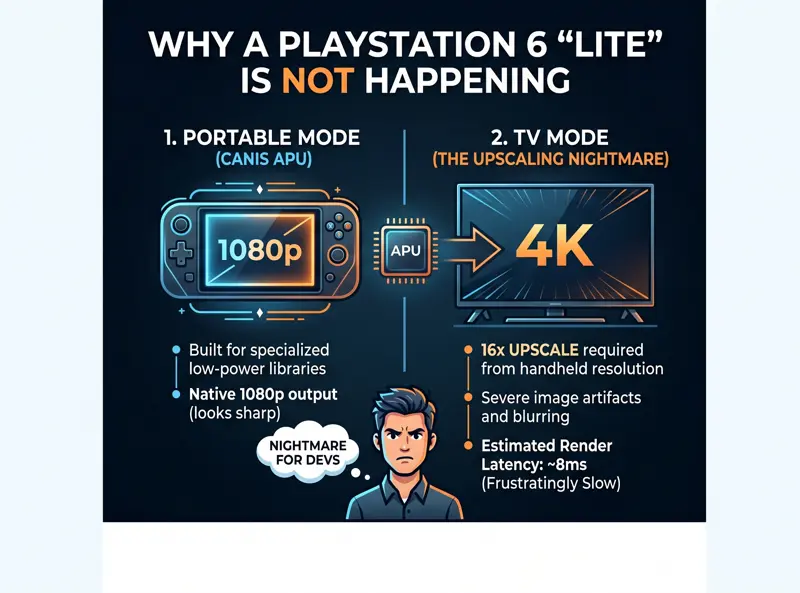
The core of the issue lies in the massive disparity between portable and home gaming environments. AMD leaker KeplerL2, a highly reliable source on NeoGAF, bluntly stated that repurposing the Canis handheld APU for a PlayStation 6 Lite model is practically non-existent because it would create an unmanageable workload for game creators. The problem is not just raw power; it is the fundamental architecture of the chip itself.
The Canis APU is constructed using specialized low-power libraries. This means that no matter how much electrical power or cooling you supply to the chip in a docked or traditional home console format, it simply cannot reach the high clock speeds required for next-gen 4K television gaming.
“Making something look good on a small 1080p screen is very different from making it look good on a large 4K TV. We also still don’t know if Sony will mandate Handheld support.”
Furthermore, relying on modern upscaling technology is not the magic bullet many assume it to be. 4K gaming upscaling limitations become severely apparent when stretching a base handheld image to fit a massive living room display.
| Target Output | Upscale Factor | Estimated Render Latency (FSR5/PSSR3) |
|---|---|---|
| 1080p (Native Handheld) | 1x (None) | \~2ms |
| 4K (Standard Docked) | 16x Upscale | \~8ms |
| 4K (Highly Optimized) | 16x Upscale | 5-6ms Minimum |
A 16x upscale from a low internal resolution introduces massive image artifacts and blurring. As KeplerL2 clarified, the processing cost of upscaling scales with the output resolution. If developers had to account for a 5-6ms latency penalty just to push a 4K image, they would have to completely alter their game logic and physics engines for the docked configuration just to maintain a stable framerate. For official insights into current hardware philosophies, you can visit the Official PlayStation Website.
A Realistic Budget Alternative: Down-clocking the Orion APU
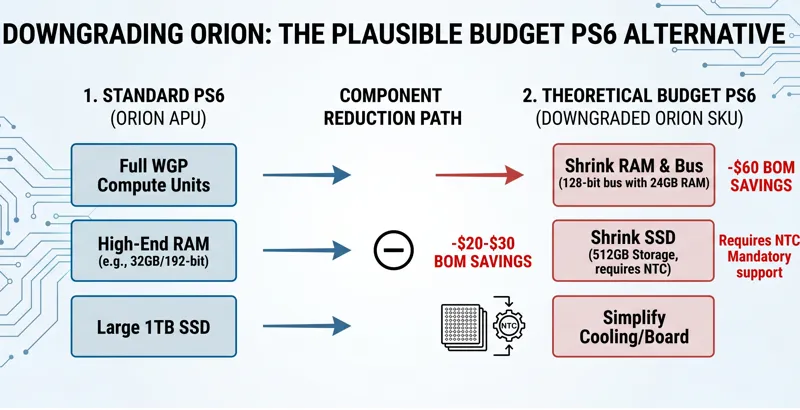
While a PS6 Lite based on the Canis handheld APU is effectively dead on arrival, Sony could still introduce a lower-end SKU to manage next-gen Sony console pricing. Instead of using a handheld chip, the most logical engineering path is to take the primary “Orion” APU—the powerhouse driving the standard PS6—and aggressively cut back its surrounding components.
| Hardware Component | Standard PS6 (Orion) | Theoretical Budget PS6 (Orion Variant) |
|---|---|---|
| CPU Configuration | Standard Next-Gen Cores | 6-core CPU cluster (-10% clock speed) |
| GPU Compute Units | Full WGP Layout | 16 WGP GPU (-10% clock speed) |
| Memory Subsystem | Maximum Next-Gen RAM | 128-bit bus with 24GB RAM |
According to hardware analysts, modifying the Orion APU in this manner would save Sony a significant amount of money in manufacturing. By restricting the console to a 128-bit bus and 24GB of RAM, Sony could shave roughly $60 off the bill of materials. The resultant lower heat output would also allow for a cheaper cooling assembly and motherboard, saving an additional $20 to $30 per unit.
“Shrinking the SSD to 512GB would be another big BOM reduction, but I think they could only get away with that if they forced devs to use NTC.”
As 2026 progresses, the overarching narrative is clear. If consumers want an affordable entry into the PlayStation 6 ecosystem, the dedicated standalone PS6 handheld will be that gateway. Creating a fragmented home console market using portable chips is simply a logistical impossibility that Sony will avoid at all costs.
| Cost Reduction Strategy | Estimated BOM Savings | Impact on Development |
|---|---|---|
| Reducing RAM to 24GB | \~$60 | Requires stricter memory management |
| Cheaper Cooling/Board | $20 – $30 | None (Handled via down-clocking) |
| Shrinking SSD to 512GB | Significant | Requires mandatory NTC texture compression |
The Future of Next-Gen Hardware
Sony faces a difficult balancing act. Keeping the primary PlayStation 6 near the $700 range will require strict component management. While a “Lite” model utilizing handheld architecture is completely off the table, the strategic deployment of the Orion architecture will dictate how accessible the next generation of gaming truly is.
Frequently Asked Questions
Why won’t Sony release a PlayStation 6 Lite using the handheld chip?
Using the handheld “Canis” APU in a home console would be a development nightmare. The low-power architecture cannot reach the high clock speeds required to drive native 4K resolutions on large living room televisions.
What are the issues with upscaling a handheld game to 4K?
Upscaling from 1080p to 4K is a massive 16x jump. This introduces high latency (up to 8ms) and severe image artifacts, forcing developers to implement complex, time-consuming optimizations just for a budget console mode.
What is the “Canis” APU?
The Canis APU is the codename for the specialized, low-power AMD chip that is heavily rumored to power Sony’s upcoming PlayStation 6 standalone handheld device.
What is the “Orion” APU?
The Orion APU is the codename for the primary, high-performance silicon chip designed to power the standard PlayStation 6 home console.
Could there be any cheaper version of the PS6?
Yes, hardware leakers suggest Sony could release a cheaper home console by using a downgraded version of the Orion APU, limiting the RAM to 24GB and potentially shrinking the SSD to 512GB to reduce manufacturing costs.
How much money would reducing the RAM to 24GB save?
According to bill of materials (BOM) estimates, reducing the memory subsystem to a 128-bit bus with 24GB of RAM would save Sony approximately $60 per console produced.
What is the cheapest way to play next-generation PlayStation games?
Based on current 2026 hardware leaks, the dedicated PlayStation 6 handheld is positioned to be the most affordable entry point into Sony’s next-generation gaming ecosystem.
Disclaimer: This article is for informational purposes only. The specifications, hardware codenames, and pricing models discussed are based on industry leaks and unverified rumors as of 2026, and may not reflect the final retail products released by Sony Interactive Entertainment.