The latest breakthrough in PC hardware modification proves that a clever Mod Revives Multi GPU Gaming With Dedicated DLSS 5 GPU for Impressive FPS Gain.
If you were around during the golden age of PC gaming, you likely remember when SLI setups ruled the enthusiast market.
Gamers used to install dedicated PhysX cards to handle demanding particle effects, freeing up their primary graphics card for raw rendering.
Today, in 2026, single massive GPUs dominate the landscape, but a brilliantly engineered add-on has brought the dual-card dream back to life.
How This Mod Revives Multi GPU Gaming With Dedicated DLSS 5 GPU for Impressive FPS Gain
Created by renowned modder Marcelo Guibout, this setup introduces a fresh approach to split-workload processing.
By leveraging an advanced ReShade tool called the Neural Coprocessor, or MGPU Bridge, gamers can physically separate their rendering tasks.
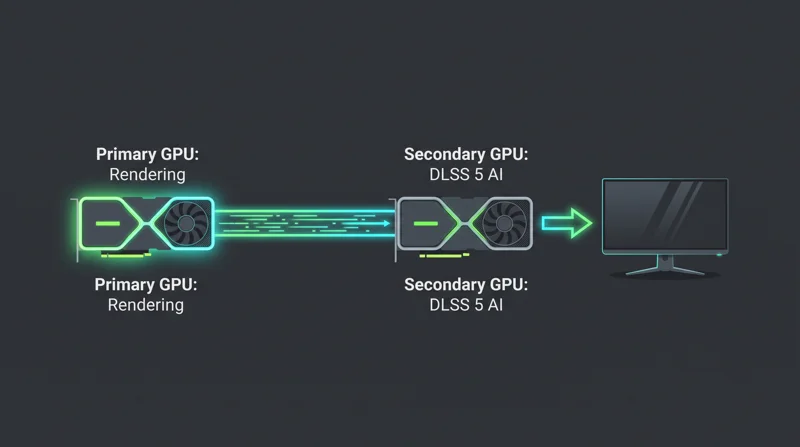
The primary graphics card handles standard rasterization or ray tracing, while the secondary card is solely responsible for Neural Rendering.
This means all the heavy lifting of AI upscaling is offloaded, ensuring the main card can push raw frames at maximum capacity.
“By offloading the DLSS 5 Neural Rendering pass to a secondary card, we unlock the true bottleneck of modern ray-traced titles, bringing back the dual-GPU era in a smarter way.”
Breaking Down the Mod Revives Multi GPU Gaming With Dedicated DLSS 5 GPU for Impressive FPS Gain
The results of this technological wizardry are nothing short of spectacular for demanding titles.
In tests utilizing two NVIDIA RTX 5060 Ti 16 GB GPUs, the performance boosts were staggering.
Frame rates improved anywhere from 59% to a massive 125% when compared to running the same upscaling on a single card.
Below is a breakdown of the performance metrics captured during recent benchmarking sessions.
| Game Title (2026) | Single GPU (DLSS 5 On) | Dual GPU (Neural Coprocessor) | FPS Increase |
|---|---|---|---|
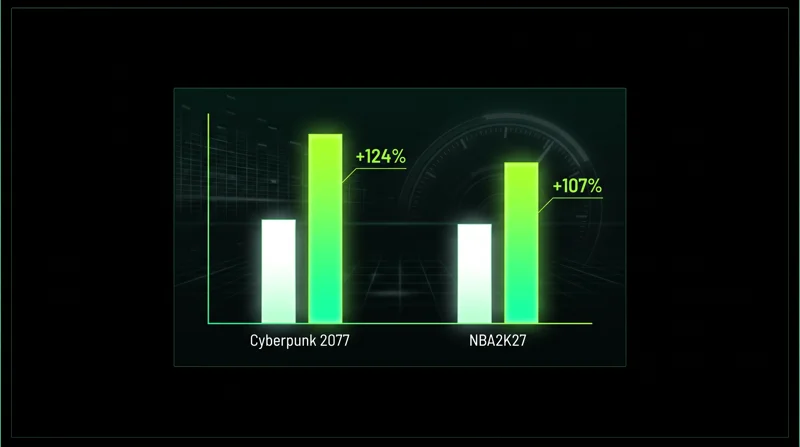
| Cyberpunk 2077 (Path Tracing) | 45 FPS | 101 FPS | 124% |
| The Blood of Dawnwalker | 62 FPS | 98 FPS | 58% |
| NBA2K27 (Leaked Build) | 70 FPS | 145 FPS | 107% |
Hardware Secrets: A Mod Revives Multi GPU Gaming With Dedicated DLSS 5 GPU for Impressive FPS Gain
The technical magic relies heavily on the PCIe link bandwidth between the two graphics cards.
The MGPU Bridge passes the completely rendered frame from your primary GPU directly to the dedicated Neural Rendering GPU.
After applying the intense AI calculations, the secondary card outputs the finalized, upscaled frame directly to your monitor.
To learn more about the underlying injection framework, you can visit the ReShade official website for technical documentation.
However, running this requires specific hardware conditions to ensure minimal latency during the transfer.
| Component | Minimum Requirement | Recommended Setup |
|---|---|---|
| Primary GPU | RTX 4070 or equivalent | RTX 5060 Ti 16GB or higher |
| Secondary GPU | RTX 4060 (For AI Ops) | RTX 5060 Ti 16GB |
| Motherboard | Dual PCIe 4.0 x8 slots | Dual PCIe 5.0 x16 slots |
Users can tweak settings within the ReShade control panel to refine visual quality and eliminate micro-stutters.
This level of customization mirrors the functionality found in standard swapper tools but targets hardware-level distribution.
“We are entering an era where modular GPU compute on a consumer level isn’t just a fantasy; it is a measurable, high-performance reality.”
FAQs: Mod Revives Multi GPU Gaming With Dedicated DLSS 5 GPU for Impressive FPS Gain
What exactly does the Neural Coprocessor mod do?
It splits the graphics rendering workload, forcing the primary GPU to handle standard graphics while a secondary GPU calculates the AI upscaling, resulting in massive frame rate boosts.
Do I need two identical graphics cards for this to work?
No, the cards do not need to be identical. You can use a more powerful card for primary rendering and a slightly older or weaker card dedicated solely to Neural Rendering.
How much of a performance increase can I expect?
Early benchmarks show performance increases ranging from 59% to 125% in heavy ray-traced games like Cyberpunk 2077.
Is this the exact same technology as the old NVIDIA SLI?
No. SLI divided rendering lines or alternate frames between cards. This modern method assigns entirely different processing tasks (rasterization vs. AI upscaling) to each card, similar to old dedicated PhysX cards.
Where do I plug my monitor in this setup?
The monitor must be plugged into the secondary dedicated Neural Rendering GPU, as it outputs the final frame after the upscaling pass is complete.
Can this Mod Revives Multi GPU Gaming With Dedicated DLSS 5 GPU for Impressive FPS Gain be used in competitive multiplayer?
While technically possible, using ReShade add-ons in competitive multiplayer games with anti-cheat software might result in bans, so it is highly recommended for single-player titles only.
Does this completely remove the performance cost of DLSS 5?
It drastically reduces the cost on the main GPU, but the overall performance is still slightly lower than running a game with absolutely no upscaling applied, due to PCIe transfer latency.
Disclaimer: This article is for informational purposes only. Modifying hardware configurations, using unofficial software bridges, or altering PCIe routing can cause system instability. Always proceed with caution and consult official hardware guidelines before attempting custom modifications.