
The cybersecurity landscape shifted dramatically today as microsoft patches record 1413 flaws, setting an unprecedented benchmark for Patch Tuesday. This massive update addresses an astonishing volume of security gaps across the company’s ecosystem.

For IT administrators and everyday users alike, the fact that microsoft patches record 1413 flaws in a single release signals a new era in digital defense. Hundreds of these vulnerabilities require immediate attention to prevent system compromises.
Among the massive list of updates is a critical fix for a severe Windows Shell vulnerability that attackers are currently exploiting. Organizations must act swiftly to secure their networks.
Why microsoft patches record 1413 flaws in a Single Update
The sheer scale of this month’s release has left many industry experts stunned. When microsoft patches record 1413 flaws, it raises immediate questions about what is driving this sudden surge in vulnerability discovery.
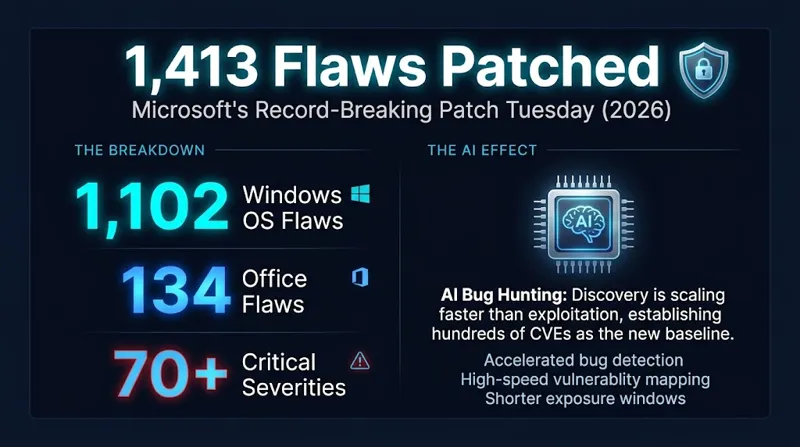
Cybersecurity professionals attribute this massive Patch Tuesday record directly to the rapid advancement of AI bug hunting. Artificial intelligence tools are accelerating vulnerability discovery for both defenders and malicious actors.
“The volume isn’t the real story anymore. What matters is that discovery is scaling faster than exploitation due to advanced AI capabilities.”
Because AI accelerates this process, it is no surprise that microsoft patches record 1413 flaws. We are moving into a reality where hundreds of CVEs are the new normal rather than a rare exception.
Breaking Down the Numbers When microsoft patches record 1413 flaws
Understanding the distribution of these vulnerabilities is crucial for prioritizing updates. The majority of the issues reside within the core operating system, but other enterprise tools are heavily impacted.
Here is a detailed breakdown of the affected products in this historic update:
| Product Category | Number of Vulnerabilities | Primary Risk Type |
|---|---|---|
| Windows OS | 1,102 | Privilege Escalation |
| Microsoft Office | 134 | Remote Code Execution |
| Developer Tools | 61 | Information Disclosure |
With over 70 of these flaws rated as Critical, system administrators cannot afford to delay deployment. The fact that microsoft patches record 1413 flaws highlights the expanding attack surface of modern enterprise environments.
Active Exploitation: The Windows Shell Vulnerability When microsoft patches record 1413 flaws
The most alarming aspect of this update is the confirmation of active exploitation in the wild. As microsoft patches record 1413 flaws, CVE-2026-96951 takes center stage as an urgent threat.
This specific Windows Shell vulnerability allows an unauthorized attacker to completely bypass critical security features over a network. It poses a severe risk to unpatched systems.
Attackers exploit this flaw to evade Mark of the Web (MOTW) defenses. By tricking a user into interacting with a malicious file or link, threat actors can silently compromise a targeted machine.
Key Threats Addressed As microsoft patches record 1413 flaws
Beyond the Windows Shell bug, several other highly critical vulnerabilities demand immediate remediation. These flaws enable everything from unauthorized application execution to denial of service.
To help teams prioritize, here are the most critical vulnerabilities patched in this release:
| CVE Identifier | CVSS Score | Vulnerability Description |
|---|---|---|
| CVE-2026-96951 | 8.8 | Windows Shell Command Injection (Exploited) |
| CVE-2026-108398 | 8.8 | .NET Framework Untrusted Search Path |
| CVE-2026-21413 | 9.8 | Raw Image Extension Buffer Overflow |
The .NET Framework untrusted search path vulnerability is particularly dangerous for post-compromise attacks. It enables hackers with local access to bypass Windows Defender Application Control completely.
“Patch what’s proven, prioritized, and public, and treat everything else as this month’s new normal in cybersecurity defense.”
Security teams are advised to review the official documentation on the Microsoft Security Update Guide to deploy risk cohorts effectively.
Best Practices as microsoft patches record 1413 flaws
Managing this historic update requires a strategic approach rather than blind patching. Organizations should utilize Microsoft’s new “risk cohorts” method to group and assess CVEs logically.
Because microsoft patches record 1413 flaws, IT departments must prioritize active threats, particularly those added to the CISA Known Exploited Vulnerabilities catalog. Action must be taken before critical deadlines.
The fact that microsoft patches record 1413 flaws will likely set the tone for the rest of 2026. Security is no longer just about installing updates; it is about rapid triage in an AI-driven threat landscape.
Frequently Asked Questions (FAQs)
Question: How should IT
What does it mean when microsoft patches record 1413 flaws?
It means Microsoft has released security updates to fix 1,413 distinct software vulnerabilities in a single month, breaking its previous Patch Tuesday records.
What is the Windows Shell vulnerability?
Tracked as CVE-2026-96951, it is a command injection flaw that allows attackers to bypass Mark of the Web (MOTW) security defenses.
Is the Windows Shell vulnerability being actively exploited?
Yes, Microsoft confirmed that this specific vulnerability is currently being exploited in real-world attacks.
Why are there so many bugs being found suddenly?
The surge is largely attributed to AI bug hunting, which allows both security researchers and threat actors to discover vulnerabilities much faster.
Which Microsoft products are most affected?
Windows OS received the bulk of the patches with 1,102 fixes, followed by Microsoft Office, Developer Tools, SharePoint Server, and SQL Server.
What is CVE-2026-108398?
It is a severe .NET Framework flaw that allows authenticated attackers to bypass Windows Defender Application Control (WDAC) and run unauthorized code.