
The intersection of new technology and ai wearables privacy wiretap laws is creating unprecedented legal challenges for everyday consumers in 2026.
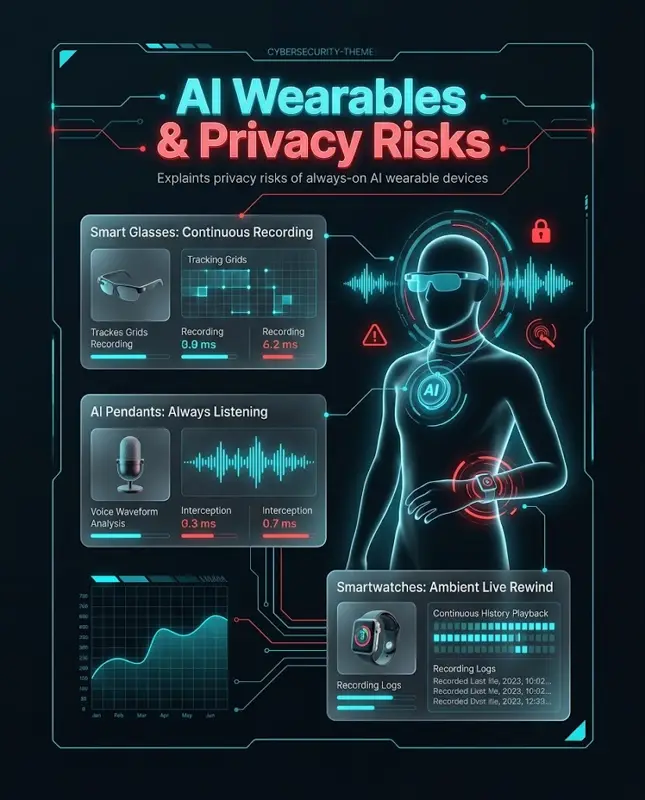
Apple, Amazon, Meta, and a host of innovative startups have recently released AI-powered, always-listening devices.
Unlike earlier smart speakers that required a specific “wake word” to activate, these modern gadgets continuously monitor your environment.
This continuous monitoring is severely pushing the limits of privacy law in completely new ways.
Legal experts are now warning that the liability for unauthorized recording may fall directly on the person wearing the device, rather than the tech giant that manufactured it.
Understanding the Scope of ai wearables privacy wiretap laws
The rise of devices like Meta’s camera-equipped glasses and Amazon’s Bee wearable has amplified AI wearable privacy concerns.
Users love the convenience of having their daily lives recorded, transcribed, and organized automatically.
However, bystander consent for recording is rarely obtained when someone walks into a public space wearing an always-on device.
Under strict ai wearables privacy wiretap laws, this lack of explicit consent from bystanders creates a massive legal gray area.
People simply do not feel comfortable knowing a nearby stranger might be ambiently transcribing their private conversations.
| Device Type | Activation Method | Privacy Risk Level |
|---|---|---|
| Early Smart Speakers | Wake Word (e.g., “Hey Siri”) | Moderate – Clear user intent required |
| Modern AI Necklaces | Always On / Continuous | High – Captures ambient conversations |
| Apple Watch Series 12 | Ambient Live Rewind | High – Constant buffering of audio |
How ai wearables privacy wiretap laws Affect Smart Devices
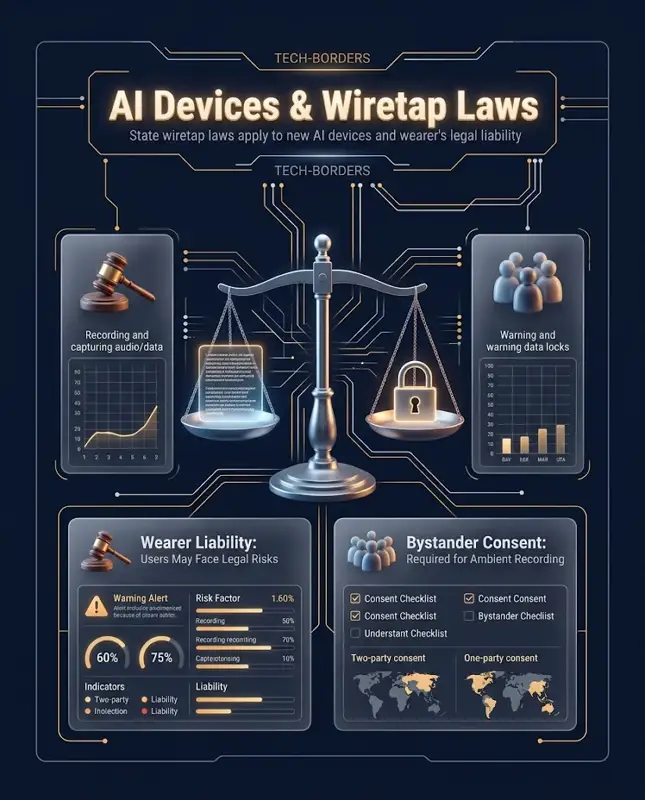
Many consumers are unaware of how wiretap laws and AI devices actually interact at the state level.
Apple’s latest Apple Watch Series 12 features Siri Recap, which ambiently takes notes throughout the user’s day.
This raises the critical issue of Apple Watch audio interception, especially in states with broad interception definitions.
State laws in places like Massachusetts and New Hampshire define an intercepting device as anything capable of receiving or acquiring the contents of a communication.
Even if the audio file itself is instantly deleted and only a text transcript remains, strict ai wearables privacy wiretap laws may still consider this an illegal interception.
“If I’m giving permission for myself to be recorded, that doesn’t mean everybody else around you has given that consent.”
Because the wearer opted into the feature without notifying those around them, the user could face civil or even criminal liability.
Bystander Protections Under ai wearables privacy wiretap laws
The problem of smart glasses continuous recording goes beyond just legal definitions; it touches on fundamental human privacy.
People can now be swept into AI-powered surveillance without owning or knowingly interacting with the collecting device.
To learn more about consumer protections and privacy rights, you can consult the Federal Trade Commission for updated technology guidelines.
Former intelligence officers warn that everyday devices now generate information that can reveal identities, locations, and associations instantly.
AI automates the process of sorting and analyzing this data, making incidental surveillance cheaper and easier than ever.
This is why understanding ai wearables privacy wiretap laws is no longer optional for tech enthusiasts.
| Legal Factor | Traditional Recording | New AI Wearables |
|---|---|---|
| Data Storage | Audio files saved to disk | Audio processed instantly, then deleted |
| State Law Definition | Clearly defined as a wiretap | Legally ambiguous “acquisition” of meaning |
| Primary Liability | Device manufacturer or operator | The individual wearing the device |
Defending Against Violations of ai wearables privacy wiretap laws
In response to these pervasive privacy threats, new startups are creating defensive technologies.
Companies like Deveillance have developed gadgets like the Spectre I, which scans for nearby AI recorders.
These defensive tools send out adversarial signals that scramble speech before unauthorized microphones can process it.
As ai wearables privacy wiretap laws continue to evolve in the courts, taking personal control over your audio privacy is becoming essential.
“We need to be able to use technology while not giving up our core values or fundamental privacy rights.”
Ultimately, until lawmakers clarify the boundaries of ai wearables privacy wiretap laws, early adopters must tread very carefully.
Frequently Asked Questions
What exactly are ai wearables privacy wiretap laws?
They are existing state and federal statutes that govern the unauthorized interception of private communications, now being applied to always-on AI devices that continuously summarize conversations.
Why do AI wearable privacy concerns focus so heavily on bystanders?
Because while the wearer of the device has consented to being recorded, the people they interact with in public or private spaces have not given their permission to be transcribed.
How does smart glasses continuous recording violate the law?
In two-party consent states, capturing the contents of a private conversation without the permission of everyone involved can be considered illegal eavesdropping or wiretapping.
Who is legally liable under current ai wearables privacy wiretap laws?
Legal experts suggest the liability may fall on the individual wearing the device rather than the tech company, as the wearer is the one opting into the ambient recording feature.
Does the Apple Watch audio interception save my voice recordings?
Apple claims features like Live Rewind and Siri Recap process audio instantly to generate text summaries and do not store or send the actual audio files to their servers.
Can I be sued if my device only saves text transcripts, not audio?
Yes. Under certain state laws, intercepting the “meaning or contents” of a communication can still be classified as an illegal interception, regardless of whether an audio file is retained.
How can I protect myself from ai wearables privacy wiretap laws violations?
You can protect yourself by turning off ambient listening features in private settings, asking for bystander consent, or using emerging defensive tech that scrambles unauthorized microphone signals.
Disclaimer: This article is for informational purposes only and does not constitute legal or professional advice. Please consult a qualified attorney for guidance on privacy laws in your specific jurisdiction.