Microsoft confirms Windows 11 26H2 for fall 2026 release reveals supported PCs and other details exactly as industry insiders predicted earlier this year. For millions of daily users, this announcement guarantees a highly predictable and stable operating system environment.
The tech giant is focusing heavily on seamless background updates rather than disruptive massive overhauls. This approach means that users will not face lengthy downtime when upgrading their machines this autumn.
Instead of a massive download, this year’s feature update will function as a simple switch. Let us explore why this update is so efficient and what it means for your hardware.
Understanding How Microsoft confirms Windows 11 26H2 for fall 2026 release reveals supported PCs and other details
This upcoming update does not introduce a completely new foundational platform. Rather, it builds directly upon the existing framework established by previous versions.
If you are currently running version 24H2 or 25H2, you already possess the core code required for 26H2. The primary advantage of this update is the resetting of the official OS life cycle.
By upgrading, you instantly secure an additional full year of critical security patches and developer support. This is crucial for both private consumers and large-scale enterprise environments.
“The next annual update for Windows 11 is coming soon, continuing our focus on delivering a predictable, low-disruption update experience for organizations and IT professionals.”
The Two-Minute Installation: Microsoft confirms Windows 11 26H2 for fall 2026 release reveals supported PCs and other details
Because the update shares a codebase with its predecessors, the installation process is remarkably swift. It utilizes an enablement package, commonly known as an eKB file.
This package is incredibly lightweight, usually measuring under 500KB in total size. When applied, it simply flips the active build number and unlocks extended support.
Most users will experience an installation time of under two minutes, requiring only a single system reboot. There will be absolutely no visual differences or forced interface changes upon restarting.
| Windows 11 Edition | Support End Date | Total Support Duration |
|---|---|---|
| Home, Pro, Pro EDU, Workstations | October 2028 | 24 Months |
| Enterprise, Education, IoT | October 2029 | 36 Months |
Hardware Needs When Microsoft confirms Windows 11 26H2 for fall 2026 release reveals supported PCs and other details
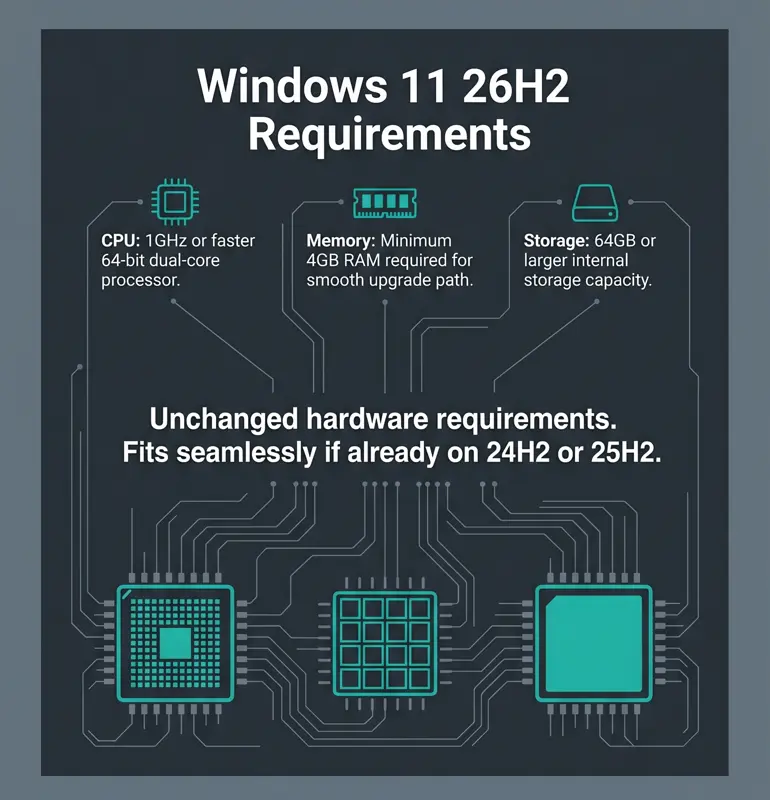
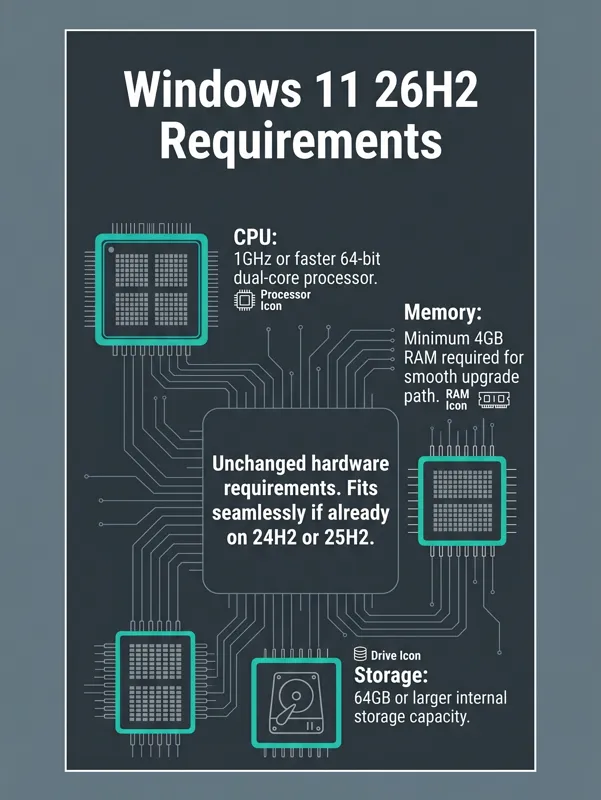
Consumers who recently upgraded their machines will be pleased with the latest hardware announcements. There are no new strict processor generations being forced upon the user base this year.
If your device already successfully runs version 24H2 or 25H2 smoothly, you are completely cleared for the 26H2 enablement package. The baseline requirements remain static.
| Hardware Component | Minimum Requirement |
|---|---|
| Processor (CPU) | 1GHz or faster 64-bit dual-core |
| Memory (RAM) | 4GB RAM |
| Storage Capacity | 64GB internal storage |
New Features Approach: Microsoft confirms Windows 11 26H2 for fall 2026 release reveals supported PCs and other details
You might wonder where all the exciting new interface features went. Microsoft has actively shifted its strategy regarding how fresh tools are deployed to users.
Major functional changes, like the movable taskbar or Low Latency Profile support, are no longer held back for a massive annual release. Instead, they are bundled directly into the monthly cumulative update cycle.
This steady stream of improvements ensures your computer is always evolving without requiring a massive system overhaul. You can monitor official development cycles via the Official Microsoft Windows Website.
“Major platform changes are now bundled with monthly releases to make system management easier for customers, particularly large enterprises.”
Looking Ahead to 2027 After Microsoft confirms Windows 11 26H2 for fall 2026 release reveals supported PCs and other details
The fact that Microsoft confirms Windows 11 26H2 for fall 2026 release reveals supported PCs and other details proves their dedication to stability this year.
However, industry analysts strongly believe this tranquil update cycle will conclude next year. Version 27H2 is widely expected to be a substantial, full-scale feature update with significant platform architecture changes.
Until then, enjoy the rapid installation speeds, extended security timelines, and consistent hardware requirements provided by the lightweight 2026 enablement package.
Frequently Asked Questions
What is the biggest news regarding this update?
The biggest news is that Microsoft confirms Windows 11 26H2 for fall 2026 release reveals supported PCs and other details, ensuring a predictable and fast update.
How long does the 26H2 installation take?
Because it uses an enablement package, the installation process usually finishes in under two minutes with a single reboot.
Do I need to buy a new computer for this update?
No, the hardware requirements remain exactly the same as they were for versions 24H2 and 25H2.
When will security support end for the 26H2 Home edition?
For standard Home and Pro users, official security support will end in October 2028.
How large is the actual update file?
The enablement package (eKB) file is incredibly small, typically coming in at under 500KB.
Are there major interface changes in this update?
No, major UI and functional changes are now delivered continuously through monthly cumulative updates instead of annual drops.
What is the difference between version 26H1 and 26H2?
Version 26H1 is specifically designed for new ARM-based silicon devices, whereas 26H2 serves all existing traditional PC architectures.
Disclaimer: This article is for informational purposes only. System requirements, update release dates, and software support lifecycles are subject to change based on the software manufacturer’s official deployment schedules.