This meta holograph avatar for ai and vr glasses update hands on review reveals a staggering leap in virtual communication.
During a recent live demonstration, the digital likeness presented was so incredibly realistic that it genuinely fooled observers at first glance.
Meta is aggressively pushing the boundaries of spatial computing, bridging the gap between physical and digital presence.
The company recently announced that these highly detailed holographic avatars are coming to their newest hardware ecosystems.
Diving Into the meta holograph avatar for ai and vr glasses update hands on Experience
Our meta holograph avatar for ai and vr glasses update hands on session started with the highly anticipated Meta Ray-Ban Display frames.
Creating a digital version of yourself is remarkably fast and entirely driven by advanced artificial intelligence.
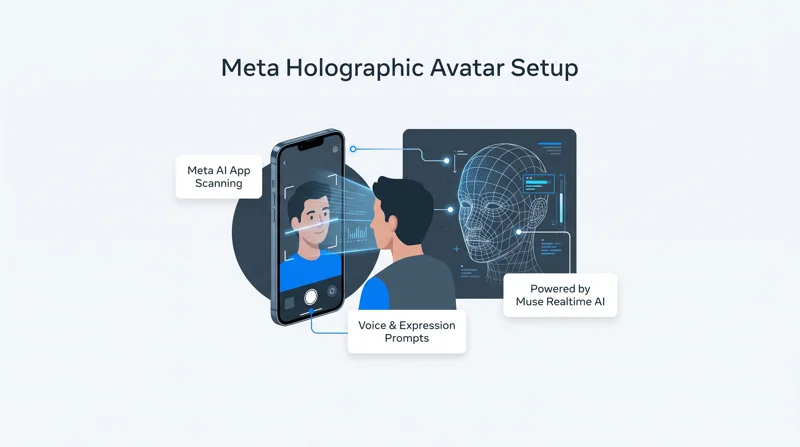
Using the Meta AI app avatar setup process, users are simply prompted to capture different angles of their face using a smartphone camera.
The system also asks a series of voice-prompted questions to accurately map your vocal mannerisms and conversational expressions.
| Device Platform | Avatar Generation Method | Estimated Setup Time |
|---|---|---|
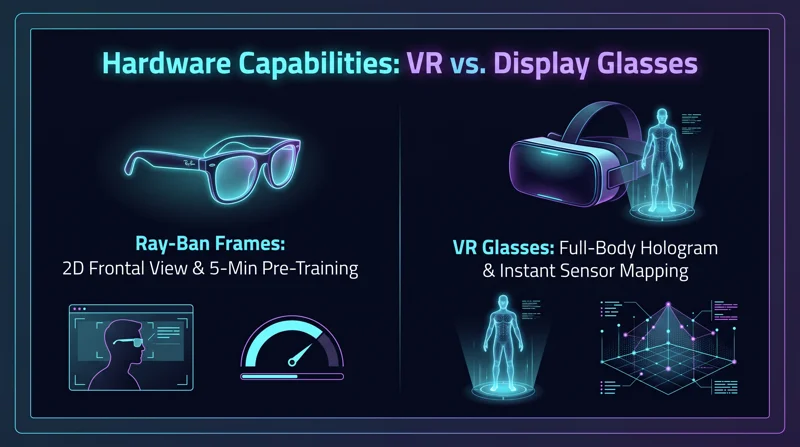
| Meta Ray-Ban Display frames | Meta AI app (Camera & Voice Prompts) | Approx. 5 Minutes |
| Meta Premium VR Glasses | Inward-facing advanced sensors | Instant / Real-time mapping |
Once finalized, this digital twin can be deployed on video calls via WhatsApp or Zoom while wearing the compatible glasses.
The entire operation is powered by the highly anticipated Muse Realtime Avatar model, operating seamlessly in the background.
This AI model uses the brief five-minute training period to accurately estimate and replicate your real-time facial expressions during a call.
“The avatars are powered by Meta’s new Muse Realtime Avatar model, and it uses that brief training period to approximate your actual facial expressions while you speak.”
Analyzing the VR Ecosystem in our meta holograph avatar for ai and vr glasses update hands on
Moving forward in the meta holograph avatar for ai and vr glasses update hands on, we tested the premium VR hardware integration.
Meta’s implementation strategy for these advanced headsets is significantly more ambitious than the lightweight display frames.
Because the VR headsets feature advanced inward-facing cameras, they can process micro-expressions dynamically as you speak.
This allows for the creation of immersive VR glasses full-body avatars that do not require any lengthy pre-training.
This hardware upgrade firmly positions Meta as a very strong Apple Vision Pro persona alternative for enterprise users.
Unlike competitors that look slightly alien or lack lower bodies entirely, Meta’s virtual holograms appear surprisingly grounded.
They generate a more authentic sense of shared presence, which will be crucial for the future of remote work meetings.
| Feature Specification | Meta VR Holograms | Competitor Personas |
|---|---|---|
| Body Rendering | Full-body visualization (frontal view) | Upper body and floating heads only |
| Realism Level | Highly natural, true-to-life mannerisms | Smooth, slightly uncanny appearance |
| Sensor Technology | Inward-facing cameras and biometric tracking | Similar external and internal sensor suites |
Conclusions from our meta holograph avatar for ai and vr glasses update hands on
As noted throughout this comprehensive meta holograph avatar for ai and vr glasses update hands on, there are still limitations.
The holograms are currently constrained to a 2D frontal view, meaning they aren’t fully 3D volumetric objects just yet.
There is also noticeable blurring around the outer edges of the avatar, and some visual distortion near the feet during movement.
Furthermore, cross-device hardware compatibility remains strictly restricted during this early software preview phase.
“Meta has said these avatars could help people feel more of a sense of presence when on a video call… a nice alternative when you’re not quite camera-ready.”
A user with Meta Ray-Ban frames cannot currently initiate an avatar call with a user wearing the heavier VR headset.
Despite these minor bugs, the underlying technology presented in this meta holograph avatar for ai and vr glasses update hands on is revolutionary.
To learn more about the broader corporate strategy behind spatial computing, you can read more from the official Meta Reality Labs division.
Expect these early access holograms to roll out to display glasses later this fall, transforming everyday video communication.
Frequently Asked Questions
What is the main focus of this meta holograph avatar for ai and vr glasses update hands on?
It explores Meta’s surprisingly realistic new holographic avatars, detailing the setup process, realism, and current hardware limitations across their latest smart glasses and VR devices.
How long does the Meta AI app avatar setup take?
For the display-enabled smart glasses, the setup process takes approximately 5 minutes, involving simple facial scans and vocal prompts via your smartphone.
Which AI engine powers these new digital likenesses?
The avatars are driven by the new Muse Realtime Avatar model, which uses your brief training data to accurately approximate your real-time facial expressions.
Are these avatars considered a good Apple Vision Pro persona alternative?
Yes, many early testers find Meta’s full-body VR avatars much more natural and less uncanny or alien-like compared to Apple’s current spatial personas.
Do the VR glasses full-body avatars require the same 5-minute pre-training setup?
No. Because the premium VR glasses possess advanced inward-facing cameras and sensors, they can read your expressions natively without needing a lengthy setup phase.
Can someone on a VR headset call someone on Ray-Ban Display glasses using these avatars?
Currently, no. Cross-device avatar calls are restricted; Ray-Ban users can only interact with other Ray-Ban users, and VR avatars are limited strictly to VR-to-VR interactions.
When will these new holographic avatars become available to the public?
The holographic avatars are officially scheduled to be available in an “early access” preview specifically for Meta Ray-Ban Display frames this coming fall.
Disclaimer: This article is for informational purposes only. Features, functionality, and release timelines are based on early previews and are subject to change by the manufacturer.