The shocking reality of humans reading copilot prompts images has recently come to light, fundamentally changing how users view their interactions with artificial intelligence. When you upload a personal photo to an AI generator, you likely expect that conversation to remain strictly between you and the machine.
However, recent leaks have exposed that this is far from the truth. A hidden workforce of human reviewers is actively monitoring, judging, and rating the content you submit to Microsoft’s popular AI assistant.
This exposure of Microsoft Copilot privacy practices reveals a massive operation where private requests are laid bare. These contractors are not just looking at text; they are analyzing intimate image edits requested by users worldwide.
The Shocking Scale of humans reading copilot prompts images
Internal documents from 2026 show that the phenomenon of humans reading copilot prompts images is widespread and highly organized. These reviewers work for third-party companies, engaging in Prolific AI training jobs to evaluate the AI’s performance.
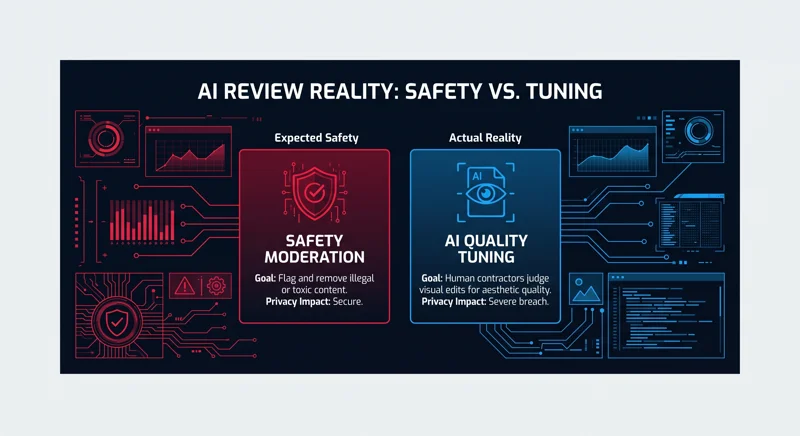
Instead of focusing on traditional AI chatbot image moderation to keep platforms safe, these workers are explicitly tasked with rating how well the AI followed a user’s instructions. This means they must visually inspect both the original user upload and the AI-generated edits.
Contractors are instructed to use their “gut reaction” to decide which generated image looks better. They are essentially scoring the AI on its ability to execute user commands, regardless of how disturbing those commands might be.
“We are not here to moderate safety; we are paid to judge if the AI correctly applied the user’s specific, and often inappropriate, image edits.”
Why are humans reading copilot prompts images for Tech Giants?
The core reason behind humans reading copilot prompts images involves Human contractors AI tuning. Artificial intelligence models require constant human feedback to understand nuanced visual edits, such as lighting, artifacts, and context preservation.
Unfortunately, this quest for perfectly tuned AI means Copilot user prompt data is sacrificed. Workers are inundated with requests to edit real photographs in highly inappropriate ways, forcing them to view content they never signed up for.
| Review Type | Primary Goal | Privacy Impact |
|---|---|---|
| Safety Moderation | Flag and remove illegal/toxic content | High (Data checked for policy breaches) |
| AI Tuning (Current) | Improve image generation quality | Severe (Private images scrutinized for aesthetics) |
Disturbing Content and humans reading copilot prompts images
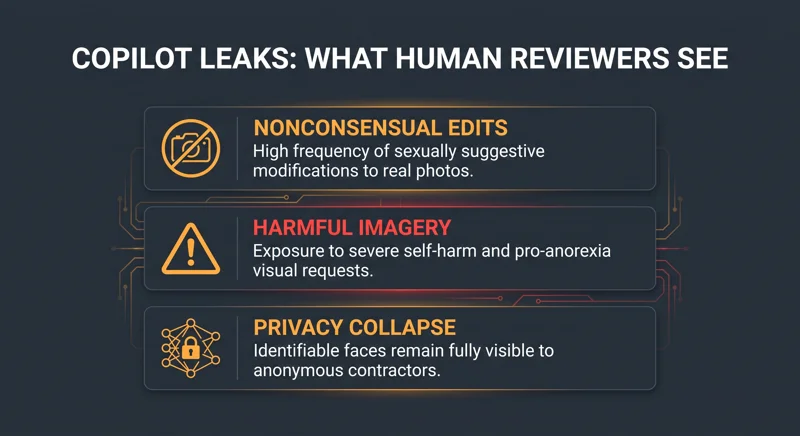
The ethical implications of humans reading copilot prompts images become horrifying when examining the actual content being reviewed. Contractors report being bombarded with sexually explicit edit requests.
Users frequently upload photos of real women, asking the AI to shorten their skirts, enlarge their chests, or place them in suggestive positions. Because the AI’s face filters are often bypassed, the identities of the subjects remain completely visible to the anonymous reviewers.
Furthermore, reviewers have been subjected to pro-anorexia content and disturbing imagery involving minors. They are exposed to these traumatizing visuals without warning, simply because they are part of the current task queue.
“It is hard to take this job seriously when my daily focus is deciding which model generated the most accurate sexually suggestive edit of a real person.”
Protecting Yourself from humans reading copilot prompts images
As the scandal surrounding humans reading copilot prompts images grows, users must reevaluate how they interact with generative AI. Any image uploaded to a cloud-based AI system should be treated as public data.
Microsoft maintains that it uses customer data to improve products, but for many, the lack of explicit, up-front transparency is a massive breach of trust. Reviewing the official Microsoft Privacy Statement is highly recommended for all users.
| Content Category Seen by Workers | Frequency Reported | Worker Reaction |
|---|---|---|
| Nonconsensual Sexual Edits | Very High | Disgust and discomfort |
| Self-Harm / Pro-Anorexia | Moderate to High | Shock and trauma |
| Inappropriate Character Edits | High | Confusion and ethical concern |
Until tech companies implement strict on-device processing or robust opt-out features for data review, the safest approach is to never upload sensitive, personal, or identifiable photographs to any AI chatbot.
Frequently Asked Questions
What exactly does humans reading copilot prompts images mean?
It refers to human contractors hired by tech companies who physically read the text prompts and look at the private images users upload to AI chatbots like Microsoft Copilot.
Why are humans reading copilot prompts images instead of AI?
Human intuition is currently required to judge the subtle visual quality and accuracy of AI-generated edits, helping to train the models to produce better future results.
Is this done for safety and moderation?
Surprisingly, no. Documents reveal these specific contractors are tasked with evaluating the quality of the AI’s output, not actively removing or flagging the content for safety violations.
What kind of disturbing content are contractors seeing?
Workers report seeing users upload photos of real people to create nonconsensual sexual edits, pro-anorexia imagery, and other highly inappropriate modifications.
Does Microsoft warn users about this process?
While privacy policies state that data may be used to improve services, most users are completely unaware that individual human reviewers are looking at their private uploads.
How can I stop humans from reviewing my AI prompts?
The only guaranteed way to prevent human review is to avoid uploading personal, sensitive, or identifiable photos to cloud-based generative AI platforms entirely.
Are other AI companies doing the same thing?
Yes, reports indicate that other major AI developers also use armies of human contractors to review real user prompts to tune and improve their respective models.
Disclaimer: This article is for informational purposes only. The information discussed is based on leaked documents and journalistic reports from 2026. Company policies and AI data handling practices are subject to change.