How to Make Your Phone Last Years Longer and Save Yourself a Fortune is a guiding principle that tech enthusiasts use to maximize the value of their expensive electronics. Today, this exact same philosophy must be applied to the modern television market. Finding a brand-new television that does not actively beg you to connect to the internet is an incredible challenge. Even if you manage to find one, there are incredibly compelling reasons to stick with a modern smart TV and utilize a reliable workaround instead. From the dawn of the era of smart TVs—displays integrated with web connectivity, built-in streaming apps, and complex user interfaces—there has been a significant demographic of buyers who wanted absolutely nothing to do with them.
Many consumers falsely assume that stripping away smart circuitry will instantly save them money at the checkout counter. Others simply hate the underlying idea of everything in their home requiring a persistent internet connection. Furthermore, privacy advocates know that if a display is connected to the web, it is highly likely collecting and selling personal viewing data to third-party data brokers. Whatever the specific reason, there has long been a deep desire for non-smart televisions. However, it is now 2026, and internet-connected displays completely dominate the market across all sizes and categories. While you might be reading guides on How to Make Your Phone Last Years Longer and Save Yourself a Fortune, applying this exact financial logic to televisions reveals a surprising truth: you are better off buying a smart TV.
Applying the Logic of How to Make Your Phone Last Years Longer and Save Yourself a Fortune to TVs
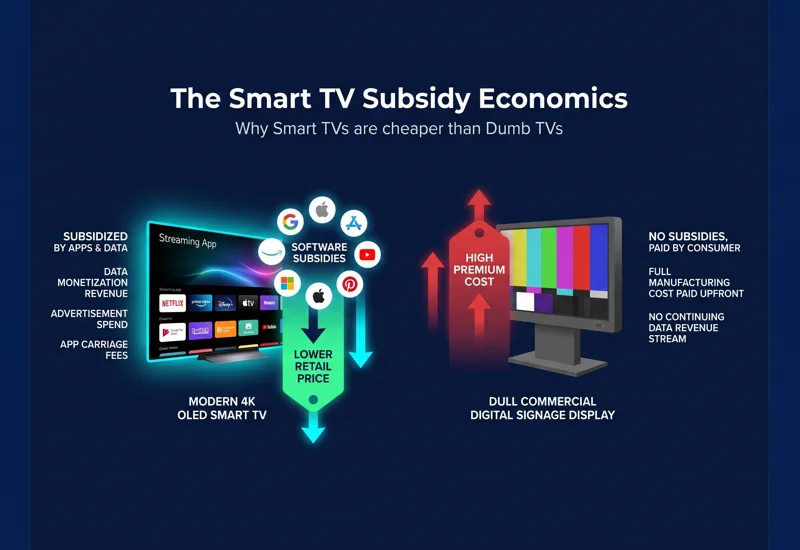
It is a massive misconception that removing software features will make a television cheaper to manufacture and purchase. In reality, the exact opposite is true. Major technology conglomerates and software giants actually pay television manufacturers substantial subsidies to integrate their proprietary streaming platforms and operating systems directly into the hardware. This creates a highly lucrative win-win scenario for the manufacturers. They no longer need to spend millions of dollars in research and development to build their own streaming ecosystems, and they can afford to sell their hardware at a drastically lower retail price.
It is very difficult to obtain specific internal financial numbers, but industry analysts strongly believe that for many inexpensive televisions, the manufacturer is only turning a profit because of that initial streaming software subsidy. When looking for budget smart TV alternatives, you will quickly realize that the hardware is heavily subsidized by your potential future data. Just like learning How to Make Your Phone Last Years Longer and Save Yourself a Fortune, understanding this economic model empowers you to make smarter purchasing decisions. You can buy the heavily subsidized hardware and simply choose not to participate in the data collection.
| TV Category | Hardware Subsidies | Retail Price Impact |
|---|---|---|
| Modern Smart TV | High (Google, Amazon, Roku) | Significantly Lowered MSRP |
| True Dumb TV | None | Higher base cost for consumers |
| Tech Longevity Strategy | How to Make Your Phone Last Years Longer and Save Yourself a Fortune | Maximizes overall hardware lifespan |
Why You Should Not Buy Non-Smart TV 2026 Options
If you are looking for a reasonably sized, name-brand television without any integrated smart features, you are unfortunately out of luck. The decision to buy non-smart TV 2026 models typically forces you into two highly compromised categories: tiny screens or completely unknown off-brand manufacturers. If you do not mind viewing your favorite movies on a display that is 40 inches or smaller, you technically have options. All of these options are extremely inexpensive, but absolutely none of them are going to provide particularly good image quality.
These so-called “nonsmart” displays are generally cheap LCD panels with minimal or entirely absent local dimming capabilities. The contrast ratios are poor, the color accuracy is abysmal, and the peak brightness is severely lacking. In larger sizes, your options dwindle even further. Some obscure brands found at massive retail chains offer basic monitors, but they are not noticeably cheaper than vastly superior performing options from brands like TCL or Hisense. If you want to know How to Make Your Phone Last Years Longer and Save Yourself a Fortune, you already know that buying cheap, low-quality tech is a terrible long-term investment. The same logic applies to televisions; buying a low-quality display just to avoid an internet connection is a massive waste of your hard-earned money.
Buying cheap, low-quality technology just to avoid a Wi-Fi setup screen is a massive mistake. Embrace the subsidized hardware, but control the connection.
Evaluating Commercial Display vs Smart TV
For those who absolutely refuse to purchase a standard consumer television, commercial displays are often touted as the holy grail. You can easily buy stripped-down displays intended specifically for commercial use, such as digital signage in restaurants, hospitality monitors in hotels, and airport terminal screens. These displays are relatively easy to find through specialized retailers or even through special order departments at major electronics stores. However, the commercial display vs smart TV debate is heavily skewed in favor of consumer models when it comes to home entertainment.
These commercial models are almost always significantly more expensive than comparable home models of the exact same size. For example, a basic 1080p commercial display with absolutely zero smart features will often cost just as much as a premium 4K OLED consumer television. While commercial displays are theoretically built to withstand 24/7 operation and last longer in harsh environments, most modern consumer televisions are incredibly reliable for standard home use. Integrating the philosophy of How to Make Your Phone Last Years Longer and Save Yourself a Fortune means buying the best quality hardware for the most reasonable price, which immediately rules out overpriced commercial monitors.
| Feature Set | Consumer Smart TV | Commercial Digital Signage |
|---|---|---|
| Picture Quality | 4K HDR, OLED, QLED technology | Often limited to basic 1080p LCD |
| Price to Value Ratio | Excellent due to software subsidies | Extremely poor for home cinema use |
| Longevity Principle | How to Make Your Phone Last Years Longer and Save Yourself a Fortune | Built for 24/7 harsh environment operation |
The Best Approach: How to Make Smart TV Dumb
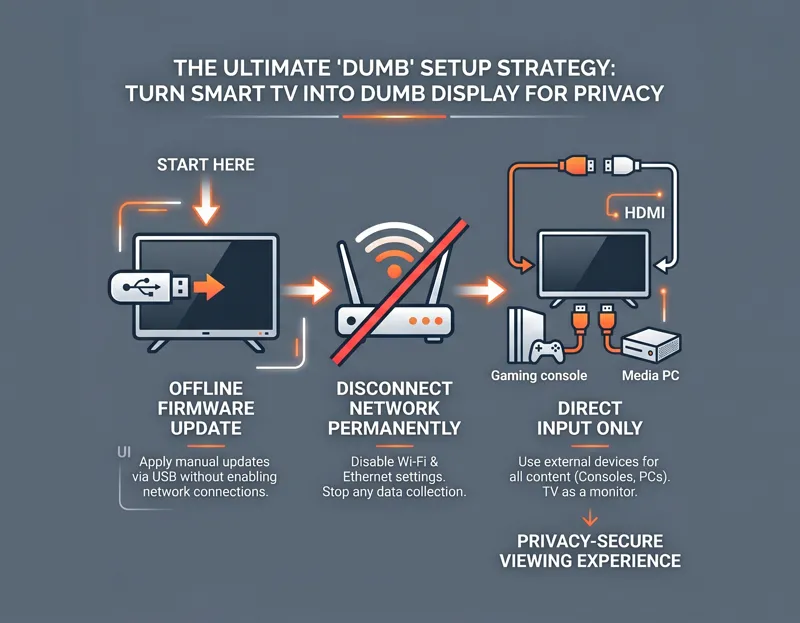
Since you are not actually saving any money by intentionally ditching smart features, perhaps your primary concern is simply that you do not want massive tech corporations harvesting and selling your personal viewing data. This is a completely fair and highly justified concern. To protect your digital privacy and still enjoy premium image quality, you need to learn how to make smart TV dumb. The most effective, foolproof method to accomplish this is brilliantly simple: do not connect the television to the internet.
While this sounds incredibly straightforward, the reality is slightly more nuanced. Modern televisions are aggressively designed to want an internet connection. During the initial setup process, the television might persistently hassle you, begging for a Wi-Fi password. It might continue to remind you that it is disconnected every single time you navigate through the core menus. However, standing your ground and refusing to input your network credentials transforms a highly advanced, heavily subsidized display into a beautifully dumb monitor. This relates perfectly to How to Make Your Phone Last Years Longer and Save Yourself a Fortune, where taking manual control over your technology settings prevents unwanted bloatware from ruining your experience.
Transforming a subsidized, high-end display into a basic monitor by simply denying it internet access is the ultimate consumer victory over aggressive corporate data harvesting.
The Secret of How to Make Your Phone Last Years Longer and Save Yourself a Fortune Applied to Updates
When you actively choose to disconnect smart TV from Wi-Fi networks, you do miss out on automatic firmware updates. Often, these digital updates provide necessary security patches and stability improvements. However, if your display is never connected to the web in the first place, its exposure to security vulnerabilities is practically non-existent. Furthermore, virtually all major television manufacturers allow you to download the latest firmware manually using a computer, transfer it to a standard USB flash drive, and update the television offline.
Some models will graciously allow you to select a “Basic TV” mode during the initial unboxing setup, which completely hides the streaming interface. If you are struggling with a persistent setup screen, it is generally recommended to connect to the internet exactly once. This allows the system to pull down the most recent factory firmware. The moment the update is completely installed, you must immediately forget the network settings and permanently disconnect smart TV from Wi-Fi. This ensures you have the best operating baseline without the continuous data drain. This strategy mirrors the lessons taught in How to Make Your Phone Last Years Longer and Save Yourself a Fortune regarding controlled software updates.
| Bypass Strategy | Action Required | Privacy Outcome |
|---|---|---|
| The “Basic TV” Mode | Select basic setup during unboxing | Disables streaming UI and tracking |
| The Update & Drop | Connect once, update, forget network | Optimal firmware with zero future tracking |
| The USB Method | How to Make Your Phone Last Years Longer and Save Yourself a Fortune applied to TV updates | 100% offline security maintenance |
Projectors: The Hidden Budget Smart TV Alternatives
If you absolutely refuse to deal with bypassing setup screens or worrying about hidden Wi-Fi connections, there is another fantastic alternative. You could completely abandon traditional flat panels and purchase a high-quality home theater projector. While many modern projectors do utilize the exact same smart interfaces as televisions, a massive portion of the projector market relies on external streaming dongles. You can simply choose to leave that dongle in the box.
By using a projector without its dedicated streaming stick, it functions as a 100% dumb display. You feed it a video signal via an HDMI cable from a Blu-ray player, a gaming console, or a dedicated, privacy-focused media PC, and it simply projects the image without any hidden data harvesting. For more comprehensive information regarding consumer data protection, you can review the guidelines provided by the Federal Trade Commission (FTC). Taking control of your hardware is the ultimate form of digital freedom.
Projectors offer a massive cinematic experience while inherently operating as traditional, non-intrusive dumb displays when you remove their external streaming sticks.
| Display Technology | Inherent Smart Features | Data Privacy Level |
|---|---|---|
| Standard LCD/OLED TV | Deeply integrated into the motherboard | Low (Unless manually disconnected) |
| Home Theater Projector | Often external via USB/HDMI dongle | High (Simply do not plug in the dongle) |
| Tech Longevity Guide | How to Make Your Phone Last Years Longer and Save Yourself a Fortune | Maximum control over hardware lifespan |
Frequently Asked Questions
Does the concept of How to Make Your Phone Last Years Longer and Save Yourself a Fortune actually apply to purchasing a television?
Absolutely. The fundamental principles of maximizing hardware longevity, avoiding low-quality generic tech, and controlling software updates to preserve performance are universal across all consumer electronics.
Why are smart TVs cheaper than non-smart commercial displays?
Tech giants like Google and Amazon subsidize the cost of manufacturing by paying TV brands to install their software. This lowers the retail price for consumers, while commercial displays lack these subsidies.
How exactly can I implement How to Make Your Phone Last Years Longer and Save Yourself a Fortune when setting up a new TV?
You can maximize the lifespan and performance of your new television by refusing to connect it to the internet, thereby preventing bloated background updates and constant data harvesting.
Is it difficult to disconnect smart TV from Wi-Fi?
Not at all. You can easily navigate to the network settings in your television’s main menu and select “Forget Network” to permanently sever the wireless internet connection.
What are the best budget smart TV alternatives if I want a dumb display?
The best alternative is actually to buy a heavily discounted, highly rated smart TV from a brand like Hisense or TCL, and simply use it as a dumb monitor by never giving it your Wi-Fi password.
Why shouldn’t I just buy a used non-smart TV from a local marketplace?
While it embodies the frugal spirit of How to Make Your Phone Last Years Longer and Save Yourself a Fortune, older used TVs suffer from backlight degradation, outdated HDMI ports, and potential OLED burn-in.
Can I still update my television’s firmware if I refuse to connect it to my home network?
Yes. The vast majority of television manufacturers provide official firmware files on their websites that you can download to a USB flash drive and install manually via the TV’s USB port.
Disclaimer: This article is for informational purposes only. Modifying television network settings or manually installing firmware should be done according to the manufacturer’s official guidelines.