To understand exactly how the developers behind lego batman legacy of the dark knight are building off of batman arkham to make the most ambitious lego game yet, we have to look back at the historical DNA of both legendary gaming franchises. For over a decade, TT Games has dominated the family-friendly action-adventure market, turning recognizable cinematic and comic book properties into charming, brick-smashing adventures. Meanwhile, Rocksteady Studios redefined the superhero genre entirely with the Batman: Arkham series, introducing a rhythmic, visceral “Freeflow” combat system and predator stealth mechanics that made players truly feel like the Caped Crusader. In 2026, these two vastly different worlds are colliding in a spectacular fashion.
The Arkham Influence in Co-Op: Fusing Bricks with Brutal Efficiency
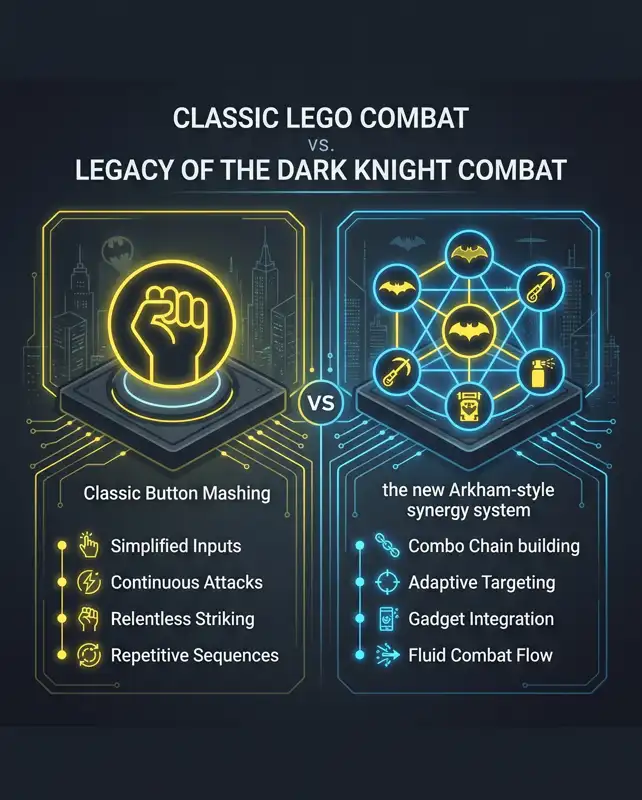
Historically, Lego game combat has been intentionally simplistic. Players would run into a room, mash a single attack button, and watch as enemies burst into a shower of plastic studs. It was accessible, harmless, and universally understood. However, as the gaming audience has matured, so too have their expectations. With Lego Batman: Legacy of the Dark Knight, TT Games recognized that Batman is the world’s greatest hand-to-hand fighter and a master tactician. To accurately represent this within a Lego framework, the developers had to reinvent their entire approach to action.
Drawing direct inspiration from their colleagues at Rocksteady, the developers have integrated a highly responsive, multi-directional combat system that rewards tactical awareness over mindless button mashing. This isn’t just a copy-paste job, however. The development team faced the monumental challenge of translating the fluidity of Arkham’s single-player brawling into an engine designed heavily around two-player cooperative experiences.
“We had to deliver an experience that matched Batman’s standard of skill and tactical awareness—a combination of stealth and use of gadgets surrounded by many enemies, all while making sure it worked flawlessly in co-op.”
The result is a system that demands communication and synergy. In Legacy of the Dark Knight, players can actively combine their unique character abilities to devastating effect. For instance, while one player controls Jim Gordon and utilizes a riot-suppression foam spray to lock a group of enemies in place, the second player controlling Batman can launch a concussive Batarang into the immobilized crowd, shattering the foam and sending the thugs flying across the arena. This level of mechanical depth completely redefines Lego co-op gameplay upgrades for the 2026 gaming landscape.
| Combat Feature | Classic Lego Games | Legacy of the Dark Knight (2026) |
|---|---|---|
| Attack Style | Single-button mashing | Multi-directional, rhythm-based strikes |
| Co-Op Synergy | Independent fighting | Combined gadget attacks and takedowns |
| Enemy Encounters | Basic swarms, easily defeated | Varied enemy types requiring specific tactics |
Integrating Stealth and Predator Tactics
Combat isn’t the only page taken from Rocksteady’s playbook. A core pillar of the Arkham experience is the predator encounter—stalking heavily armed thugs from the shadows, utilizing gargoyles, floor grates, and silent takedowns to thin the herd. Legacy of the Dark Knight introduces a simplified, yet highly effective, Lego variant of this stealth mechanics. Players must use the environment to their advantage, approaching enemies from unexpected directions to avoid taking massive damage.
This introduces a thrilling new dynamic to the traditional linear levels. Instead of simply pushing forward and fighting everything in sight, players must evaluate a room, utilize Batman’s detective vision to spot vulnerabilities, and coordinate stealth takedowns. It is a brilliant way to make players feel like the Dark Knight, utilizing shadows and gadgets to instill fear into the plastic hearts of Gotham’s criminal underworld.
A New Level of Challenge for Older Fans: Enter Dark Knight Mode
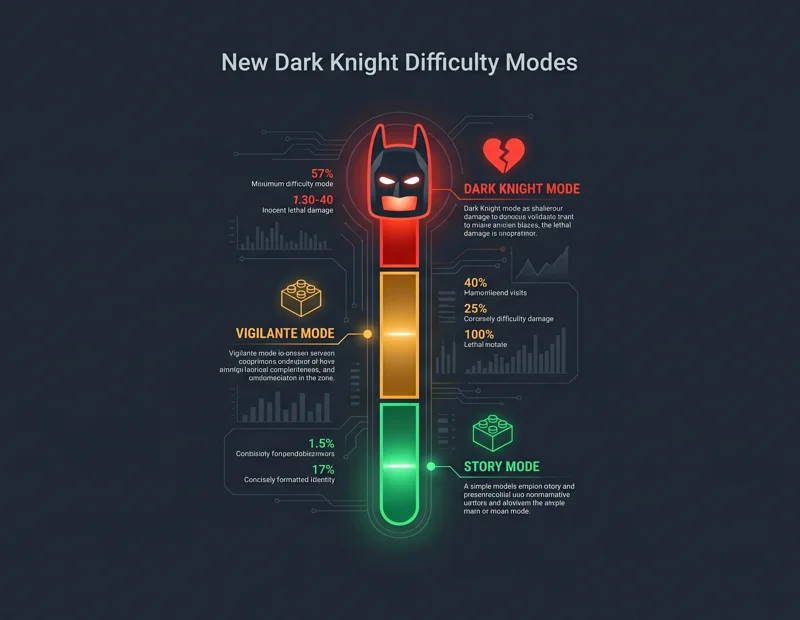
Perhaps the most shocking revelation from the recent TT Games developer interview is the introduction of dynamic difficulty scaling, specifically the grueling “Dark Knight” mode. For nearly two decades, the primary critique of the Lego franchise by older gamers has been the complete lack of challenge. Dying merely meant losing a few studs before instantly respawning with zero real consequences.
To cater to a broad audience that includes both young children and adult franchise veterans, the developers have introduced a rigid choice of difficulty settings. If you want a low-stress, forgiving experience where you can simply enjoy the story and the iconic Batman lore, the standard mode remains intact. Button prompts will guide you, enemies will be lenient, and you will undoubtedly feel like a superhero.
“If you dial it up to Dark Knight mode, you’ll really need to use your understanding of the systems, use stealth, and use your upgrades effectively. Because if you don’t, you won’t progress.”
However, if you crave a punishing, authentic Arkham-style challenge, Dark Knight mode fundamentally changes the rules of the game. In this hardcore difficulty tier, enemies deal massive damage, button prompts for counters vanish, and environmental hazards are lethal. You are forced to master the Rocksteady Arkham combat mechanics woven into the game. If you fail to utilize stealth to thin out the ranks, or if you ignore your tactical gadget combinations, your hearts will deplete rapidly, and you will be forcefully set back to previous checkpoints.
| Difficulty Setting | Target Audience | Mechanic Adjustments |
|---|---|---|
| Story Mode | Young players, casual fans | Forgiving damage, on-screen prompts, endless respawns |
| Vigilante Mode | Standard gamers | Balanced enemy AI, moderate gadget reliance |
| Dark Knight Mode | Hardcore veterans | No counter prompts, high damage, strict checkpoint setbacks |
The Emotional Core: Nostalgia Meets Innovation
Beyond the fists and Batarangs, TT Games is making a massive push for narrative emotional resonance. According to Strategic Director Jonathan Smith, the stories surrounding Bruce Wayne are powerful because of the emotional connection fans have with the iconography. The bat signal illuminating a cloudy Gotham sky, the swirling cape, and the heavily armored cowl—these elements evoke a specific feeling that the developers are leaning into heavily.
To support this, the game features a deep progression and character upgrade system, a first for the series on this scale. As you navigate the grim, brick-built streets of Gotham, you will gather resources to physically upgrade the Batcave, unlock new iterations of the Batsuit spanning decades of comic history, and modify your gadgets. This level of customization ensures that your version of Batman grows and adapts to the increasing threats posed by his legendary Rogues Gallery.
“The iconography that comes with the Batman mythology—the bat, the cowl, the bat signal—really hits home, leveraging the presence of characters and vehicles that fans already have a deep attachment to.”
The dedication to authenticity is what ultimately sells the experience. By respecting the source material and looking toward industry-defining titles for mechanical inspiration, TT Games is crafting a love letter to DC Comics fans. You can find more official updates regarding the game’s development and release schedules on the official Warner Bros. Games website.
Synergizing Gadgets for Maximum Destruction
The true genius of Lego Batman: Legacy of the Dark Knight lies in how it handles inventory management and crowd control. In older titles, gadgets were primarily used as specialized keys to unlock specific doors or solve environmental puzzles. A grapple gun pulled a specific orange hook; a bomb blew up a shiny silver barrier. While puzzle-solving remains a core component, gadgets have been fully weaponized for combat.
| Character Action 1 | Character Action 2 | Resulting Synergy Effect |
|---|---|---|
| Jim Gordon: Foam Spray | Batman: Concussive Batarang | Massive AoE (Area of Effect) crowd clearing |
| Robin: Staff Vault | Batman: Grapple Pull | Mid-air juggle combo for heavy damage |
| Batgirl: EMP Blast | Nightwing: Electrified Escrima Sticks | Stuns mechanical enemies and disables shields |
When playing on the Dark Knight difficulty settings, mastering these synergies is not optional—it is required for survival. The enemy AI is programmed to flank players, utilize ranged weaponry to interrupt combos, and employ heavy armor that cannot be pierced by standard strikes. You must use the environment, your teammate, and your utility belt in perfect harmony to secure victory.
A Promising Future for Lego Games
The pivot towards complex, rewarding gameplay systems marks a massive turning point for the Lego video game franchise. For years, critics argued that the formula had grown stale, relying too heavily on massive character rosters rather than meaningful gameplay innovation. Lego Batman: Legacy of the Dark Knight completely shatters that narrative.
By studying the successes of Rocksteady’s masterpiece and successfully porting those intricate mechanics into a family-friendly, cooperative environment, TT Games has created something entirely unprecedented. It respects the intelligence and skill of its adult audience while providing the necessary safety nets for younger players to still enjoy the ride. As 2026 unfolds, this title is positioned to not only be the definitive Lego superhero game but potentially one of the best action titles of the year.
Frequently Asked Questions
What makes Lego Batman: Legacy of the Dark Knight different from previous Lego games?
This new entry completely revamps the combat system, taking heavy inspiration from the Rocksteady Arkham games to introduce tactical, multi-directional brawling, stealth mechanics, and a deep character upgrade system.
How does the new co-op combat system work?
Co-op in this game relies on gadget synergy. Players must communicate to combine their characters’ unique abilities in real-time to execute devastating area-of-effect attacks and control large crowds of enemies.
What is the Dark Knight difficulty mode?
Dark Knight mode is a hardcore difficulty setting designed for veteran players. It removes counter prompts, increases enemy damage, and imposes severe penalties for dying, requiring players to master stealth and gadget combos to progress.
Are there still puzzle elements in the game?
Yes, classic Lego puzzle-solving remains a core component. However, the gadgets used to solve these puzzles are now seamlessly integrated into the combat system as offensive weapons.
Did Rocksteady Studios develop this game?
No, the game is developed by TT Games. However, TT Games explicitly studied and adapted the groundbreaking Freeflow combat and predator mechanics pioneered by Rocksteady in the Arkham series.
Can young children still enjoy this game?
Absolutely. The developers have included multiple difficulty settings. The standard story mode remains highly forgiving, featuring on-screen prompts and low-stress encounters perfect for younger audiences.
Is there a character customization or upgrade system?
Yes, for the first time on this scale, players can gather resources to upgrade the Batcave, enhance their utility belt gadgets, and unlock different suits that alter gameplay mechanics.
Disclaimer: This article is for informational purposes only. Game features, difficulty settings, and release details are based on preview sessions and developer interviews and may be subject to change prior to the official launch.