In this comprehensive Framework Laptop 13 Pro review Much better battery much worse price is the defining theme of 2026’s most anticipated modular PC release. The landscape of repairable technology has shifted dramatically, and Framework is at the bleeding edge of this transformation.

For years, enthusiasts have praised the original Framework Laptop 13 for its anti-obsolescence philosophy. It stood as a beacon of hope against glued-together, disposable electronics. However, the original design was plagued by one severe limitation: mediocre battery life.
Enter the Framework Laptop 13 Pro. This device represents the closest the company has ever come to a true, second-generation chassis revision. It brings massive improvements to daily usability.
But these upgrades come with severe financial compromises. By adopting bleeding-edge memory standards amidst global component shortages, the barrier to entry has skyrocketed. In our Framework Laptop 13 Pro review Much better battery much worse price becomes immediately apparent when you look at the $3,000 top-tier configuration.
Design Evolution in the Framework Laptop 13 Pro review Much better battery much worse price
The visual identity of the Framework Laptop 13 Pro takes a significant leap forward. It abandons the traditional, industrial silver for a sleek, anodized dark gray “Graphite” finish.
This new aesthetic rivals premium competitors. It sits perfectly on the spectrum of dark-finished aluminum, closely resembling Apple’s Midnight finish but lacking the bluish tint. Be warned, however, that it attracts fingerprints just as easily.
Framework proudly states that the Laptop 13 Pro is fully machined out of extruded blocks of 6063 aluminum. This manufacturing shift results in a chassis that feels significantly more rigid, solid, and substantial than its predecessors.
| Feature | Original Framework 13 | Framework Laptop 13 Pro |
|---|---|---|
| Chassis Material | Standard Aluminum | Extruded 6063 Aluminum |
| Color Finish | Industrial Silver | Graphite (Dark Gray) |
| Trackpad Mechanism | Physical Clickpad | Haptic Feedback Glass |
| Expansion Release | Push-and-hold buttons | On/Off retention switches |
This structural redesign was not merely for aesthetics. The redesigned bottom case is the foundational change that enabled the massive battery upgrade. It allowed engineers to squeeze a 74 WHr battery into a footprint that previously held a 61 WHr or 55 WHr cell.
The expansion module release mechanism has also been modernized. Gone are the days of holding down a stiff button while prying out a module. The Pro model utilizes the superior on/off retention switches first introduced in the larger Laptop 16.
Keyboard and Haptic Trackpad Innovations
While testing for this Framework Laptop 13 Pro review Much better battery much worse price quickly became apparent in the input devices. The keyboard maintains its excellent 1.5mm key travel, feeling exactly like the beloved original.
However, Framework now offers customizable keycap highlights in lavender or orange/gray, adding a touch of personality. The real revolution lies below the spacebar: the new haptic trackpad.
To maximize internal volume for the 74 WHr battery, the physical clicking mechanism had to be eliminated. Framework replaced it with a haptic motor that simulates a click via localized vibrations.
“The transition to a haptic trackpad is a masterstroke in internal spatial engineering, unlocking the epic battery life enthusiasts have begged for since day one.”
If you set the firmness to maximum, the illusion is highly convincing. It provides consistent feedback regardless of where your finger presses, solving the “diving board” effect common in older PC laptops.
A Display Worthy of a Pro Designation
The display panel receives a quiet but vital overhaul. It retains the perfect 13.5-inch size, the productivity-focused 3:2 aspect ratio, and the sharp 2,880 x 1,920 resolution. The variable refresh rate still dynamically scales from 30 Hz to 120 Hz.
But the Pro moniker brings touch support for the first time. Even if you despise fingerprints on your screen, the underlying panel improvements are undeniable.
It boasts a blazing 700-nit typical brightness, ensuring excellent outdoor visibility. The contrast ratio has been bumped to 1,800:1, and a superior anti-glare coating significantly reduces harsh reflections in office environments.
It is not an OLED panel, and it still lacks complete DCI-P3 color gamut coverage, which might disappoint professional colorists. Minor backlight bleed was also observed on dark screens, reminding us that IPS technology still has its limits.
Performance and Panther Lake Integration
At the heart of the Framework Laptop 13 Pro review Much better battery much worse price dynamic is the processor. The laptop is powered by Intel’s highly anticipated Core Ultra Series 3, codenamed Panther Lake.
These chips are a revelation, offering a generational leap in CPU efficiency, integrated Intel Arc GPU performance, and raw processing power. Our review unit featured the Core Ultra X7 358H, a chip that balances extreme capabilities with mobile thermal constraints.
Framework intelligently caps the sustained power limits at 30W in “Best Performance” mode and 25W in “Balanced” mode. This conservative tuning prevents thermal throttling and keeps fan noise manageable, though it means it won’t break synthetic benchmark records against thicker gaming laptops.
| Performance Metric | Core Ultra X7 358H (30W Limit) | Previous Gen Core i7 |
|---|---|---|
| Single-Core Speed | Exceptional | Good |
| Multi-Core Rendering | Highly Efficient | Thermally Constrained |
| Integrated GPU | Intel Arc (Full Enablement) | Intel Iris Xe |
| AI Processing (NPU) | Next-Gen Dedicated NPU | Basic NPU |
Where Panther Lake truly dominates is in efficiency. When combined with the massive new battery and low-power RAM, the laptop transforms into an endurance monster.
The Battery Life Revolution
When conducting our Framework Laptop 13 Pro review Much better battery much worse price becomes a literal translation of the user experience. The battery life is nothing short of extraordinary.
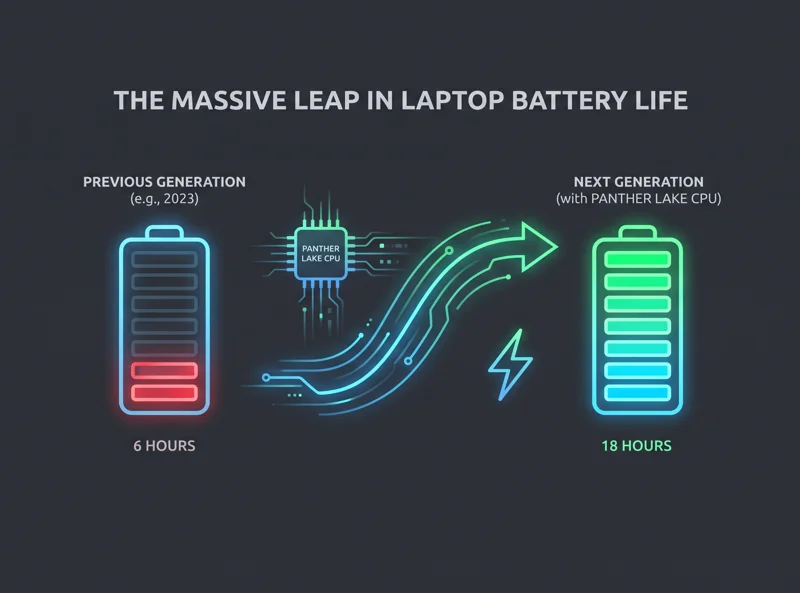
In the grueling PCMark 10 Modern Office benchmark, with the 120Hz display locked at 200 nits of brightness, the Laptop 13 Pro lasted over 18 hours. Let that sink in. Eighteen hours of continuous simulated productivity.
This decisively eliminates the biggest criticism of the original Framework 13. You can easily leave your charger at home for a two-day business trip.
| Hardware Configuration | Battery Capacity | Tested Runtime (PCMark 10) |
|---|---|---|
| Core Ultra Series 3 (Pro) | 74 WHr | 18 Hours, 5 Minutes |
| Core Ultra Series 3 (Pro Board only) | 61 WHr (Legacy) | 15 Hours, 45 Minutes |
| Ryzen AI 300 Board | 74 WHr (New) | 11 Hours, 10 Minutes |
| Original 11th Gen Intel | 55 WHr (Legacy) | ~6 Hours, 30 Minutes |
Even if you drop the new Core Ultra Series 3 motherboard into an older chassis with the 61 WHr battery, the efficiency of Panther Lake pushes the runtime to nearly 16 hours. The chip architecture is doing incredibly heavy lifting here.
The Agony of LPCAMM2 Memory
Now we must address the “much worse price” aspect of the Framework Laptop 13 Pro review Much better battery much worse price equation. The culprit is the memory.
To utilize the high-end Core Ultra Series 3 processors and their powerful integrated graphics, Framework had to switch to LPDDR5X memory. Standard DDR5 SO-DIMMs simply do not have the bandwidth or power efficiency required.
Framework, staying true to its core mission, refused to solder the memory to the motherboard. Instead, they adopted the bleeding-edge LPCAMM2 (Compression-Attached Memory Module) standard.
“LPCAMM2 is an engineering marvel that saves space and power, but in the 2026 tech economy, its price tag is absolutely devastating to the consumer.”
Unlike SO-DIMMs that slot in at an angle, LPCAMM2 modules are screwed flat against the motherboard over an interposer. A metal shield acts as both a heat spreader and electromagnetic interference (EMI) shield, which Framework claims dramatically improves Wi-Fi performance.
The problem is the global supply chain. Due to severe 2026 RAM shortages, LPCAMM2 modules are incredibly scarce. Framework’s suppliers doubled their wholesale costs, forcing massive price hikes onto the consumer.
| LPCAMM2 Capacity | Current 2026 Market Price | Impact on Base Laptop Price |
|---|---|---|
| 16GB LPCAMM2 | $239 | Pushes base model over $1,500 |
| 32GB LPCAMM2 | $800 | Creates extreme bottleneck for pros |
| 64GB LPCAMM2 | $1,600 | Makes workstation builds financially unviable |
A staggering $800 for 32GB of RAM is difficult to swallow. It makes the Framework Laptop 13 Pro review Much better battery much worse price reality a bitter pill for loyal fans who expect accessible repairability.
Upgrading Your Legacy Framework Laptop
Despite the high costs, Framework’s commitment to the Right to Repair movement remains intact. You do not need to buy a whole new laptop to get these features.
However, the upgrades have strict dependencies. You cannot simply drop the new 74 WHr battery into a 2022 chassis. The larger battery requires the new machined bottom case, which in turn requires the new haptic input cover to fit correctly.
Think of it as the “Chassis Upgrade Trio.” If you want the physical battery, you must buy all three parts.
| Component Upgrade | Cost | Dependencies / Requirements |
|---|---|---|
| 74 WHr Battery | $89 | Requires Pro Bottom Case + Pro Input Cover |
| Pro Input Cover Kit | $179 | Requires 74 WHr Battery + Pro Bottom Case |
| Pro Bottom Case | $169 | Requires 74 WHr Battery + Pro Input Cover |
| Touchscreen Display Kit | $299 | Fully backwards compatible |
| Panther Lake Board | $449 – $899 | Requires new LPCAMM2 RAM module |
Conversely, the motherboards, displays, and USB-C expansion cards remain universally interchangeable. If you just want the massive efficiency gains of the Panther Lake board, you can install it in your old chassis with your old battery—provided you buy the expensive LPCAMM2 RAM.
The Ultimate Machine for Linux Developers
Framework aggressively markets the Laptop 13 Pro as the “MacBook Pro for Linux users.” This isn’t just marketing fluff. The hardware compatibility out of the box is phenomenal.
Ubuntu 24.04 LTS is available as a pre-installed option. Fedora 44 and Ubuntu 26.04 LTS are officially supported with full driver optimization. Community distros like Arch, Bazzite, and NixOS run beautifully, provided you use Linux kernel 6.19 or higher to ensure the Panther Lake architecture is recognized.
BIOS updates are effortlessly delivered through LVFS, eliminating the need to dual-boot Windows just to keep your system firmware secure. It is a seamless, professional-grade Linux experience.
Final Verdict: The Framework Laptop 13 Pro review Much better battery much worse price
Reaching the conclusion of our Framework Laptop 13 Pro review Much better battery much worse price remains the unavoidable takeaway. Framework has built a masterpiece of modular engineering.
“It trades one set of problems (battery anxiety) for another (financial anxiety). It is the right refresh, sadly released at the wrong time in global supply chain history.”
The build quality is vastly improved, the haptic trackpad feels futuristic, and the 18-hour battery life is life-changing for road warriors. It is the most polished product the company has ever released.
Yet, the exorbitant cost of LPCAMM2 memory makes recommending a brand-new, fully built system very difficult for casual buyers. If you are an existing owner, carefully cherry-picking motherboard upgrades might be the most financially sound path forward.
For those who value right-to-repair above all else and have deep pockets, the Framework Laptop 13 Pro is a triumphant, uncompromising machine that proves sustainable tech can rival the industry’s closed-ecosystem giants.
Frequently Asked Questions

Can I put the new 74 WHr battery in my older Framework Laptop 13?
Not by itself. The 74 WHr battery is physically larger and requires the new Pro bottom case and the new Pro input cover (haptic trackpad) to fit correctly. You must upgrade all three parts together.
Why is the Framework Laptop 13 Pro so expensive compared to last year?
The primary reason is the shift to LPCAMM2 memory. Severe global component shortages in 2026 have caused the price of this specific, bleeding-edge RAM format to skyrocket, sometimes costing up to $800 for a 32GB module.
Does the Framework Laptop 13 Pro review Much better battery much worse price claim hold true for all configurations?
Yes. The battery life improvement is universal across the Pro lineup due to the highly efficient Core Ultra Series 3 chips and LPDDR5X RAM, but the high baseline cost of the LPCAMM2 memory affects every configuration.
Can I reuse my old DDR4 or DDR5 SO-DIMM RAM in the new Laptop 13 Pro?
No. The new Core Ultra Series 3 motherboards strictly require LPCAMM2 format memory. There are no slots for traditional SO-DIMM sticks on the new Panther Lake boards.
Is the new haptic trackpad a downgrade from a physical clickpad?
Most users find it to be an upgrade. It provides a consistent clicking sensation across the entire surface of the pad and eliminates the “diving board” hinge effect of older physical trackpads.
How good is Linux support on the new Framework Laptop 13 Pro?
It is exceptional. Framework officially supports Ubuntu and Fedora, with BIOS updates delivered seamlessly via LVFS. It is highly optimized for developers requiring a robust Linux environment.
Will the price of LPCAMM2 memory ever go down?
Historically, memory prices fluctuate based on global supply chains. As LPCAMM2 becomes more widely adopted by other manufacturers like Dell and Lenovo, production volume should increase, eventually driving prices down from their 2026 highs.
Disclaimer: This article is for informational purposes only. Hardware prices, stock availability, and component compatibility are subject to change based on the manufacturer’s supply chain and official updates. Always verify specifications on the official Framework website before making a purchase.