The ford apple software self driving partnership marks a monumental shift in automotive technology in 2026, bringing Apple software directly into the core navigation and autonomous driving systems of Ford’s next-generation electric vehicles.
In an industry first, Ford Motor has announced that driver-assistance systems in its upcoming line of electric vehicles will rely on embedded Apple Maps software to navigate highways, on-ramps, and interchanges hands-free.
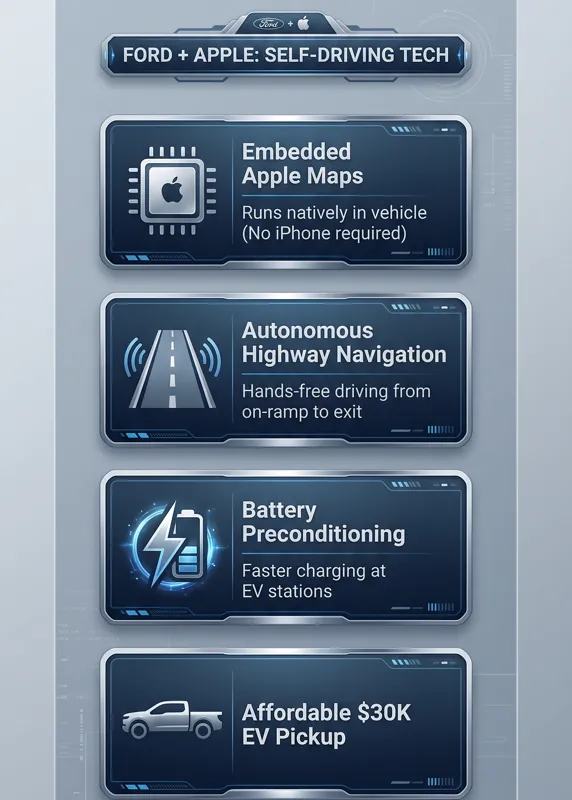
Unlike standard Apple CarPlay setups that mirror a smartphone screen, this deep integration allows Apple software to run natively within the vehicle without requiring an active iPhone connection.
How the Ford Apple Software Self Driving Partnership Works
The ford apple software self driving initiative blends Ford’s vehicle control hardware with Apple’s mapping algorithms. Ford engineers manage steering, braking, and throttle controls, while Apple Maps handles spatial location tracking and route guidance.
This collaboration debuts next year in a new affordable electric pickup truck priced around $30,000, developed under the leadership of former Tesla executive Alan Clarke.
By embedding Apple Maps natively into the vehicle’s operating framework, Ford lowers internal software development costs while offering advanced hands-free highway driving capabilities.
“Apple Maps will be embedded in the vehicle, so you don’t have to pay anything extra. This is one of the most important announcements for Ford.” — Jim Farley, Chief Executive of Ford Motor
| System Feature | Integration Details |
|---|---|
| Software Host | Embedded directly into vehicle hardware (No iPhone required) |
| Navigation Function | Manages highway interchanges, on-ramps, and off-ramps |
| Battery Preconditioning | Adjusts EV battery temperature automatically when routing to chargers |
| Debut Model | Next-gen $30,000 Ford electric pickup truck |
Ford Apple Software Self Driving Strategy vs Rivals Like Tesla and GM
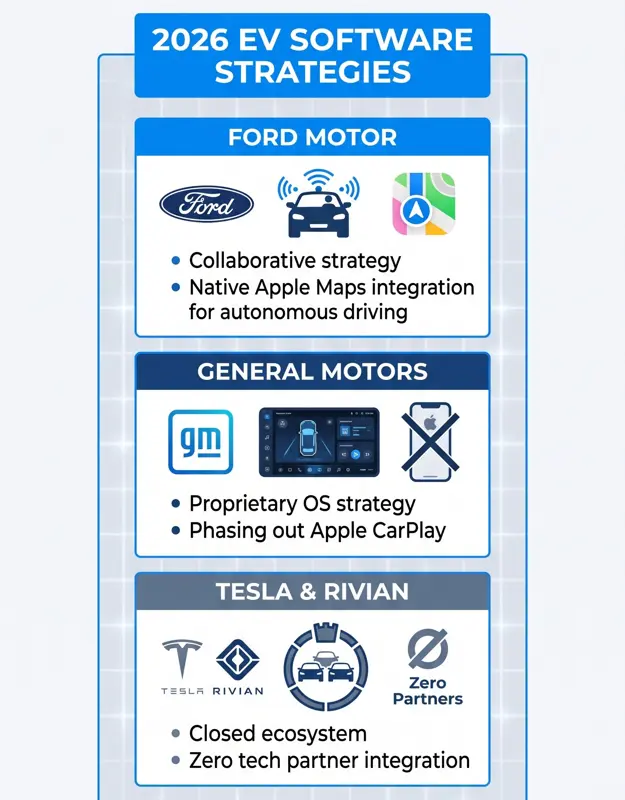
The adoption of ford apple software self driving architecture sets Ford apart from major automotive competitors who are choosing to build closed software ecosystems.
EV automakers such as Tesla and Rivian have famously blocked Apple CarPlay and Android Auto, forcing customers to use in-house software platforms.
Similarly, General Motors announced plans to phase out Apple CarPlay in favor of its proprietary software, attempting to retain exclusive control over user data and digital subscription revenue.
Ford’s collaborative strategy acknowledges the immense development hurdles traditional automakers face when building complex software from scratch, particularly against tech-savvy Chinese competitors like Xiaomi and Geely.
| Automaker | Software Strategy | Apple Integration Status |
|---|---|---|
| Ford Motor | Hybrid collaborative model | Deep native embedding of Apple Maps for autonomous navigation |
| General Motors (GM) | In-house proprietary OS | Phasing out CarPlay in favor of GM software |
| Tesla & Rivian | Closed vertical integration | Zero native integration with Apple or Google interfaces |
The Future of Ford Apple Software Self Driving Innovations
This partnership also brings practical performance improvements to existing vehicles. For instance, recent software updates to the Mustang Mach-E allow Apple Maps to trigger battery preconditioning when navigating to fast-charging stations, dramatically reducing charge times.
With Apple having shelved its secret autonomous car project, providing software infrastructure to legacy automakers offers a strategic pathway into the automotive sector.
“This is the beginning. We have a lot of plans for our Maps over the coming years, and we’re excited to be working with Ford engineers.” — Eddy Cue, Apple Senior Vice President of Services
Check for live press updates and vehicle specifications directly on the official Ford website as release dates approach.
FA