If you are looking up the area code 485, you are likely trying to figure out who just called your phone. The immediate and most important fact you need to know is that this area code is completely unassigned in the North American Numbering Plan (NANP). It does not belong to any city, state, or province in the United States, Canada, or the Caribbean.
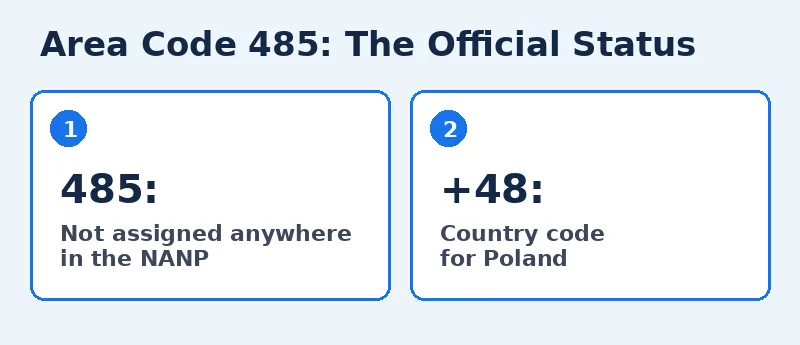
Quick answer (verified November 25, 2026): 485 has no location and no assigned use in the North American Numbering Plan. It does not appear in NANPA’s official list of geographic area codes in service (439 codes at the time of our check) or in NANPA’s planned area code report, and the NANP’s non-geographic codes are assigned only from dedicated ranges (5YY, 6YY, 600, 700 and 8YY) that do not include 485. A call displaying a 485 area code is either a spoofed (fake) caller ID or a misformatted international number – Poland’s country code is +48, so a Polish number can display as starting “48 5”.
People usually look up the 485 area code after seeing it on an incoming call or text. Because 485 is not assigned anywhere in the NANP, a domestic call displaying it cannot be coming from a real 485 location – and that makes understanding the spoofing and international-dialing explanations below worth a few minutes.
In this comprehensive guide, we will explain everything you need to know about this mysterious three-digit sequence. We will cover the reality of the 485 area code usa status, decode the confusion surrounding international dialing, and provide actionable tips to protect your personal information.
Is There a 485 Area Code Location in the US?
To put it simply, there is no official 485 area code location. The telecommunications infrastructure in North America is strictly managed to ensure numbers are distributed logically and efficiently.
Currently, no phone carrier can assign a 485 phone number to a customer: the code appears in no official in-service, planned, or non-geographic record.
Therefore, if you receive a domestic call displaying this prefix, the displayed caller ID has been manipulated: no genuine phone number starts with a 485 area code.
“Because the 485 code is absent from every official assignment record, any domestic call displaying this prefix is showing a falsified caller ID rather than a real 485 number.”
Current official status (checked November 25, 2026)
We re-checked the official records on November 25, 2026. NANPA (the North American Numbering Plan Administrator) publishes the authoritative list of geographic area codes in service – 439 codes at the time of our check – plus a separate report of planned area codes not yet in service. 485 appears in neither. The NANP’s non-geographic area codes are drawn only from dedicated ranges (5YY and 6YY personal-communication codes, 600 Canadian non-geographic, 700 carrier-internal, and 8YY toll-free, per the NANP dialing plan), and 485 is not in any of them. In short: no carrier can assign a real 485 phone number today, and any inbound call showing 485 as the area code did not come from a genuine 485 location.
Understanding the International Confusion: The +485 Country Code
A significant portion of the confusion regarding the area 485 originates from international dialing codes. Many smartphone screens will display an incoming international call with a plus sign, leading people to search for the +485 country code.
If you see a number starting with +485, you are not looking at a single country code. Instead, you are looking at a combination of a country code and a localized routing number.
+485 Which Country Does It Belong To?
When users search for +485 which country or ask about the +485 which country code, they are actually dealing with the country code for Poland, which is +48. The following digit, the “5”, is simply the beginning of the local Polish phone number or a specific cellular network indicator.
So, there is no standalone 485 country code. If you are trying to identify a 485 which country code origin, break the number down: if the displayed number is genuine, it originates from Poland (+48), and the rest of the digits indicate the specific region or mobile provider there. Keep in mind that caller ID can be falsified for international-looking numbers too, so an unexpected +48 call deserves the same caution as any unknown call.
On small screens, swipe the table sideways to see all columns.
| Dialing Prefix | Classification | Origin / Meaning |
|---|---|---|
| 485 (Domestic) | NANP Area Code | Unassigned / Invalid in North America |
| +48 | International Country Code | Poland |
| +485 (International) | Country Code + Local Prefix | If genuine, a local or mobile number in Poland |
Answering Global Queries: Area 485 De Donde Es?
Because spam calls cross global borders, people from all linguistic backgrounds search for this number. A very common query among Spanish speakers is area 485 de donde es. The answer remains exactly the same: “No es de ningún lado en los Estados Unidos.” It translates to the fact that it is an unassigned prefix in the US.
Whether you search for the +485 area code in English or Spanish, the answer is the same: a domestic call displaying 485 has a falsified caller ID, while a genuine number beginning +48 5 belongs to Poland.
Why Am I Getting Calls From a 485 Phone Number?
If the 485 area code does not exist in the United States, you might be wondering how your phone is ringing with that exact sequence on the screen. The answer lies in a malicious practice known as Caller ID Spoofing.
Modern telecommunications technology, specifically Voice over Internet Protocol (VoIP), allows callers to transmit falsified caller ID information to your phone carrier. An unassigned code like 485 can be typed into that software just as easily as a real one.
Why Scammers Might Pick an Unassigned Code
An unfamiliar or obviously invalid code can still prompt people to answer out of curiosity. Whatever the reason a falsified 485 number was used, the practical takeaway is the same: treat it as an unknown, untrusted caller.
Answering calls from unknown numbers can confirm to an automated dialing system that your line is active, which can lead to more unwanted calls.
On small screens, swipe the table sideways to see all columns.
| Call Behavior | Likely Intent | Recommended Action |
|---|---|---|
| Call drops immediately upon answering | Robocaller verifying an active line | Block the number immediately |
| Automated voice offering a “free” prize | Phishing for personal data | Hang up and do not press any buttons |
| Incoming text with a malicious link | Smishing (SMS Phishing) malware attempt | Delete the text and report as spam |
How Official Area Codes Are Created and Assigned
To understand why the area code 485 location is currently empty, it helps to understand how the system works. The numbering plan in North America is a finite resource. As cities grow and more devices require cellular connections, existing area codes run out of available seven-digit combinations.
When number exhaustion occurs, authorities must step in and introduce a new prefix. They typically do this through two primary methods:
1. The Overlay Plan
An overlay happens when a new area code is added to the exact same geographical boundary as an existing one. For example, if a city uses code 123, a new code, 456, will be assigned to that same city. This requires all residents to dial the full ten-digit phone number for local calls.
2. The Geographic Split
A geographic split physically divides an existing region into two parts. One half gets to keep the old area code, while the other half is assigned a brand new one. This method is becoming less common because it forces thousands of businesses to change their printed phone numbers and marketing materials.
If telecommunications planners ever need a new prefix for an overlay or a split, an unassigned code like 485 could be considered. Until NANPA publishes it in a planned or in-service report, it remains an invalid sequence for calls.
“The careful management of telephone numbering resources ensures that we do not run out of unique phone numbers, keeping unassigned prefixes like 485 available for possible future assignment.”
How to Protect Yourself from 485 Scams
Now that you know the truth about the +485 country confusion and the fake domestic numbers, you must take steps to protect your device. Scammers are relentless, but you can block them effectively.
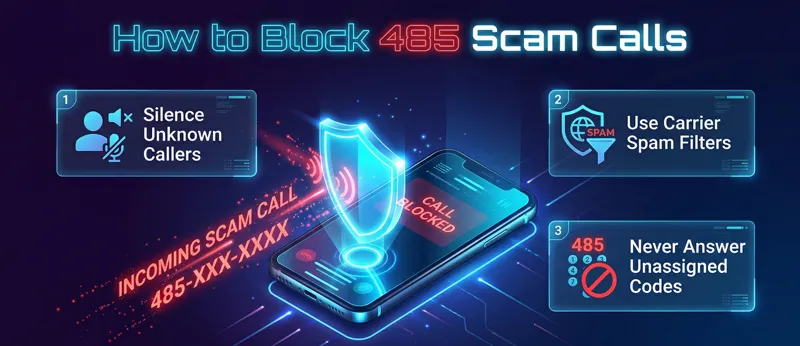
First, never answer a call from a number you do not recognize, especially if it uses the +485 code and you have no personal or business connections in Poland. If it is a legitimate emergency, the caller will leave a voicemail.
Second, utilize the built-in blocking features on your iOS or Android device. You can choose to automatically silence unknown callers. Additionally, contact your mobile carrier to see if they offer network-level spam blocking applications.
For more official information on how numbering plans are administered and to verify the status of any area code, you can visit the official website of the North American Numbering Plan Administrator.
On small screens, swipe the table sideways to see all columns.
| Protection Method | How It Works | Effectiveness |
|---|---|---|
| Built-in Smartphone Silencing | Sends unknown numbers directly to voicemail without ringing. | High (for preventing interruptions) |
| Carrier Spam Filters (e.g., Scam Shield) | Identifies known spoofed numbers and blocks them at the network level. | Very High |
| Third-Party Call Blockers (e.g., RoboKiller) | Uses community databases to flag and block the 485 phone code. | Moderate to High |
Reporting scam calls: you can report unwanted or scam calls to the FTC at reportfraud.ftc.gov, and most carriers (including Verizon, AT&T and T-Mobile) offer free spam-call filtering tools in their apps.
Frequently Asked Questions (FAQ)
Where is the 485 area code location?
There is no official 485 area code location. The prefix is unassigned and is not used in the United States, Canada, or any North American territory.
What is the +485 country code?
There is no specific +485 country code. The country code +48 belongs to Poland, and the number 5 indicates the beginning of the local or mobile number in that country.
Why did a 485 phone number call me?
If the call appears as a standard US number (e.g., 485-XXX-XXXX), the displayed caller ID is falsified: the call cannot be coming from a real 485 number, because that code is not assigned to anyone.
Can I call back a 485 number?
It is highly discouraged. If it is a spoofed domestic number, the call will fail to connect. If it is an international number from Poland, you may be charged expensive long-distance dialing fees.
Area 485 de donde es?
El código de área 485 no pertenece a ninguna ciudad o estado en los Estados Unidos. Es un código no asignado. Si recibe una llamada con este número, probablemente sea una estafa telefónica (spoofing).
How can I stop receiving calls from the 485 prefix?
The best method is to enable the “Silence Unknown Callers” feature on your smartphone and register your personal number on the National Do Not Call Registry.
Will the 485 area code usa ever become active?
It is possible, but nothing is scheduled: 485 is not in NANPA’s planned-codes report, so no activation has been announced. If it is ever assigned, it would appear in NANPA’s official reports first.
Disclaimer: This article is for informational purposes only. Telecommunications data, including area codes and country codes, is subject to change by administrative authorities. Always exercise caution when answering calls from unknown numbers to protect yourself from fraud.
Sources
- NANPA – Geographic NPAs In Service (official in-service area code list) (checked November 25, 2026)
- NANPA – Planned NPAs Not Yet in Service (official planned area code report) (checked November 25, 2026)
- Canadian Numbering and Dialling Plan (CSCN/CRTC) – NANP non-geographic code ranges (5YY/6YY/600/700/8YY) (v9.0, checked November 25, 2026)
- FTC – Report Fraud (report scam calls)