Recent supply chain leaks confirm that apple working on new lighter vision pro version is officially underway, signaling a major strategic evolution for spatial computing in 2026. After years of consumer feedback regarding facial fatigue and front-heavy chassis weight, Cupertino is actively reinventing its flagship headset.
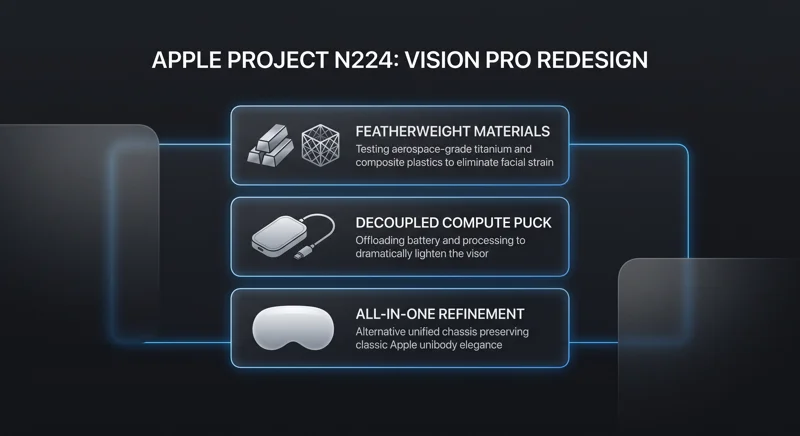
Following the quiet shelving of the previously rumored entry-level Vision Air (codenamed N100), attention has pivoted entirely toward a new internal initiative codenamed Project N224. Rather than serving as an underpowered budget tier, this project aims to preserve the flagship tier while drastically dropping overall bulk.
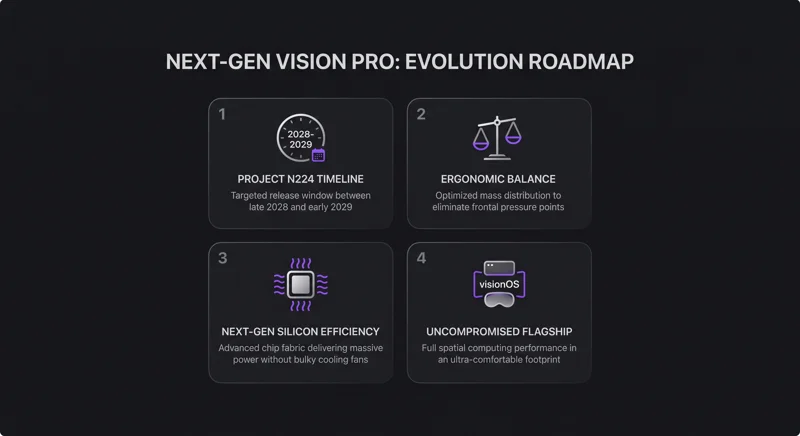
With Bloomberg reports highlighting an anticipated Project N224 release date between late 2028 and early 2029, development is accelerating rapidly behind closed doors. Engineers are exploring multiple industrial prototypes to determine the optimal physical balance for extended daily use.
Behind Closed Doors: Apple Working on New Lighter Vision Pro Version
The primary driver behind apple working on new lighter vision pro version stems directly from user ergonomics. Despite universal acclaim for high-resolution micro-OLED displays and unmatched eye-tracking, prolonged wearability remains the platform’s greatest hurdle.
Project N224 is fundamentally positioned as a direct Apple Vision Pro successor to the current M5 model. While early prototypes retain the signature curved glass aesthetic, testing laboratories are experimenting with advanced composite plastics, aerospace-grade titanium, and specialized alloys to strip away excess grams.
“Re-engineering the chassis around featherweight titanium and composite materials is central to eliminating the front-heavy pressure point.”
By overhauling the external frame, industrial designers hope to preserve premium build quality while matching the comfort standards set by lightweight spatial eyewear. This transformation represents the most substantial visionOS headset redesign since the platform’s initial unveiling.
| Development Project | Codename | Primary Focus | Current Status |
|---|---|---|---|
| Vision Air (Budget) | N100 | Low-cost entry-level spatial display | Shelved / Cancelled |
| Vision Pro Next-Gen | N224 | Flagship power with radical weight reduction | Active Development |
Exploring Project N224: Apple Working on New Lighter Vision Pro Version
Internal reporting reveals that apple working on new lighter vision pro version currently encompasses four distinct concept designs. Each iteration addresses internal thermal dissipation and component distribution from a different angle.
One of the most audacious concepts mirrors the approach seen on a recent Meta VR glasses competitor. In this experimental framework, both the heavy battery array and core computational hardware are decoupled from the visor and relocated into a pocket-sized processing unit.
By transitioning to an Apple external compute puck, the headset itself retains only essential sensors, micro-OLED panels, and cooling loops. This configuration yields a dramatic reduction in face-borne mass, shifting thermal energy away from the user’s forehead.
“Decoupling the thermal processor into a tethered unit could finally unlock true all-day wearable spatial computing.”
However, this direction faces intense internal deliberation. Key product executives reportedly favor retaining a unified, all-in-one housing, fearing a multi-piece setup compromises consumer elegance and portability.
| Hardware Element | Current Vision Pro (M5) | Project N224 Prototype (Testing) |
|---|---|---|
| Processing Architecture | Internal M-series with active fans | Next-gen A-series or external puck |
| Chassis Enclosure | Laminated glass and aluminum | Titanium frame with lightweight composites |
| Weight Distribution | Primarily frontal load | Optimized counterbalance ergonomics |
Silicon Evolution: Apple Working on New Lighter Vision Pro Version
Silicon roadmaps provide crucial clues regarding how apple working on new lighter vision pro version can succeed without performance regressions. Current prototypes benefit immensely from advancing chip lithography.
With processors like the upcoming A20 Pro achieving staggering efficiency per watt, next-generation mobile silicon may soon outpace earlier M-series chips while remaining passively cooled. This efficiency leap is vital for shrinking internal heatsinks and fan assemblies.
For official product portfolios and enterprise documentation, visit the Apple Vision Pro official page to explore current spatial computing hardware.
As spatial audio, EyeSight, and gesture navigation continue to mature within visionOS, apple working on new lighter vision pro version represents the definitive path toward mainstream adoption. Resolving physical wearability remains the final frontier.
Frequently Asked Questions
Why is apple working on new lighter vision pro version instead of the Vision Air?
Apple shelved the low-cost N100 Vision Air to prioritize Project N224, focusing on delivering a lighter, more comfortable headset while preserving flagship performance.
What is the expected Project N224 release date?
Industry reports from Bloomberg suggest that Project N224 is slated for release between late 2028 and early 2029.
How does apple working on new lighter vision pro version reduce headset weight?
Engineers are testing titanium frames, lightweight plastic composites, and potentially offloading the main computing chip into an external tethered puck.
What are the four concept designs currently in testing?
Prototypes range from an egg-shaped all-in-one visor constructed with composite metals to modular glass designs utilizing an external compute puck similar to smart glasses.
Will the new version feature an external compute puck?
It is currently one of the primary prototypes being evaluated, although some executives continue to advocate for a streamlined, all-in-one form factor.
Which processors will likely power the next spatial headset?
Future models may leverage advanced A-series silicon, such as the A20 Pro, offering superior thermal efficiency and performance exceeding earlier M-series chips.
How does this development impact the visionOS headset redesign?
A lighter chassis and optimized sensor array allow visionOS to become far more practical for prolonged workplace collaboration and cinematic entertainment.
Disclaimer: This article is for informational purposes only. Information regarding unreleased hardware, codenames, and launch timelines is based on early industry leaks and supply-chain reports, which remain subject to revision prior to official commercial release.