12 Reasons to Wait for the iPhone 18 Pro are finally becoming crystal clear as we edge closer to Apple’s highly anticipated September 2026 launch window. If you are currently debating whether to upgrade your smartphone today, you might want to hold onto your cash.
While the current generation of premium smartphones is impressive, the upcoming cycle promises massive leaps in processing power, display technology, and mobile photography. Industry insiders are already buzzing about a major shift in Apple’s release cycle, adopting a unique two-phase rollout starting this year.
From the revolutionary Apple A20 Pro chip 2nm to advanced camera hardware, the next iteration is shaping up to be a true powerhouse. Let us dive into the ultimate breakdown of why patience will pay off.
Design and Display: 12 Reasons to Wait for the iPhone 18 Pro
The visual and structural changes coming to the new lineup are subtle but deeply impactful. While the overall footprint remains familiar, Apple is refining the details to perfection.
One of the most notable 12 Reasons to Wait for the iPhone 18 Pro is the rumored unified rear aesthetic. By minimizing the color difference between the Ceramic Shield 2 glass and the aluminum frame, Apple is aiming for a seamless, ultra-premium look.
1. Fresh Colors and a Seamless Chassis
Apple is reportedly testing a stunning deep red finish for the upcoming Pro lineup, alongside potential light blue, dark cherry, and silver variants. Interestingly, rumors suggest the classic black option might be ditched entirely this year.
The rear camera plateau may also see a thickening, protruding the individual lenses slightly more, hinting at the massive optical upgrades housed within the device.
2. Unmatched iPhone 18 Pro Max Battery Capacity
If you are tired of your phone dying before the day ends, the upgraded iPhone 18 Pro Max battery capacity is a massive selling point. Leaks suggest a significant bump in milliampere-hour (mAh) ratings.
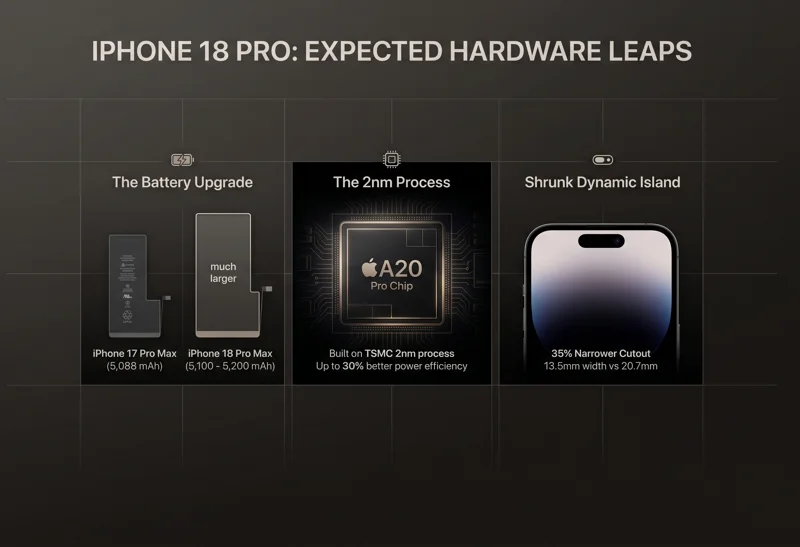
A reputable Chinese leaker indicated that the battery will range from 5,100 to 5,200 mAh, surpassing the current 5,088 mAh record holder. To accommodate this, the chassis will be slightly thicker, adding about 3 grams of weight.
| Model Comparison | Estimated Battery Capacity | Estimated Weight |
|---|---|---|
| iPhone 17 Pro Max | 5,088 mAh | 221 grams |
| iPhone 18 Pro Max | 5,100 – 5,200 mAh | 243 grams |
3. A Smaller Dynamic Island Under-Display Face ID
Another major factor among the 12 Reasons to Wait for the iPhone 18 Pro is the evolution of the front display. We are finally expecting a smaller Dynamic Island under-display Face ID integration.
Reports claim the new cutout will be approximately 35% narrower, dropping from 20.7mm to roughly 13.5mm. Moving the TrueDepth camera receiver and transmitter beneath the screen frees up valuable display real estate.
Apple is weighing two options for the new Dynamic Island, with the ultimate goal of introducing a significantly smaller footprint enabled by under-display Face ID components.
4. Power-Efficient LTPO+ Display Technology
Screen tech is taking a leap forward with LTPO+ display panels supplied by Samsung Display and LG Display. This is a critical component of the 12 Reasons to Wait for the iPhone 18 Pro.
LTPO+ allows for much finer control over OLED light emission. It intelligently optimizes brightness based on environmental conditions, which directly contributes to the extended battery life mentioned earlier.
Performance Beast: 12 Reasons to Wait for the iPhone 18 Pro
Underneath the stunning display, the internal architecture is receiving a generational overhaul. If you demand peak performance, this device is engineered specifically for you.
The processing power alone justifies holding onto your current device, as Apple moves to a smaller, denser, and much more efficient manufacturing process.
5. The Revolutionary Apple A20 Pro Chip 2nm
At the heart of the device lies the Apple A20 Pro chip 2nm, a marvel of modern engineering. Moving to a 2-nanometer fabrication process drastically increases transistor density.
This translates to a 15% speed gain and a staggering 30% improvement in power efficiency compared to previous generations. It is designed to handle intensive Apple Intelligence tasks effortlessly.
| Chipset Generation | Fabrication Process | Efficiency Gain |
|---|---|---|
| A19 Pro | 3nm | Baseline |
| A20 Pro | 2nm | Up to 30% Better |
6. 12GB of RAM with Wafer-Level Packaging
To support the massive AI capabilities, the device will pack 12GB of RAM. The real game-changer is TSMC’s Wafer-Level Multi-Chip Module (WMCM) technology.
This integrates the RAM directly onto the same wafer as the CPU and GPU, ensuring lightning-fast data transfer and reducing latency during heavy multitasking.
7. The In-House C2 5G Modem
Apple is finally reducing its reliance on Qualcomm. The integration of the next-generation C2 modem is one of the stealthier 12 Reasons to Wait for the iPhone 18 Pro.
This in-house chip brings faster speeds, better power management, and mmWave 5G support in the United States, giving Apple total control over network performance.
Photography Redefined: 12 Reasons to Wait for the iPhone 18 Pro
For content creators, the camera system is the most critical feature. The 2026 lineup is set to introduce hardware that mimics professional DSLR equipment.
The combination of new sensors and mechanical aperture controls makes this upgrade cycle a dream for photographers.
8. The iPhone 18 Pro Variable Aperture Camera
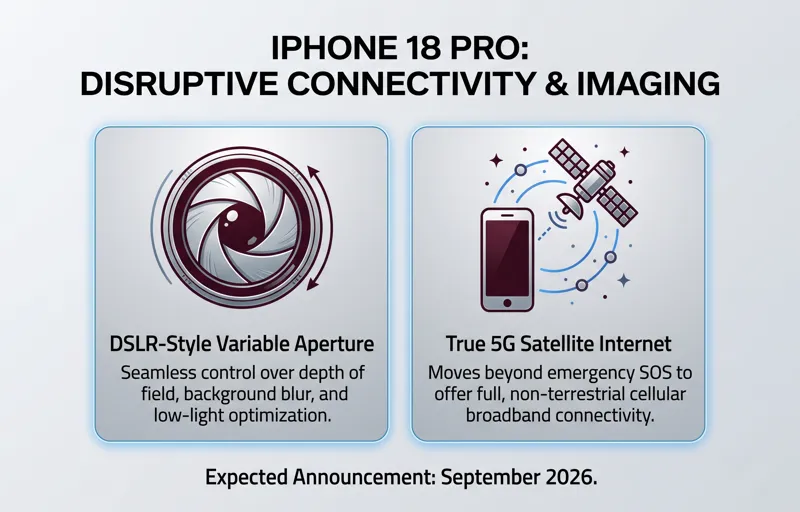
Say goodbye to fixed f/1.78 apertures. The introduction of an iPhone 18 Pro variable aperture camera means you finally have hardware-level control over depth of field.
This DSLR-style physical lens adjustment allows more light in for night shots, or narrows the opening for sharper landscapes. It is a monumental leap for mobile photography.
With a variable lens, the new pro model allows users to manually shift the aperture, enabling sharper focus on subjects or smoother, natural background blur.
9. A Brand New Samsung-Made Sensor
Breaking Sony’s monopoly, Samsung is reportedly supplying a new three-layer stacked image sensor known as PD-TR-Logic for the new lineup.
This sensor improves camera responsiveness, significantly reduces low-light noise, and pushes dynamic range to unseen levels on a smartphone.
| Camera Feature | Previous Generation | 2026 Pro Generation |
|---|---|---|
| Main Lens Aperture | Fixed f/1.78 | Variable Aperture |
| Sensor Manufacturer | Sony Exclusive | Samsung Stacked Sensor |
10. A Simplified, More Reliable Camera Control
The current Camera Control button, while innovative, is costly to repair due to its complex capacitive and pressure layers. Apple is optimizing this.
By retaining only the pressure-sensing recognition, Apple reduces manufacturing costs while keeping all the swipe and tap functionality intact, ensuring better long-term durability.
Connectivity & Software: 12 Reasons to Wait for the iPhone 18 Pro
Beyond hardware, the software and connectivity features are pushing the boundaries of what a mobile device can do in the wild.
If you travel frequently or rely heavily on smart assistants, these final points will convince you to hold off on upgrading today.
11. The Ultimate 5G Satellite Internet Smartphone
Imagine streaming data without a cell tower in sight. The upcoming device aims to be the ultimate 5G satellite internet smartphone.
Partnering with infrastructure upgrades via Amazon and Globalstar, future models will move beyond mere emergency SOS texts to offer full, non-terrestrial broadband connectivity.
This advancement would allow future devices to gain full internet connectivity through satellite networks, eliminating dead zones permanently.
12. iOS 27 and a Completely Rebuilt Siri
Rounding out the 12 Reasons to Wait for the iPhone 18 Pro is the highly anticipated iOS 27 update, which features the biggest Siri shake-up in history.
Powered by the 12GB of RAM, this conversational Siri boasts onscreen awareness, personal context understanding, and broad internet-connected knowledge. For official updates on software, you can always check the Apple Newsroom.
| Software Capability | Legacy Siri | iOS 27 Siri AI |
|---|---|---|
| Context Awareness | Basic Queries | Full Onscreen Awareness |
| Memory | None | Standalone App for Past Chats |
In conclusion, the combination of a 2nm chip, a variable aperture lens, and true satellite internet makes the wait entirely worthwhile.
Frequently Asked Questions
What is the main benefit of the Apple A20 Pro chip 2nm?
The 2nm process increases transistor density, providing a 15% speed boost and up to 30% better power efficiency compared to previous 3nm chips.
How does the iPhone 18 Pro variable aperture camera work?
It physically adjusts the lens opening just like a DSLR camera, allowing more light in dark settings or narrowing for sharper focus and natural background blur.
Will there be a smaller Dynamic Island under-display Face ID?
Yes, rumors suggest the Dynamic Island will be approximately 35% narrower because the Face ID receiver and transmitter are moving completely under the display.
Is the iPhone 18 Pro Max battery capacity increasing?
Absolutely. The Pro Max model is expected to feature a much larger battery ranging between 5,100 to 5,200 mAh, housed inside a slightly thicker chassis.
Will the new model be a 5G satellite internet smartphone?
Yes, reports indicate Apple is adding support for non-terrestrial 5G networks, allowing users to access full broadband internet via satellites, not just emergency SOS.
To reduce repair costs, Apple is removing the capacitive layer and relying entirely on a more robust pressure-sensing technology for taps and swipes.
When is the expected release date?
Following Apple’s new two-phase rollout, the premium Pro and Pro Max models are scheduled to be released in September 2026.
Disclaimer: This article is for informational purposes only. The specifications, features, and release dates discussed are based on industry leaks, supply chain rumors, and analyst reports as of mid-2026, and are subject to change by the manufacturer.