The Unpatchable usbliter8 Exploit Breaks the foundational security architecture of millions of active iOS devices in 2026. Security researchers at Paradigm Shift recently published a functional proof of concept that bypasses Apple’s strict chain of trust.
This unprecedented zero-day exploit targets the critical SecureROM boot chain on older silicon generations. Because this foundational code is permanently burned into physical silicon during factory manufacturing, it remains completely outside the reach of digital patches.
In this comprehensive analysis, we will explore exactly how the Unpatchable usbliter8 Exploit Breaks hardware boundaries. We will review the affected chipsets, the technical underpinnings of the flaw, and what it practically means for mobile enterprise deployment.
The Impact: How the Unpatchable usbliter8 Exploit Breaks SecureROM
This vulnerability functions similarly to the infamous checkm8 exploit from 2019. When the Unpatchable usbliter8 Exploit Breaks the SecureROM boot chain, it grants attackers low-level arbitrary code execution privileges before the standard iOS operating system can even initialize.
However, this is strictly a physical attack vectors scenario. A malicious actor cannot execute this command remotely across a network; it requires hands-on physical custody of the smartphone while placed into Device Firmware Update (DFU) mode.
“Because the flaw resides in unchangeable boot read-only memory, impacted Apple products will remain vulnerable for their entire operational lifespan.”
The attack relies on connecting the smartphone via USB to a specialized microcontroller board running an RP2350 chip. Once properly interfaced, the entire payload executes flawlessly in less than two seconds, allowing untrusted code execution directly at EL1.
Affected Hardware: Where the Unpatchable usbliter8 Exploit Breaks the Chain
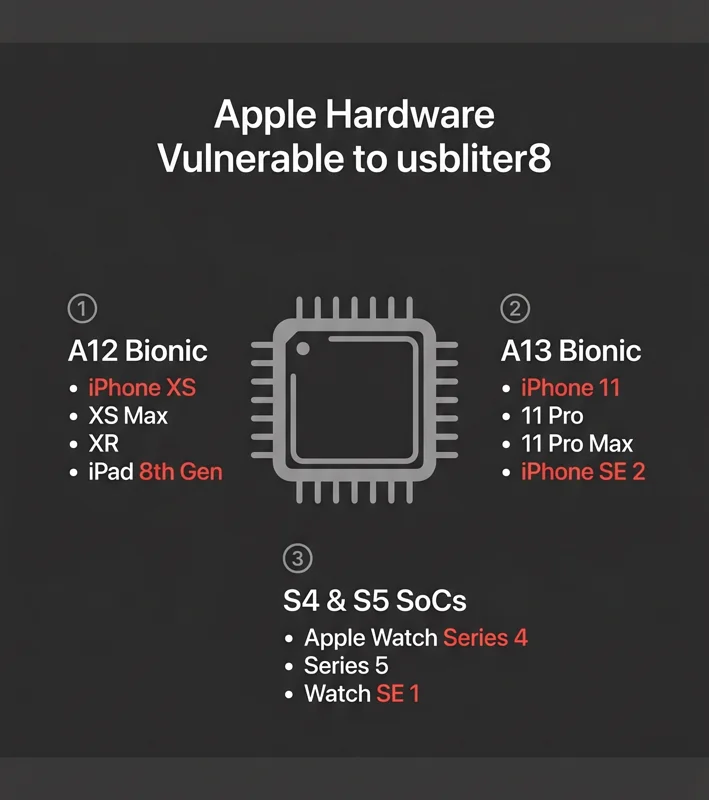
The scope of this vulnerability covers multiple generations of consumer hardware. The public proof of concept natively supports Apple A12, A13, S4, and S5 Systems-on-Chip (SoCs), leaving several mainstream smartphone families permanently exposed.
Devices running the A11 processor or older are unaffected by this specific bug, while newer iterations starting from the A14 chip appear to have robust architectural mitigations that keep them entirely out of reach from this exploit path.
| Processor Generation | Popular Affected Devices | Vulnerability Status |
|---|---|---|
| Apple A12 Bionic | iPhone XS, XS Max, XR, iPad 8th Gen | Permanently Vulnerable |
| Apple A13 Bionic | iPhone 11, 11 Pro, 11 Pro Max, iPhone SE (2nd Gen) | Permanently Vulnerable |
| Apple S4 & S5 | Apple Watch Series 4, Series 5, Watch SE (1st Gen) | Permanently Vulnerable |
Enterprise administrators should systematically catalog their current mobile inventories to isolate these models. In highly sensitive settings, upgrading to modern devices with newer processing hardware is strongly advised to maintain strict operational integrity.
The Technical Mechanics: Why the Unpatchable usbliter8 Exploit Breaks Trust
The root technical vulnerability stems directly from a hardware design flaw within the integrated Synopsys DWC2 USB controller. The controller handles incoming USB Setup packets using Direct Memory Access (DMA) but improperly manages internal write pointers.
When processing smaller, non-standard packets, pointer increments fail to align with the data size. This mismatch eventually triggers a repeatable buffer underflow, shifting the DMA pointer backwards across system memory blocks.
On A12 and A13 architectures, Apple configured the USB Device Address Resolution Table (DART) in a complete bypass mode. Consequently, the corrupted underflowing pointer can seamlessly overwrite crucial SRAM segments without restriction.
For more details on security standards, you can monitor the updates on the Cybersecurity and Infrastructure Security Agency Website.
Bypassing Pointer Authentication on Later Silicon Iterations
The method by which the Unpatchable usbliter8 Exploit Breaks defense mechanisms depends heavily on the specific chip target. On the A12 architecture, the DMA buffer rests right next to the active USB stack, enabling simple control hijacking.
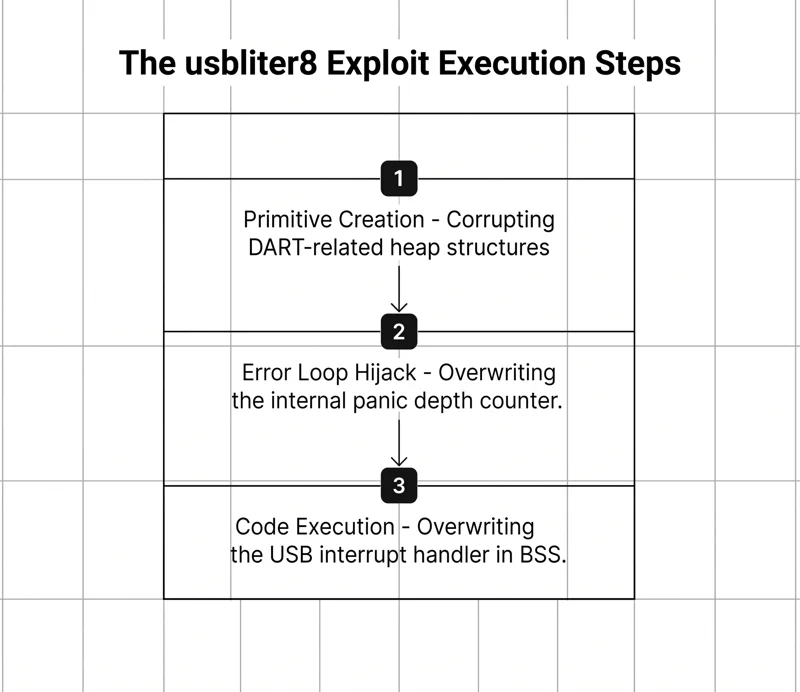
The A13 presents a much steeper challenge because Pointer Authentication (PAC) actively safeguards system return addresses. Researchers skillfully bypassed this security layer in multiple phases by corrupting specific heap structures first.
| Exploit Step | Technical Mechanism Employed |
|---|---|
| 1. Primitive Creation | Corrupting DART-related heap structures to establish bounded writes. |
| 2. Error Loop Hijack | Overwriting the internal panic depth counter to stop immediate reboots. |
| 3. Code Execution | Overwriting the USB interrupt handler pointer located directly in the BSS segment. |
“By altering the USB serial string to state ‘PWND:[usbliter8]’, attackers can completely force custom unsigned images to boot.”
Real-World Threats and Enterprise Mitigation
For the average daily user, the immediate security risks associated with this disclosure remain relatively low. An attacker must possess your physical device, a matching microcontroller rig, and specialized knowledge to execute the script.
However, in corporate security environments, this news presents an immediate hardware custody dilemma. Because the physical defense boundaries are gone, safety relies entirely on ensuring these legacy devices never encounter untrusted hosts.
The public availability of the code means it will likely transition into commercial forensic utility kits rapidly. Organizations handling sensitive data must prioritize migrating away from A12 and A13 devices immediately.
Frequently Asked Questions
Can Apple patch this issue with a standard iOS software update?
No, because the vulnerability resides in SecureROM, which is permanently burned into the physical chip silicon at manufacture time.
Does the Unpatchable usbliter8 Exploit Breaks scenario allow remote hacking over cellular data?
No, this exploit requires direct physical possession of the device, tethered via USB to a specialized microcontroller board in DFU mode.
Which specific iPhone models are currently vulnerable to this exploit?
The iPhone XS, XS Max, XR, iPhone 11 series, and the second-generation iPhone SE are all affected by this hardware vulnerability.
Does this vulnerability compromise the data inside the Secure Enclave?
The current research does not demonstrate a Secure Enclave compromise, as it remains isolated, though the exploit path opens new testing routes.
Why are A11 and A14 processors safe from this exploit?
The A11 driver manually resets its memory address after every packet, while the A14 correctly configures DART memory protection schemes.
What does an attacker gain after successfully executing the usbliter8 exploit?
They can demote the processor’s production security mode and completely bypass code signature verification to run unsigned iBoot images.
What should corporate IT departments do with affected hardware inventories?
IT administrators should treat this as a hardware retirement issue and accelerate upgrade cycles toward safer A14 or newer processors.
Disclaimer: This article is for informational purposes only. Cybersecurity threat landscapes and hardware vulnerabilities evolve rapidly, and users should follow updates from verified vendor advisories.