ubiquiti patches critical unifi flaws across multiple platforms to secure enterprise networks from catastrophic breaches.
Network administrators around the world received an urgent wake-up call this week. A massive security update has been rolled out to address severe vulnerabilities.
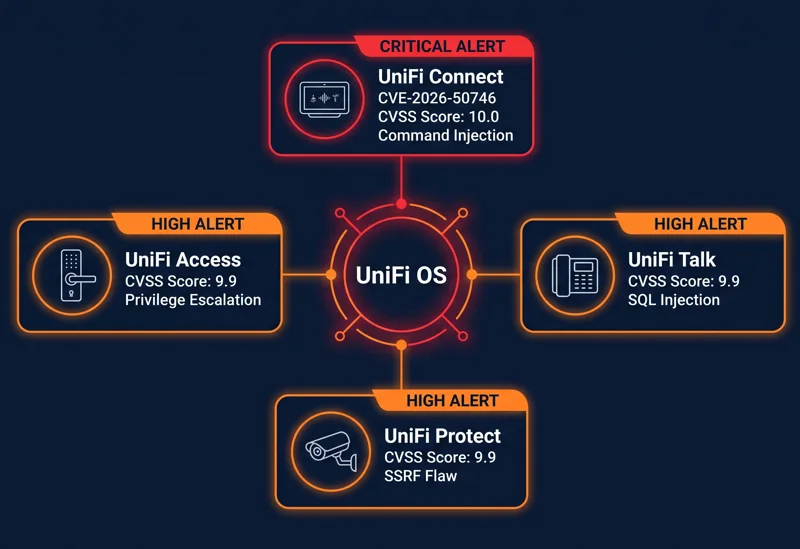
These exploits affect major applications, including Connect, Talk, Access, Protect, and the underlying OS firmware. If left unpatched, these vulnerabilities could result in complete system compromise.
Understanding why ubiquiti patches critical unifi flaws today
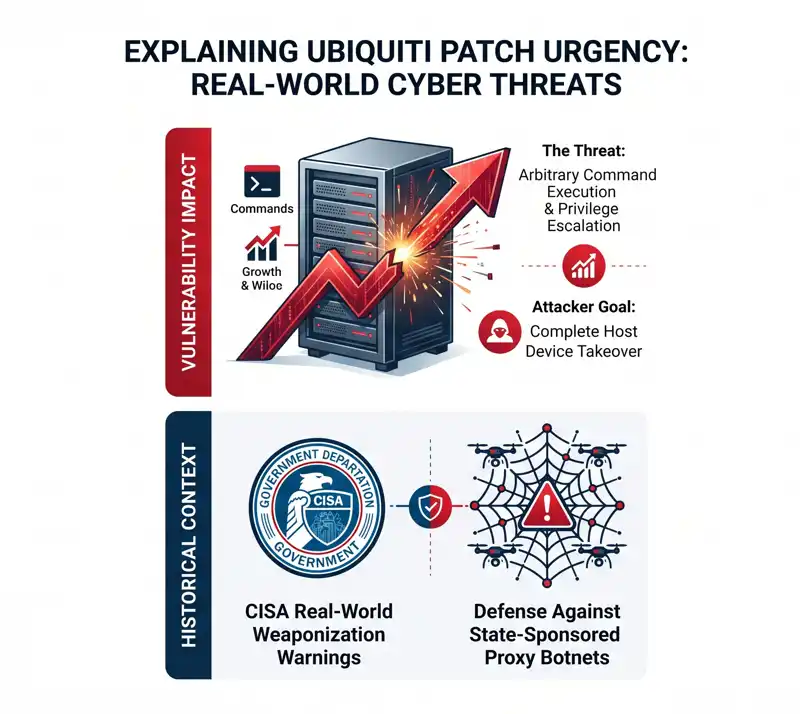
The core of this security crisis revolves around multiple vulnerabilities that allow arbitrary command execution and privilege escalation.
The most alarming flaw, identified as CVE-2026-50746, carries a maximum CVSS score of 10.0. This improper access control vulnerability impacts the Connect Application specifically.
An attacker with mere network access could exploit this flaw to execute a command injection directly onto the host device.
It is precisely because of severities like this that ubiquiti patches critical unifi flaws with such urgency. System administrators must prioritize these updates to avoid unauthorized network access.
“A CVSS score of 10.0 represents a worst-case scenario for network administrators, requiring immediate and decisive patching.”
How ubiquiti patches critical unifi flaws across different applications
Beyond the Connect application, the Talk Application also faces severe risks. CVE-2026-50747 exposes a series of authenticated SQL injection vulnerabilities.
With a CVSS score of 9.9, this flaw allows attackers to escalate their privileges, granting them unauthorized control over the host.
Similarly, the Access Application suffers from improper input validation (CVE-2026-50748), leading to potential command injection attacks.
When ubiquiti patches critical unifi flaws across these diverse endpoints, they effectively close the door on multi-vector attacks targeting the smart building ecosystem.
| Vulnerability (CVE) | Affected Application | CVSS Score | Fixed Version |
|---|---|---|---|
| CVE-2026-50746 | UniFi Connect | 10.0 | 3.4.20 |
| CVE-2026-50747 | UniFi Talk | 9.9 | 5.2.2 |
| CVE-2026-55115 | UniFi Protect | 9.9 | 7.1.83 |
| CVE-2026-54402 | UniFi OS | 9.9 | 5.1.19 |
CISA warnings and why ubiquiti patches critical unifi flaws so rapidly
The urgency of these patches is heavily influenced by recent historical events and real-world cybersecurity threats.
Last month, the U.S. Cybersecurity and Infrastructure Security Agency (CISA) flagged three previous OS vulnerabilities that were actively weaponized in real-world attacks.
Furthermore, Russian state-sponsored threat actors previously compromised Edge OS routers to build a massive proxy botnet known as MooBot.
Although law enforcement dismantled MooBot in early 2024, the threat landscape remains highly volatile for enterprise hardware.
This history explains exactly why ubiquiti patches critical unifi flaws before they can be exploited in the wild by malicious syndicates.
“Proactive patching is the only defense against sophisticated state-sponsored threat actors looking to weaponize network infrastructure.”
For more official details on securing your hardware, always consult Ubiquiti’s official security portal.
| Historical Threat Context | Details and Impact |
|---|---|
| CISA Weaponization Warning | Three prior OS vulnerabilities (CVE-2026-34908 to 34910) were flagged as actively exploited. |
| MooBot Botnet Operation | Russian state-sponsored actors enlisted compromised routers into a malicious proxy network. |
FAQs: When ubiquiti patches critical unifi flaws in 2026
What is the most severe vulnerability in this update?
The most severe is CVE-2026-50746, a CVSS 10.0 command injection flaw affecting the Connect application.
Have these new vulnerabilities been exploited in the wild?
Currently, there is no evidence that these specific flaws have been actively exploited, but rapid patching is strongly advised.
Why is it so important that ubiquiti patches critical unifi flaws quickly?
Because past vulnerabilities have been weaponized by state-sponsored actors to create botnets and disrupt enterprise networks.
What applications are affected by these updates?
The vulnerabilities impact Connect, Talk, Access, Protect, and the core OS systems.
What does a Server-Side Request Forgery (SSRF) flaw do?
Found in the Protect application, it allows an attacker with low privileges to manipulate the server and escalate their access.
Does this update resolve the issues flagged by CISA last month?
This update addresses new critical flaws, but it follows the same proactive security measures emphasized by recent CISA warnings.
How can administrators protect their networks?
The fact that ubiquiti patches critical unifi flaws means administrators simply need to update their host devices to the latest firmware versions immediately.
Disclaimer: This article is for informational purposes only. It is not intended as professional cybersecurity advice. Always consult official vendor documentation for patching instructions.