In a shocking move for consumers in 2026, two year old surface pcs get 300 price hikes as sub 1000 models go away entirely from Microsoft’s retail offerings. If you have been patiently holding out for an upgrade to the Surface lineup, perhaps anticipating the integration of Qualcomm’s new Snapdragon X2 Elite processors, the current market reality is grim. Microsoft is radically restructuring its PC pricing strategy, abandoning budget-conscious buyers and inflating the cost of aging hardware. Buyers are now expected to pay a minimum of $1,500 for hardware architectures that debuted at the $1,000 mark just 24 months prior.
The Death of the Budget Surface: Unpacking the Price Hikes
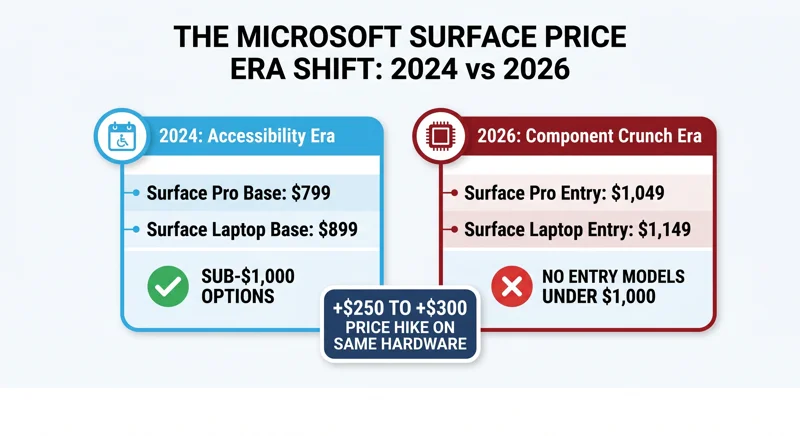
The era of accessible, premium Microsoft hardware is officially over. The entry-level tiers that made the Surface brand a staple for students and budget-conscious professionals have been systematically dismantled. The 12-inch Surface Pro tablet, which originally disrupted the market with a starting price of $799, now commands an exorbitant $1,049. Similarly, the 13-inch Surface Laptop has jumped from its initial $899 price tag to $1,149. These represent a staggering $250 price increase for technology that has not seen a single internal upgrade since 2024.
| Surface Model | 2024 Launch Price | 2026 Adjusted Price | Total Price Increase |
|---|---|---|---|
| 12-inch Surface Pro | $799 | $1,049 | +$250 |
| 13-inch Surface Laptop (Base) | $899 | $1,149 | +$250 |
| High-End 13-inch Surface Pro | $999 | $1,499 | +$500 (Since Launch) |
The situation is even worse for the higher-end SKUs. Both the premium Surface Laptop and the 13-inch Surface Pro from 2024 initially started at $999. By 2025, Microsoft discontinued their 256GB entry-level versions, effectively pushing the starting price to $1,199. Now, in 2026, those exact same models start at an eye-watering $1,499, representing a direct $300 price hike year-over-year.
“Paying more for the same stuff is the undeniable and unfortunate story of consumer technology in 2026, leaving loyal Microsoft users feeling abandoned by the brand.”
The Culprit: Memory Component Shortages 2026
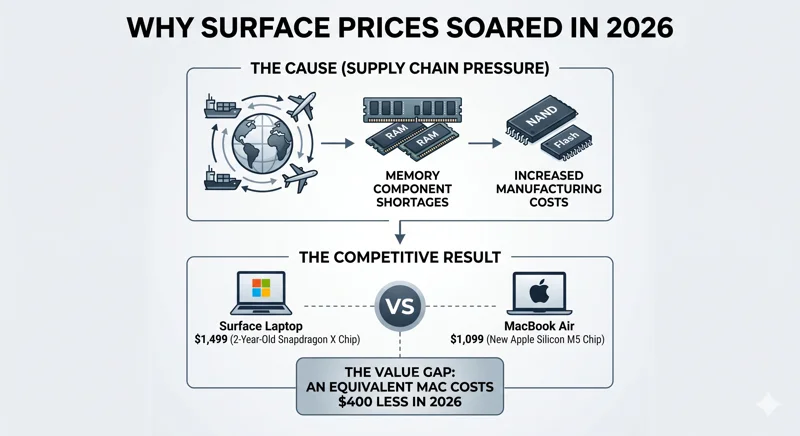
According to official statements, Microsoft attributes this drastic Microsoft Surface price increase to “recent increases in memory and component costs.” Throughout 2026, severe supply shortages for RAM and NAND storage chips have wreaked havoc on the global consumer tech supply chain. These constraints are delaying next-generation product launches, rapidly depleting the stock of existing products, and forcing both large corporations and small manufacturers to pass the inflated manufacturing costs directly onto the consumer.
The Apple Value Advantage: Surface Laptop vs MacBook Air
The 2024 Surface updates were a monumental shift for Microsoft’s first-party PC ecosystem. They represented the flagship transition from traditional Intel and AMD x86 architecture to Arm-based Snapdragon PCs. Microsoft heavily promoted its Windows x86-to-Arm code translation layer, known as Prism, successfully rallying third-party developers to build Arm-native applications. While these Arm-based PCs remain functional and heavily stocked at retailers, this pricing strategy makes hardware comparisons highly unfavorable for Microsoft.
| Flagship Arm-Based Laptop | Processor Generation | 2026 Starting Price |
|---|---|---|
| Microsoft Surface Laptop | 2024 Snapdragon X | $1,499 |
| Apple MacBook Air | 2026 Apple Silicon M5 | $1,099 |
| Apple MacBook Neo | Apple Silicon | Sub-$1,000 |
When placing the Surface Laptop vs MacBook Air, the reality is stark. An equivalent, newly released M5 MacBook Air now costs a full $400 less than a similarly specced, two-year-old Surface Laptop. Furthermore, absolutely nothing in Microsoft’s current lineup can compete with the pure value-for-money offered by Apple’s budget-friendly MacBook Neo. To review current pricing straight from the source, you can visit the Official Microsoft Surface Store.
“Apple’s tight vertical integration and control over its custom silicon supply chain have shielded its pricing structure, exposing Microsoft’s heavy reliance on volatile third-party component markets.”
| Market Force in 2026 | Impact on Microsoft PC Strategy | Impact on Apple Mac Strategy |
|---|---|---|
| RAM Shortages | Forced to raise MSRP by up to $300 | Absorbed costs, maintained base pricing |
| NAND Flash Costs | Eliminated all sub-$1000 base models | Introduced value-tier MacBook Neo |
| Processor Innovation | Stuck on 2024 chips pending Snapdragon X2 | Successfully launched new M5 architecture |
Frequently Asked Questions
Why did Microsoft raise the price of older Surface PCs?
Microsoft instituted the price hikes due to severe global supply shortages and the rising costs of memory and storage components in 2026.
Can I still buy a new Microsoft Surface for under $1,000?
No. As of this pricing update, sub-$1000 Windows laptops in the primary Surface lineup have been completely eliminated.
How much did the high-end Surface Laptop price increase?
The high-end Surface Laptop started at $999 in 2024, increased to $1,199 in 2025, and now costs $1,499 in 2026—a total increase of $500 from its original launch.
Are the current Surface PCs using Intel or AMD chips?
The 2024 flagship models affected by this price hike utilize Arm-based Snapdragon X processors, not traditional Intel or AMD chips.
How does the Surface Laptop compare in price to Apple’s M5 MacBook Air?
An equivalent M5 MacBook Air is currently priced about $400 cheaper than a similarly specified, two-year-old Surface Laptop.
What is Microsoft Prism?
Prism is Microsoft’s translation layer built into Windows that allows traditional x86 applications to run smoothly on Arm-based processors like the Snapdragon series.
Will the upcoming Snapdragon X2 Elite laptops be more expensive?
While unconfirmed, analysts fear that if Microsoft integrates the new Snapdragon X2 Elite chips, they may introduce yet another price increase on top of these current inflated base prices.
Disclaimer: This article is for informational purposes only. Product pricing, availability, and hardware specifications are subject to change based on global market conditions and official updates from Microsoft and Apple.