The news that Three Recent Chrome Releases Fix 1442 vulnerabilities marks an unprecedented milestone in web browser security history.
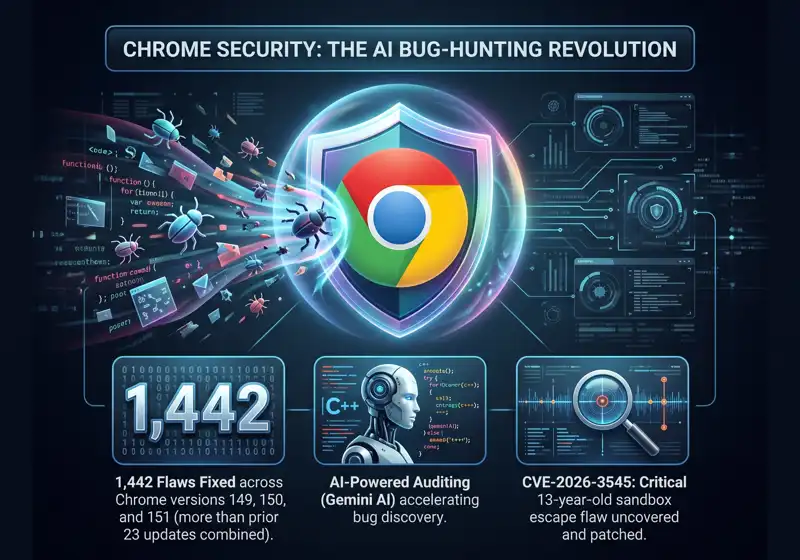
Google recently confirmed that Chrome versions 149, 150, and 151 resolved a staggering number of security flaws across desktop platforms.
This massive wave of security patches surpasses the total number of bugs fixed across the prior 23 Chrome milestone releases combined.
The sudden surge in patched vulnerabilities highlights both the power of modern artificial intelligence and the changing threat landscape of 2026.
How Three Recent Chrome Releases Fix 1442 Security Bugs
Understanding how Three Recent Chrome Releases Fix 1442 flaws requires looking closely at the release milestone breakdown.
In Chrome 149 and Chrome 150 alone, Google fixed a total of 1,072 security bugs within a single month.
With the release of Chrome 151, developers patched an additional 370 security vulnerabilities to protect end users worldwide.
Remarkably, Google’s internal security research team discovered 349 of the 370 bugs addressed in the version 151 patch.
| Chrome Version | Vulnerabilities Fixed | Primary Bug Source |
|---|---|---|
| Chrome 149 & 150 | 1,072 Flaws | AI Automated Fuzzing & External Reports |
| Chrome 151 | 370 Flaws | Google Internal Security Audit (349 Bugs) |
| Total Combined Patch | 1,442 Flaws | Comprehensive AI-Driven Security Sweep |
Why Three Recent Chrome Releases Fix 1442 Vulnerabilities via AI
The primary driver behind this sudden spike in bug identification is Large Language Models (LLMs) used for security auditing.
Security teams now leverage advanced AI harnesses, including Google’s custom Gemini models, to analyze complex source code repositories.
For example, AI agents uncovered a critical sandbox escape flaw tracked as CVE-2026-3545 in the Navigation component.
This high-severity flaw had remained hidden deep within the legacy Chrome C++ codebase for over 13 years.
“Every bug found and fixed is one less foothold for an attacker. We must ship fixes faster than adversaries can exploit them.” – Google Chrome Security Team
Across the cybersecurity industry, the U.S. National Vulnerabilities Database (NVD) has recorded 46,872 flaws in 2026 so far.
Because automated AI scanning accelerates flaw discovery, tech companies are forced to issue patches at unprecedented speeds.
Future Plans as Three Recent Chrome Releases Fix 1442 Vulnerabilities
To keep pace with AI-powered cyber threats, Google is restructuring its release pipeline and browser architecture.
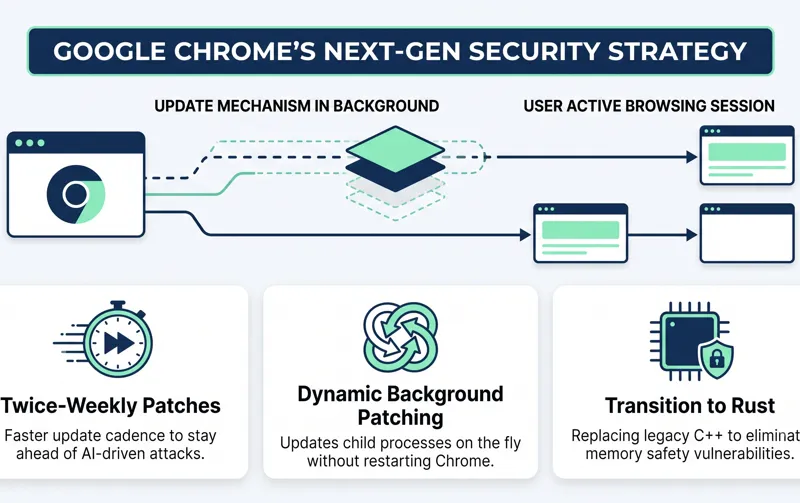
Google is transitioning toward a strict two-week major milestone cadence, paired with twice-weekly security patches.
Additionally, developers are testing dynamic patching capabilities that update background components without forcing full browser restarts.
By replacing child processes on the fly, Chrome can deploy critical patches seamlessly while users continue browsing.
| Security Initiative | Traditional Security Method | 2026 AI-Era Approach |
|---|---|---|
| Update Cadence | Monthly Major Releases | Twice-Weekly Patch Deployments |
| Patch Application | Manual Browser Restart Required | Dynamic In-Memory Background Patching |
| Language Safety | Legacy C++ Frameworks | Memory-Safe Rust & Web Technologies |
Long-Term Memory Safety as Three Recent Chrome Releases Fix 1442 Bugs
Beyond issuing quick security updates, Google is actively removing entire bug classes from its browser codebase.
The development team is systematically replacing memory-unsafe C++ components with memory-safe programming languages like Rust.
Furthermore, parts of the top-level Chrome user interface are being rewritten using standard HTML, CSS, and TypeScript.
To verify official browser update logs, you can check the Chrome Releases Blog for detailed patch announcements.
“By leveraging Chrome’s multi-process architecture, dynamic patching sequentially replaces background child processes with updated binaries on the fly.”
These strategic engineering investments ensure that browser security evolves rapidly enough to counter AI-assisted exploits.
Frequently Asked Questions
Why did Three Recent Chrome Releases Fix 1442 security flaws all at once?
The massive fix volume was caused by AI-powered scanning tools discovering historical code vulnerabilities at a much faster rate than human auditing ever permitted.
What was the most serious flaw fixed in these updates?
A critical sandbox escape flaw (CVE-2026-3545) with a CVSS score of 9.6 was patched after lying hidden in the codebase for 13 years.
Do I need to manually restart Chrome to receive these security patches?
While restarting ensures immediate protection, Google is rolling out dynamic patching features that apply updates seamlessly in the background.
How often will Google update Chrome following the news that Three Recent Chrome Releases Fix 1442 bugs?
Google is moving to major releases every two weeks and piloting up to two dedicated security patch releases every week.
How is AI changing browser security in 2026?
AI tools like Gemini allow security teams to fuzz and analyze millions of lines of complex C++ code automatically, surfacing hidden bugs in seconds.
Is Google changing the coding language used to build Chrome?
Yes, Google is migrating legacy C++ components to memory-safe languages like Rust to eliminate use-after-free and memory corruption flaws.
How can I check if my Chrome browser is fully updated?
Open Chrome, click the three-dot menu icon in the upper corner, select “Help,” and click “About Google Chrome” to trigger an automatic update check.
Disclaimer: This article is for informational purposes only. Web browser features and official patch rollout schedules are subject to technical changes by the software vendor.