
There is a usd 300 gotcha in an M5 Max Mac Studio upgrade that is catching creative professionals, tech enthusiasts, and early adopters completely off guard this year.
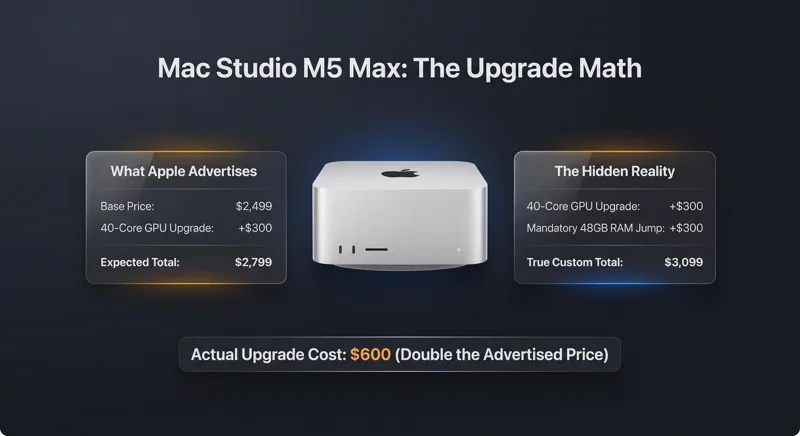
When Apple officially unveiled its updated Mac Studio lineup alongside new Mac mini models, consumers were initially thrilled by the stable retail pricing structure.
The base entry point for the desktop remains unchanged at a reasonable $2,499, which seems identical to previous generations on the surface.
However, when buyers attempt to customize their machine with better graphics capabilities on the official storefront, an unexpected pricing adjustment appears.
What appears to be a modest, straightforward step up in graphical performance quickly snowballs into a mandatory doubled expenditure that inflates checkout totals.
Understanding these hidden mechanics is crucial before placing an order to avoid unnecessary budget overruns on your workstation hardware.
Why There is a usd 300 gotcha in an M5 Max Mac Studio upgrade
The confusion starts directly within the hardware customizer interface on Apple’s online configurator.
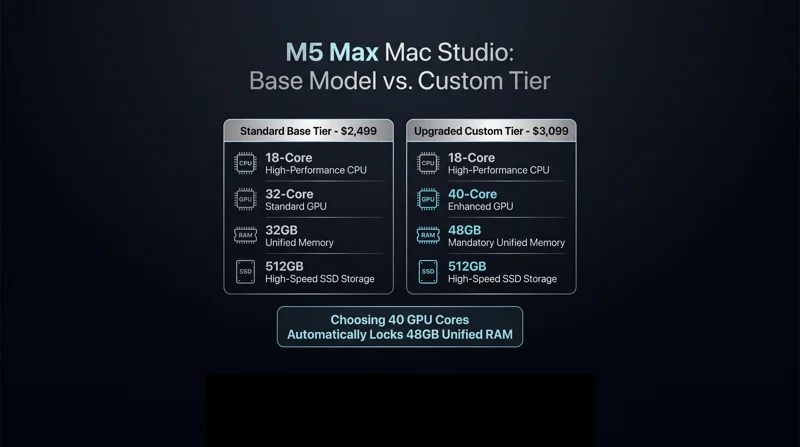
The standard baseline configuration of the machine features an 18-core CPU accompanied by a 32-core GPU and 32GB of unified memory.
For professionals seeking additional graphics performance for 3D modeling, video rendering, or AI computation, Apple lists an upgraded 40-core GPU option.
The website clearly and prominently labels this graphics chip upgrade as costing an additional $300.
Yet, buyers quickly discover that there is a usd 300 gotcha in an M5 Max Mac Studio upgrade because selecting the chip automatically alters other hardware parameters.
Apple does not allow the 40-core GPU variant to run alongside the base 32GB memory tier under any circumstance.
Consequently, checking the box for the upgraded GPU forces an automatic memory jump from 32GB to 48GB, tacking on another $300 charge.
| Configuration Tier | Advertised Added Price | Mandatory RAM Pairing | Actual Total Extra Cost |
|---|---|---|---|
| Base 32-Core GPU Model | $0 (Base $2,499) | 32GB Unified Memory | $0 |
| Upgraded 40-Core GPU Model | +$300 (Advertised) | 48GB Unified Memory (+$300) | +$600 (Total $3,099) |
Selecting the 40-core GPU forces an involuntary jump to 48GB of unified memory, transforming an advertised $300 upgrade into a $600 invoice increase.
The Hidden Cost: There is a usd 300 gotcha in an M5 Max Mac Studio upgrade
Because you cannot separate the 40-core silicon from the 48GB unified memory tier, the true entry barrier to better graphics is $600 rather than $300.
This subtle bundling caught prominent industry analysts and reviewers by surprise when they calculated configuration pricing charts.
Even seasoned tech journalists assembling spec breakdowns missed the automatic RAM bump during their initial store visits.
The problem is compounded by Apple’s rather vague interface notifications during checkout.
When you select the enhanced processor, the website displays a subtle prompt stating that other parts of your configuration have been updated.
Because the prompt does not explicitly emphasize the accompanying $300 memory fee, hasty shoppers might finalize their carts without realizing the price doubled.
This opaque user experience highlights why there is a usd 300 gotcha in an M5 Max Mac Studio upgrade for ordinary buyers.
Detailed Hardware Breakdown and Configuration Tiers
To fully grasp the financial impact, one must examine the specific technical differences between these silicon tiers.
Apple’s M5 Max platform utilizes a modular system architecture where memory bus bandwidth and GPU core clusters operate in tight synchronization.
The base chip utilizes an 18-core CPU paired with a 32-core GPU, providing plenty of horsepower for mainstream video editors and sound designers.
In contrast, the top-tier binned variation increases graphic compute units to 40 cores, offering tangible performance gains for heavy visual effects rendering.
However, Apple’s packaging architecture demands a higher memory density on the system substrate to feed the 40 graphics cores efficiently.
This technical dependency is the engineering justification behind why there is a usd 300 gotcha in an M5 Max Mac Studio upgrade.
| Component Specification | Standard Base M5 Max | Custom Configured M5 Max |
|---|---|---|
| CPU Core Count | 18 Cores | 18 Cores |
| GPU Core Count | 32 Cores | 40 Cores |
| Base Unified Memory | 32GB | 48GB (Required Minimum) |
| Storage Capacity | 512GB SSD | 512GB SSD (Configurable) |
| Base Retail Price | $2,499 | $3,099 |
While the memory increase to 48GB delivers legitimate workflow benefits, burying the mandatory surcharge beneath a generic popup creates frustrating customer friction.
Customer Reaction: There is a usd 300 gotcha in an M5 Max Mac Studio upgrade
The consumer reaction across social media and hardware forums has been divided between technical understanding and pricing frustration.
Many creators acknowledge that having 48GB of unified memory is exceptionally beneficial for complex timeline caches and 3D scenes.
In fact, modern creative apps readily consume more than 32GB of RAM during intense multitasking or high-resolution ProRes playback.
However, the lack of transparency in the initial price tag remains the core criticism among the community.
Displaying a single upgrade as “+$300” when clicking it unavoidably increases the checkout total by “+$600” feels misleading to prospective customers.
You can check the latest configurations and full specification sheets directly on the Apple Mac Studio Official Store.
Prospective buyers are advised to calculate their full budget requirements including taxes before hitting the purchase button.
Smart Buying Advice to Avoid Overspending
If you are planning to purchase the desktop, evaluating your actual software demands is the best way to determine your true investment level.
For music producers, graphic designers, software developers, and general video editors working in 4K, the base 32-core GPU is more than adequate.
The base machine provides extraordinary single-core and multi-core throughput without requiring the additional graphics cores.
However, if your daily livelihood relies on GPU-accelerated rendering engines like Octane, Blender, or DaVinci Resolve Studio, the $600 total investment is worthwhile.
In that scenario, you gain both eight extra graphics compute cores and 16GB of extra unified memory, which significantly speeds up output times.
Knowing in advance that there is a usd 300 gotcha in an M5 Max Mac Studio upgrade prevents checkout surprises and helps teams budget accurately.
Always double-check the final line-item invoice before confirming payment details to make sure you received your intended specifications.
Frequently Asked Questions
What is the base starting price of the M5 Max Mac Studio?
The base M5 Max Mac Studio starts at $2,499, featuring an 18-core CPU, 32-core GPU, and 32GB of unified memory.
Why does upgrading to the 40-core GPU cost $600 instead of $300?
While the GPU upgrade alone is listed at $300, Apple requires it to be paired with 48GB of RAM, which adds an unavoidable second $300 charge.
Can I keep 32GB of memory and only upgrade to the 40-core GPU?
No, Apple’s online configuration system automatically changes your memory selection to 48GB and does not permit 32GB with the 40-core chip.
Is the 48GB RAM upgrade worth the extra money?
Yes, for demanding creative workflows like 3D animation, 8K video editing, and complex audio engineering, 48GB provides substantial headroom.
Both the standard and upgraded M5 Max chips feature the same 18-core CPU; the variation exists entirely in the GPU cores and memory requirement.
Did the starting price of the Mac Studio increase from the previous generation?
No, the base starting price remains identical to the prior M4 Max generation at $2,499.
How does Apple notify buyers about this forced change during checkout?
Apple displays an interface message stating that other parts of your configuration have been updated to reflect your new hardware selection.
Disclaimer: This article is for informational purposes only. Hardware pricing, system configurations, and availability are subject to change based on official updates from Apple Inc.