In the ever-shifting landscape of PC gaming hardware and software, it is becoming increasingly evident that the rampocalypse has bought microsoft valuable time in the fight against steamos. For decades, companies have tried and largely failed to break Microsoft’s iron grip on the PC gaming ecosystem. However, over the past few years, Valve and its Linux-based SteamOS operating system managed to achieve what seemed impossible: taking a noticeable, organic bite out of Windows’ dominance. Yet, just as Valve was preparing to launch an aggressive hardware expansion in 2026, an unprecedented global component crisis—dubbed the “RAMpocalypse”—has slammed the brakes on their momentum. This massive supply chain disruption, driven by the insatiable demands of the artificial intelligence industry, has unintentionally provided Microsoft with a crucial window to fix Windows 11 and fortify its gaming defenses.
Valve’s Interrupted Momentum and the Rise of SteamOS
To understand the magnitude of this shift, we must look at where SteamOS was heading before the component crisis hit. Valve’s strategy of using the Proton compatibility layer to make Windows games run flawlessly on Linux was a masterstroke. Instead of begging developers to create native Linux ports, Valve simply made the games work. Between 2021 and early 2026, Linux’s share of the PC gaming market climbed from a negligible 1 percent to over 5 percent. While this might sound small, it represents millions of users and a historic shift in an ecosystem where Windows historically held a 96 percent monopoly.
Valve was poised to completely capitalize on this success. SteamOS was gaining official support for third-party gaming handhelds, and manufacturers were finally experimenting with shipping devices that had SteamOS pre-installed instead of Windows. Furthermore, late last year, Valve announced the highly anticipated Steam Machine—a direct competitor to traditional game consoles and low-end gaming PCs. The timing seemed perfect. Windows 11 was facing intense criticism for high system requirements, intrusive ads, and bloatware. Microsoft appeared incredibly vulnerable.
“By making Windows games run on Linux organically, Valve accomplished via word-of-mouth what it utterly failed to do in the early 2010s when trying to fight Microsoft directly.”
The RAMpocalypse: AI’s Insatiable Hunger for Components
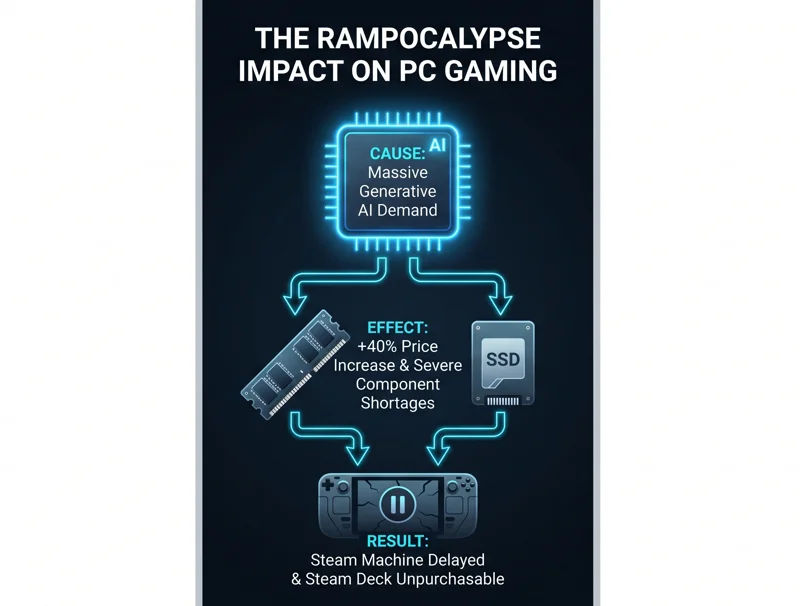
But Valve’s ambitious hardware push to compete directly with Microsoft has hit a massive, expensive wall. The technology industry is currently experiencing the RAMpocalypse, a severe period of massive cost increases and crippling supply constraints for all kinds of PC components, most notably memory (RAM) and storage chips.
The root cause of this crisis is the generative AI gold rush. Chip manufacturers worldwide have pivoted their production lines to chase the incredibly lucrative AI market. Artificial intelligence server farms have an all-consuming need for unified memory, NAND storage, top-tier GPUs, and CPUs. Consequently, there is vastly reduced manufacturing capacity remaining for consumer-grade hardware. Tech companies are fighting over the scraps, driving up prices in a market already strained by international tariffs and complex global logistics.
| Component Type | Primary Industry Driver | Impact on Consumer Hardware |
|---|---|---|
| Unified RAM | Generative AI Training Servers | Critical shortage, 40% price increase |
| NAND Flash Storage | Cloud Datacenters & LLMs | Reduced capacity, elimination of budget drives |
| Consumer GPUs | Enterprise AI Compute Processing | Stagnant generation upgrades, low inventory |
For Valve, these supply chain nightmares have been devastating. The company relies on high-volume, low-margin hardware sales to get SteamOS into the hands of consumers. Because of the RAMpocalypse, the much-anticipated Steam Machine has been indefinitely delayed. Furthermore, securing components for the original Steam Deck has become nearly impossible, rendering the popular handheld largely unpurchasable for months. Third-party handheld manufacturers, seeing the skyrocketing costs of RAM, have also delayed their SteamOS-based devices. Valve’s hardware strategy has essentially evaporated overnight, severely throttling the adoption rate of their operating system.
Microsoft’s Strategic Window: Rebuilding Windows for Gamers
While Valve is stuck waiting for the global supply chain to normalize, Microsoft has been handed a golden opportunity to regroup. For the first few years of the Steam Deck’s existence, Microsoft’s response was sluggish and fragmented. Windows handhelds suffered from clunky interfaces, high battery drain, and poor resource management compared to the highly optimized SteamOS. Now, with Valve temporarily sidelined, Microsoft is aggressively executing a turnaround strategy.
“The global RAMpocalypse has given Microsoft the exact thing it needed most: time to fix Windows before gamers permanently migrate to Linux.”
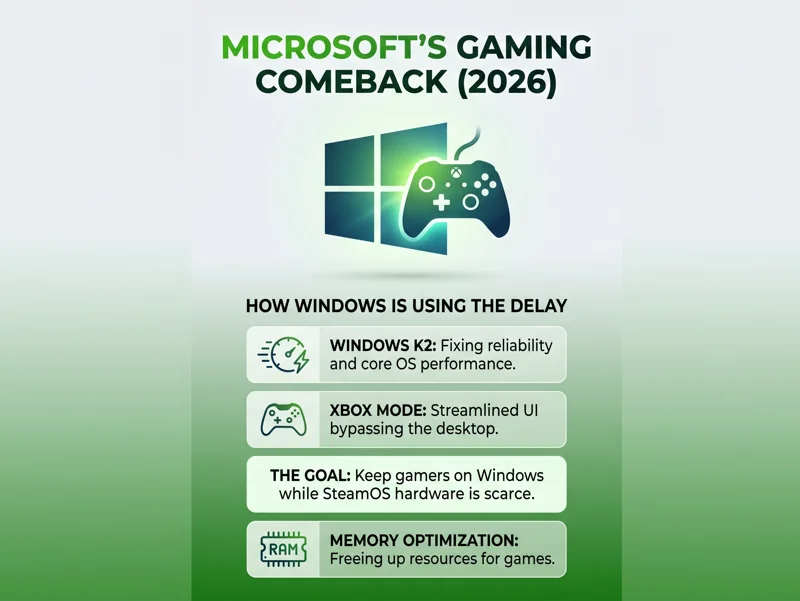
Internal reports indicate Microsoft is pushing a massive initiative known as “Windows K2.” This is not an entirely new operating system replacing Windows 11, but rather a foundational overhaul aimed directly at fixing reliability, performance, and the overall user experience. Microsoft is acutely aware that SteamOS currently offers a slight but consistent performance lead when running games on identical hardware, particularly on devices relying on integrated graphics and shared memory. The K2 initiative is designed to close this gap entirely.
| Windows K2 Initiative Area | Specific Improvement Goal | Benefit to PC Gamers |
|---|---|---|
| Resource Management | Reduce background OS memory usage | Frees up critical RAM for game performance |
| Update Frequency | Minimize forced Windows Update restarts | Uninterrupted gaming sessions |
| User Interface (UI) | Remove intrusive ads and bloatware | Cleaner, faster navigation to game launchers |
The Power of Xbox Mode on Windows 11
Perhaps the most significant weapon in Microsoft’s newly bought time is the widespread rollout of “Xbox Mode” for Windows 11. Initially confined to specific ASUS handhelds, this feature is now becoming available across the Windows ecosystem. Xbox Mode fundamentally changes how the PC operates; it prevents the standard Windows desktop UI from loading entirely, instead booting directly into a streamlined, controller-friendly interface. By bypassing the traditional Windows desktop shell, the system frees up vital memory and CPU cycles—a massive advantage for gamers using lower-end hardware or handhelds during this period of expensive RAM.
While early iterations of Xbox Mode were imperfect and often required a keyboard and mouse for initial game setups, Microsoft is using this delay in Valve’s hardware roadmap to polish the experience. If Microsoft can make Xbox Mode feel as seamless and console-like as SteamOS, they will effectively neutralize one of Valve’s biggest selling points for casual PC gamers.
| Gaming OS Feature | SteamOS (Valve) | Windows 11 Xbox Mode (Microsoft) |
|---|---|---|
| Controller Optimization | Native, seamless integration | Improving, native Xbox UI |
| Game Compatibility | High via Proton (some anti-cheat issues) | 100% Native PC compatibility |
| Hardware Availability | Severely limited by RAMpocalypse | Universal across existing PCs |
The Future of the PC Gaming Monopoly
For more detailed data on how the market is shifting month to month, analysts constantly monitor the Steam Hardware & Software Survey. The data shows that while Linux made historic gains, Windows still controls over 90 percent of the market. The familiarity of Windows is a powerful defensive moat. If a consumer is frustrated with Windows 11 but cannot purchase a Steam Deck due to hardware shortages, they are highly likely to simply stick with what they have.
“If you’re thinking of buying a Steam Machine and literally can’t find one, you’re going to spend that money on something running Windows instead.”
Valve’s software progress has certainly not stopped. They continue to refine the Proton layer and recently improved performance on GPUs with lower memory capacities—a direct software solution to a hardware problem. However, software cannot entirely replace the need for physical devices. The RAMpocalypse has undeniably leveled the playing field just when Valve was preparing a major offensive. Whether Windows continues its undisputed reign or Valve’s hardware troubles turn out to be merely a temporary blip remains to be seen. But one thing is certain: Microsoft has been granted a desperately needed reprieve.
| Timeline | Market Event | Advantage |
|---|---|---|
| 2021 – 2024 | Steam Deck launch & Proton success | SteamOS (Valve) |
| Late 2025 | Steam Machine announced | SteamOS (Valve) |
| 2026 | RAMpocalypse component shortages hit | Windows (Microsoft) |
| Late 2026+ | Windows K2 & Xbox Mode mass rollout | Windows (Microsoft) |
Frequently Asked Questions
What exactly is the RAMpocalypse?
The RAMpocalypse refers to the severe global shortage and massive price increases of PC components, specifically memory (RAM) and storage chips, heavily driven by the tech industry pivoting resources to build servers for generative AI.
Why did the RAMpocalypse delay the Steam Machine?
Valve relies on low-cost, high-volume hardware to push SteamOS. With component prices skyrocketing due to the shortages, Valve cannot currently manufacture the Steam Machine at a competitive, consumer-friendly price point, forcing indefinite delays.
How does the hardware shortage help Microsoft?
Because consumers cannot easily buy SteamOS hardware right now, Microsoft has the time needed to fix Windows 11 performance issues and launch new gaming features, preventing gamers from migrating to Linux while Valve is stalled.
What is Microsoft’s Windows K2 initiative?
Windows K2 is an internal Microsoft effort designed to drastically improve the reliability, speed, and security of the operating system. It focuses on reducing bloat, minimizing forced restarts, and boosting gaming performance on lower-end hardware.
How does Xbox Mode improve Windows 11 for gamers?
Xbox Mode bypasses the standard Windows desktop interface, booting the PC directly into a controller-friendly layout. This stops unnecessary background applications from running, freeing up RAM and CPU power exclusively for gaming.
SteamOS and Linux have made historic gains, climbing from under 1 percent to over 5 percent of the PC gaming market over recent years. However, this growth rate is severely threatened as long as new SteamOS hardware remains unpurchasable.
Does Windows still dominate PC gaming?
Yes. Despite the rise of SteamOS, Windows continues to dominate the landscape, running on over 90 percent of the gaming PCs tracked by global hardware surveys.
Disclaimer: This article is for informational purposes only. Technology markets, supply chains, and hardware availability are highly volatile and subject to rapid change based on global economic factors.