Recent aerospace procurement filings from 2026 have confirmed that nasa to increase value of clps contract to support surge of lunar lander missions. The agency is taking aggressive financial steps to ensure its proposed Moon Base becomes a reality before the end of the decade. By increasing the maximum value of its Commercial Lunar Payload Services (CLPS) contract from $2.6 billion to an astonishing $4.2 billion, NASA is signaling to the commercial space sector that the era of slow, methodical lunar exploration is over. The goal is no longer just exploration; it is establishing a permanent, high-cadence supply chain to the lunar surface.
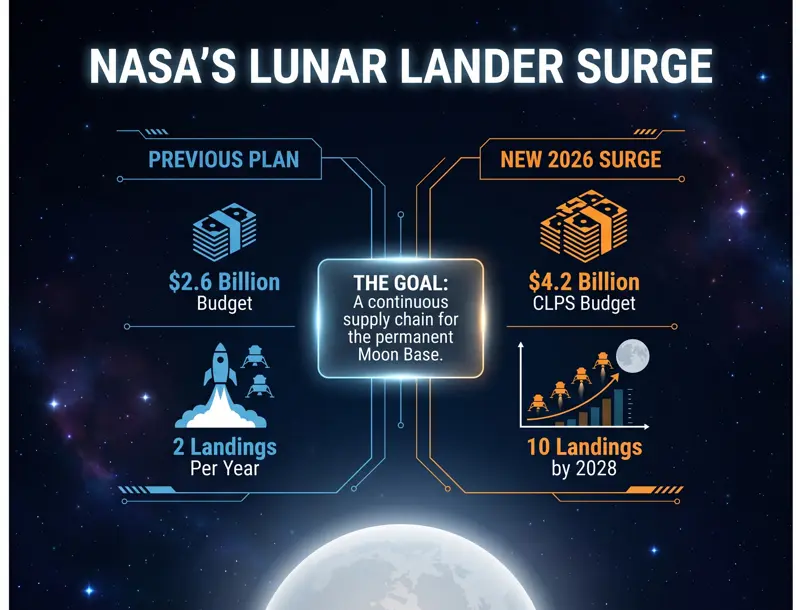
Currently, the CLPS contract encompasses 13 private aerospace companies eligible to compete for specific mission task orders. Thus far, NASA has awarded slightly less than $2 billion in task orders. Under the previous pace of roughly two missions annually, the agency would have barely reached the original contract ceiling by its expiration in 2028. However, this sudden $1.6 billion injection suggests an impending blitz of new, high-value mission awards over the next 24 months as the agency prepares for its CLPS 2.0 follow-on contract.
| CLPS Contract Metric | Original Plan | Updated 2026 Plan |
|---|---|---|
| Maximum Contract Value | $2.6 Billion | $4.2 Billion |
| Average Landing Cadence | 2 per year | Up to 10 per year (by 2028) |
| Contract Expiration | 2028 | 2028 (Transitioning to CLPS 2.0) |
The Drive Toward a Monthly Moon Base Cadence
The motivation behind this massive budget expansion was made clear during NASA’s recent “Ignition” event. The agency outlined its foundational blueprint for a lunar habitat, simply referred to as “Moon Base.” To construct and supply this base, NASA is projecting an unprecedented logistical pipeline: nine robotic landings in 2027, scaling up to ten landings in 2028. This translates to a near-monthly launch cadence.
“We have to start ramping now into this higher cadence, with a target of monthly landings, to bring some of the things to the surface very, very soon for Moon Base.”
Joel Kearns, deputy associate administrator for exploration in NASA’s Science Mission Directorate, emphasized that the agency is actively looking for opportunities to buy into this ramped-up demand in the very short term. The challenge, however, shifts from NASA’s budget to the commercial sector’s manufacturing capabilities. Can private industry keep up with a monthly lunar launch schedule?
Commercial Aerospace Scrambles to Scale Production
The proposed surge has sparked healthy skepticism within the industry, primarily due to the intricate supply chains and lengthy development cycles required for spacecraft. However, the top contenders in the CLPS program are already expanding their infrastructure to meet the call.
| Aerospace Company | Current Lunar Lander Hardware | Manufacturing Scaling Efforts |
|---|---|---|
| Firefly Aerospace | Blue Ghost series | Added clean rooms to support 8 spacecraft simultaneously. |
| Blue Origin | Blue Moon Mark 1 (Endurance) | Operating a 190,000 sq ft dedicated Lunar Plant 1 factory. |
| Astrobotic | Griffin / Peregrine | Scaled facilities designed from day one for multiple landers. |
Firefly Aerospace is currently pushing forward with three landers in production (Blue Ghosts 2, 3, and 4) and has secured additional clean room space to handle up to eight spacecraft simultaneously. Similarly, Blue Origin is finalizing tests on its Blue Moon Mark 1 lander at its massive 190,000-square-foot Lunar Plant 1 facility in Florida, preparing for the delivery of NASA’s VIPER rover in 2027.
“There’s a lot of creative solutions that we can come up with. Having that signal is really important. We know that this is coming. We can set ourselves up for success.”
From Bespoke Crafts to Build-to-Print Standardization
The most critical bottleneck for these companies is the supply chain. Ben Bussey, chief scientist at Intuitive Machines, noted that fulfilling multiple missions per year requires either an ironclad external supply chain or bringing component manufacturing entirely in-house. To learn more about how NASA manages these commercial partnerships, you can review details on NASA’s official website.
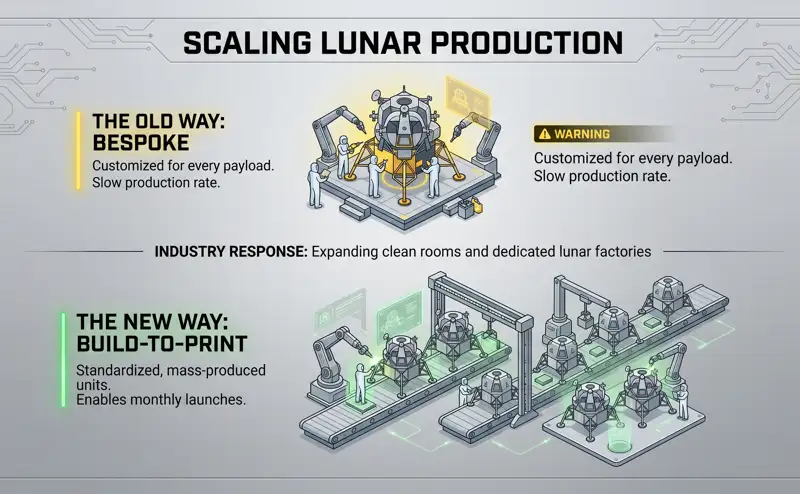
Historically, early CLPS landers were heavily customized, bespoke machines tailored to specific scientific payloads. To achieve NASA’s ambitious 2028 goals, this artisanal approach to spacecraft manufacturing must end. The industry is rapidly pivoting toward standardizing its hardware.
| Manufacturing Approach | Characteristics | Scalability for Moon Base |
|---|---|---|
| Bespoke / Custom | Highly modified per payload, slow production. | Poor (Cannot support monthly flights). |
| Build-to-Print | Standardized, mass-produced identical units. | Excellent (Essential for high-cadence logistics). |
“Going to build-to-print landers is maybe the response to the signal from NASA’s Ignition plans… We’re going to build-to-print dozens of landers to help NASA achieve its goals.”
By treating lunar landers like assembly-line vehicles rather than unique scientific experiments, companies like Blue Origin and Intuitive Machines hope to meet NASA’s demand. If successful, this financial and logistical surge will permanently transform Earth’s relationship with its closest celestial neighbor, laying the groundwork for continuous human presence on the moon.
Frequently Asked Questions
What is the CLPS program?
CLPS stands for Commercial Lunar Payload Services, a NASA initiative that contracts private aerospace companies to deliver science and technology payloads to the Moon.
By how much is NASA increasing the CLPS contract?
NASA is increasing the maximum value of the CLPS contract from $2.6 billion to $4.2 billion.
Why does NASA need more lunar landers?
NASA requires a sharp increase in robotic lunar landers to deliver supplies and infrastructure for its proposed “Moon Base,” targeting nearly monthly landings by 2028.
How many missions is NASA targeting for 2028?
During the “Ignition” event, NASA outlined plans for up to 10 robotic lunar landings in the year 2028 alone.
Which companies are involved in the CLPS program?
There are 13 eligible companies, with key players currently producing landers including Firefly Aerospace, Blue Origin, Astrobotic, and Intuitive Machines.
What is the biggest challenge for these commercial companies?
The primary hurdle is managing the spacecraft component supply chain and scaling up manufacturing to transition from building custom landers to mass-producing them.
What does “build-to-print” mean in this context?
“Build-to-print” means manufacturing standardized, identical lunar landers on a production line, rather than custom-designing each spacecraft for its specific payload.
Disclaimer: This article is for informational purposes only. Aerospace project timelines, contract values, and mission launch dates are subject to change based on technological development and government funding adjustments.