
Recent leaks have revealed that the nvidia geforce rtx 5060 and 5060 ti planned with 9 gb vram will soon disrupt the entry-level and mid-range PC gaming markets in 2026. Following rumors about the RTX 5050 sporting similar specifications, fresh intelligence sourced from the Board Channels forum indicates that NVIDIA is doubling down on this unique memory configuration for its 60-class desktop graphics cards. By leveraging next-generation GDDR7 memory modules, NVIDIA intends to strike a delicate balance between catering to budget consumers and aggressively managing soaring DRAM and Bill of Materials (BOM) costs. However, this shift is not without its controversies, as it introduces a significant architectural change that could divide the PC building community.
The Leak & Specs: A New Era for the RTX 5000 Series
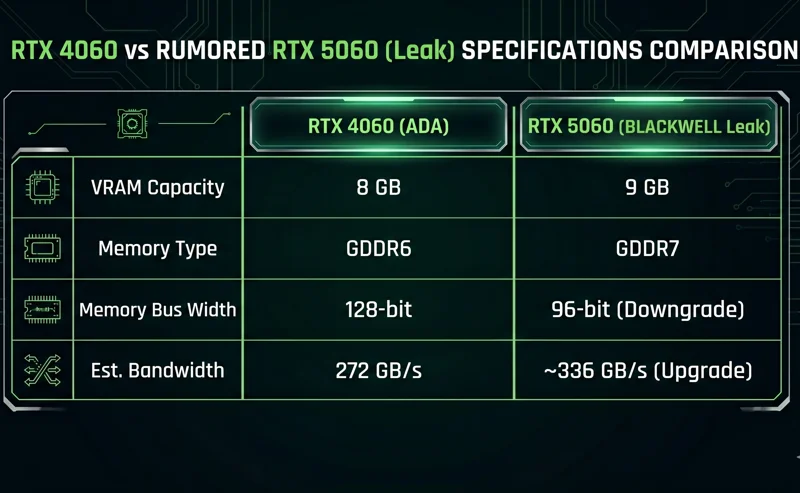
According to prominent hardware leakers, the upcoming 60-class GPUs will move away from the traditional 8GB and 16GB capacities seen in the previous Ada Lovelace generation. Instead, NVIDIA is opting for a 9GB configuration, utilizing three cutting-edge 3GB (24 Gbit) GDDR7 memory modules. This allows the manufacturer to increase the total memory pool slightly compared to the base RTX 4060, while capitalizing on the massive speed improvements inherent to GDDR7 technology.
“By transitioning to 24 Gbit GDDR7 modules, NVIDIA can offer 9GB of VRAM, giving budget gamers a slight capacity bump while heavily offsetting the manufacturing costs associated with standard 128-bit memory configurations.”
The highly anticipated budget GPU release date is tentatively scheduled between May and June of 2026. Industry analysts strongly suspect that a high-profile Computex graphics card launch is imminent, which aligns perfectly with NVIDIA’s historical release cadence for mainstream desktop components. You can monitor upcoming announcements directly through the official NVIDIA GeForce portal.
| GPU Model | VRAM Capacity | Memory Type | Bus Interface |
|---|---|---|---|
| RTX 4060 (Previous Gen) | 8 GB | GDDR6 | 128-bit |
| RTX 5060 (Leaked 2026) | 9 GB | GDDR7 | 96-bit |
| RTX 5060 Ti (Leaked 2026) | 9 GB | GDDR7 | 96-bit |
The Performance Trade-Off: The NVIDIA 96-bit Bus Downgrade
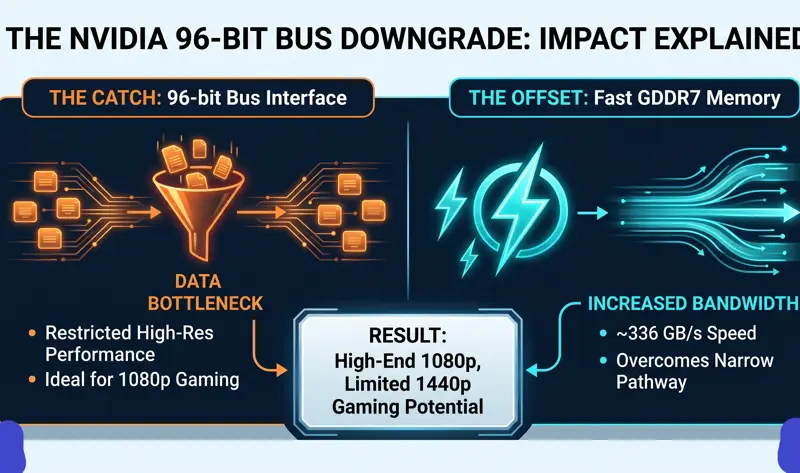
While an extra gigabyte of VRAM sounds appealing on paper, the true cost of this redesign is the memory interface. The new RTX 5000 series specs for these mid-range cards detail a controversial NVIDIA 96-bit bus downgrade. Moving from a 128-bit bus down to a 96-bit bus fundamentally restricts how much data can travel between the GPU core and the video memory at any given time.
NVIDIA’s strategy relies heavily on the raw speed of GDDR7 to mask this narrower highway. The leaked specifications suggest that despite the narrower bus, the total GDDR7 memory bandwidth will hover around 336 GB/s. This is a respectable number that actually surpasses the older 128-bit GDDR6 setups. However, critics argue that pairing a 96-bit bus with 60-class tier cards artificially limits their potential at higher resolutions like 1440p, effectively restricting them to high-refresh-rate 1080p gaming.
“The reduction to a 96-bit memory bus is a calculated risk. While GDDR7 speeds compensate for the narrower interface, modern games pushing high-resolution textures will quickly test the limits of this architectural compromise.”
Will the RTX 5060 Series Be Worth It?
For PC builders targeting a strict budget, these upcoming cards present an interesting value proposition. The inclusion of new architectural features, improved ray tracing cores, and enhanced DLSS frame generation capabilities will likely make the RTX 5060 and 5060 Ti highly capable 1080p powerhouses. However, gamers expecting a massive generational leap for 1440p performance might need to adjust their expectations or save up for the higher-tier 5070 models.
| Performance Metric | RTX 4060 | RTX 5060 / 5060 Ti (Expected) |
|---|---|---|
| Total Memory Bandwidth | 272 GB/s | \~336 GB/s |
| Primary Target Resolution | 1080p Gaming | 1080p Ultra / 1440p Entry |
| Manufacturing Cost Focus | Standard Module Usage | BOM Reduction via 24Gbit Chips |
Frequently Asked Questions
What is the main rumor about the new budget NVIDIA GPUs?
Leaks suggest that both the RTX 5060 and 5060 Ti will feature 9 GB of GDDR7 VRAM on a narrower 96-bit memory bus.
Why is NVIDIA using 9 GB of VRAM instead of 8 GB or 16 GB?
NVIDIA is reportedly using three new 24 Gbit (3GB) GDDR7 memory modules to lower Bill of Materials (BOM) costs while still providing a slight capacity increase over the previous generation.
What does
bit bus downgrade mean for gaming?
Answer: A narrower bus width restricts the physical pathway for data transfer. While the high speed of GDDR7 compensates for this, it may limit optimal performance at higher resolutions like 1440p or 4K.
When is the expected release date for the RTX 5060 and 5060 Ti?
Current rumors point to an announcement and potential launch window between May and June of 2026, likely aligning with the Computex trade show.
Will the RTX 5060 have higher bandwidth than the RTX 4060?
Yes, despite the narrower 96-bit bus, the transition to ultra-fast GDDR7 memory is expected to yield a total bandwidth of around 336 GB/s, which is higher than the RTX 4060’s 272 GB/s.
What memory type will the RTX 5000 series use?
The upcoming Blackwell architecture, which includes the 5000 series desktop GPUs, is heavily rumored to transition to the new GDDR7 memory standard.
Are these specifications officially confirmed by NVIDIA?
No, currently these specifications are based on reliable leaks from hardware forums and supply chain analysts. Official specs will be confirmed upon NVIDIA’s formal announcement.
Disclaimer: This article is for informational purposes only. The specifications, release dates, and performance metrics discussed are based on industry leaks and rumors as of early 2026 and are subject to change prior to official confirmation by the manufacturer.