The tech world in 2026 is experiencing a seismic shift as Nvidia chases $200B CPU market with AI agent PCs from Microsoft Dell and HP. Moving beyond its traditional stronghold of discrete graphics cards, the semiconductor giant is now aggressively pursuing the central processing unit sector. This bold maneuver at the Computex trade show has redefined what personal computers are capable of achieving, introducing the highly anticipated RTX Spark superchip to the global audience.
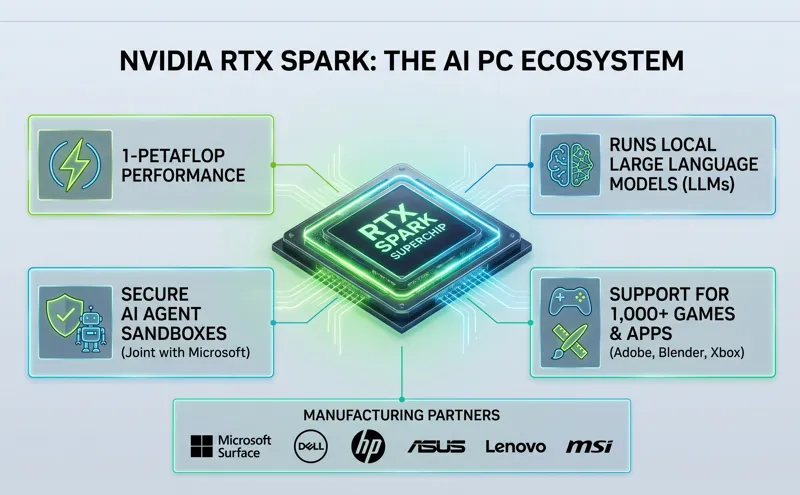
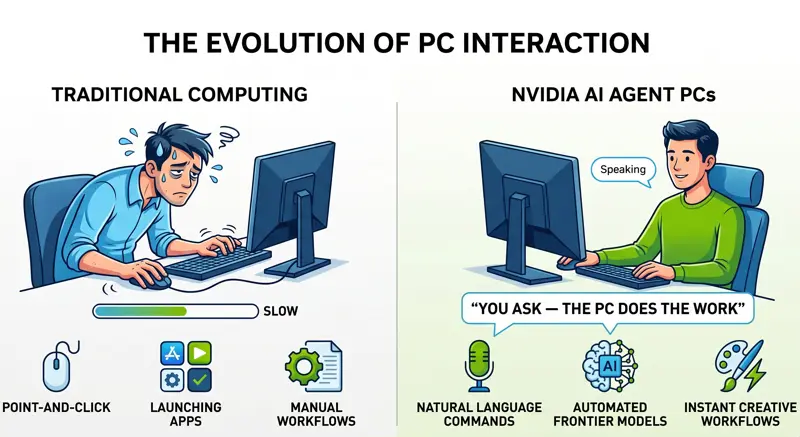
For years, users have relied on cloud-based systems for heavy artificial intelligence computing. However, with the newly introduced 1-petaflop processor, everyday users and enterprise clients will soon have massive computing power right on their desks. The era of pointing, clicking, and typing is slowly fading away, replaced by seamless verbal commands and automated desktop tasks.
The Strategy: Nvidia chases $200B CPU market with AI agent PCs from Microsoft Dell and HP
The ambitious goal set by CEO Jensen Huang is not just about competing with existing processors; it is about entirely creating a new category of hardware. As Nvidia chases $200B CPU market with AI agent PCs from Microsoft Dell and HP, the core strategy relies on the proprietary RTX Spark technology. This chip acts as a “superchip,” meticulously designed to handle the complex computations required by modern AI tools.
These new machines are built to run local large language models seamlessly without relying on constant internet connections. By partnering with major hardware manufacturers, Nvidia ensures that its new architecture will reach millions of consumers globally right from day one.
| Feature | Specification Detail |
|---|---|
| Processor Name | RTX Spark (Superchip) |
| Performance | 1-Petaflop capability |
| Key Partners | ASUS, Dell, HP, Lenovo, Microsoft |
Why Nvidia chases $200B CPU market with AI agent PCs from Microsoft Dell and HP using RTX Spark
The foundation of this massive hardware shift is the concept of AI agents like OpenClaw or Hermes Agent. Because Nvidia chases $200B CPU market with AI agent PCs from Microsoft Dell and HP, the company had to ensure that these agents operate in highly secure environments. Jointly developed with Microsoft, these secure sandboxes prevent data leaks while allowing the AI to access local files and complete complex workflows.
This integration provides enough CPU, GPU, and RAM allocation seamlessly managed by underlying Nvidia CUDA software. More than 100 Windows software makers, including Adobe and Riot Games, have already optimized their applications to take advantage of this localized power.
“With RTX Spark and Microsoft Windows, you ask — and the PC does the work. Frontier models. Creative workflows. RTX games. All on a laptop.”
Local Large Language Models: How Nvidia chases $200B CPU market with AI agent PCs from Microsoft Dell and HP
Operating local large language models is a game-changer for data privacy and speed. While it is true that Nvidia ARM-based Windows devices have failed before—most notably the 2013 Surface RT disaster—the current landscape is drastically different. This time, as Nvidia chases $200B CPU market with AI agent PCs from Microsoft Dell and HP, the chips are vastly more powerful and specifically tailored for modern demands.
Microsoft is already positioning its RTX Spark-equipped device as the Surface Laptop Ultra, branding it the most powerful Surface ever built. Dell and HP are quickly following suit with their premium enterprise and creator lineups.
| Manufacturer | Flagship AI PC Model |
|---|---|
| Microsoft | Surface Laptop Ultra |
| Dell | XPS Agent Edition (Rumored) |
| HP | Spectre AI Pro |
Financial Goals: Nvidia chases $200B CPU market with AI agent PCs from Microsoft Dell and HP
The financial motivations are staggering. Having already sold $20 billion worth of the high-end server CPU called Vera, Nvidia sees the consumer PC market as the next logical frontier. As Nvidia chases $200B CPU market with AI agent PCs from Microsoft Dell and HP, investors are closely watching the adoption rates of these advanced computing machines.
The concept is simple: if billions of AI agents are going to use tools just like humans use PCs today, the demand for powerful, localized CPUs will skyrocket. Nvidia aims to be the primary supplier for this incoming hardware revolution.
“We’ll have billions of agents, and those billions of agents will all use tools. We’re going to need a lot more CPUs to power the future of computing.”
Competitors React as Nvidia chases $200B CPU market with AI agent PCs from Microsoft Dell and HP
The industry is not sitting idle. Competitors are heavily monitoring pricing structures. Currently, Nvidia sells the DGX Spark mini-computer to developers for about $4,800. For mainstream adoption, the new consumer laptops will need to compete with affordable options like the popular Mac Mini. If you want to learn more about Nvidia’s broader vision, you can visit the official Nvidia website.
| Market Segment | Target Audience |
|---|---|
| Enterprise | Data analysts and security-focused firms |
| Creators | Video editors, 3D modelers using Blender |
| Gamers | Players utilizing RTX AI-enhanced titles |
Future Outlook: Nvidia chases $200B CPU market with AI agent PCs from Microsoft Dell and HP
Ultimately, the success of this endeavor depends on whether consumers truly want to transition from traditional operating systems to agent-driven workflows. Given Nvidia’s track record of pushing technological boundaries and generating record quarterly revenues, betting against their vision is incredibly risky. As Nvidia chases $200B CPU market with AI agent PCs from Microsoft Dell and HP, the standard for what defines a personal computer is being rewritten forever.
FAQs About How Nvidia chases $200B CPU market with AI agent PCs from Microsoft Dell and HP
What is the RTX Spark?
The RTX Spark is a new 1-petaflop superchip developed by Nvidia, designed specifically to run AI agents securely on local Windows PCs.
Which companies are partnering with Nvidia?
Major PC manufacturers including ASUS, Dell, HP, Lenovo, Microsoft Surface, and MSI are launching PCs powered by the RTX Spark.
What is the main advantage of these AI PCs?
They feature secure sandboxes to run local large language models, providing better privacy, faster AI performance, and eliminating the need to rely strictly on cloud processing.
Has Nvidia tried making ARM-based Windows devices before?
Yes. In 2013, Nvidia and Microsoft collaborated on the Surface RT, which ultimately failed. However, the new RTX Spark is significantly more powerful and represents a completely different technological approach.
How does this impact software developers?
More than 100 Windows software makers, including Adobe and Riot Games, have already signed on to support the new chip, optimizing their software for local AI tasks.
What is the financial goal behind this launch?
CEO Jensen Huang aims to capture a new $200 billion market by selling high-performance CPUs for AI processing, expanding far beyond their traditional GPU business.
Will these new AI PCs be affordable?
Pricing details are still emerging, but manufacturers will have to compete strategically against existing affordable AI-capable devices like Apple’s Mac Mini.
Disclaimer: This article is for informational purposes only…