The 2026 technological landscape has been forever changed by the reality of manufacturing qubits that can move. For over a decade, the ultimate quantum computing breakthrough seemed trapped by a massive hardware dilemma.
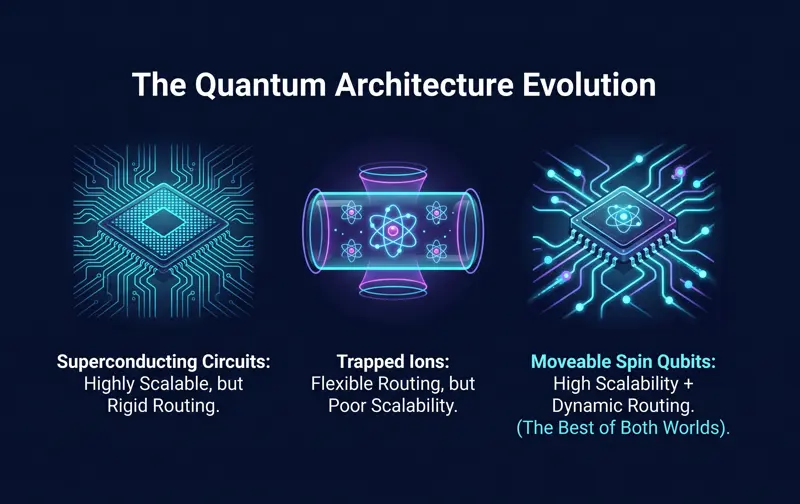
Engineers were forced to choose between highly scalable electronic chips that locked qubits rigidly in place, or flexible atom-based systems that were notoriously difficult to scale. Neither option offered a clear path to commercial viability.
Today, manufacturing qubits that can move bridges this gap perfectly. This hybrid approach combines the massive scalability of solid-state chips with the free-flowing flexibility of trapped-ion systems.
At the core of this paradigm shift is advanced spin qubits technology. By isolating electrons in silicon, researchers have created stable, scalable, and fully mobile data carriers.
“By turning rigid silicon arrays into dynamic data networks, we have completely resolved the worst routing bottleneck in quantum architecture.”
The Science Behind manufacturing qubits that can move
Historically, stationary superconducting setups limited entanglement strictly to immediate physical neighbors on a chip. This structural flaw required engineers to build highly complex, error-prone wiring just to execute simple logic operations.
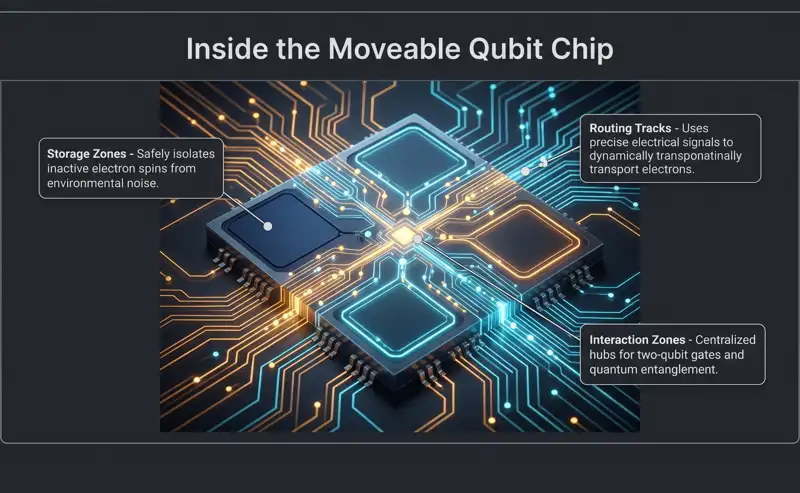
However, the process of manufacturing qubits that can move allows electron spins to travel along a microscopic conveyor belt. This drastically reduces the physical wiring needed on the processor.
Through precision quantum dot manufacturing, engineers can now create traveling potential wells. These tiny electric pockets shuttle the electrons across the purified silicon substrate without collapsing their delicate quantum state.
| Architecture Feature | Stationary Superconducting Qubits | Dynamic Spin Qubits (2026) |
|---|---|---|
| Fabrication Scalability | High (Silicon Fab) | High (CMOS Compatible) |
| On-Chip Mobility | None (Static) | High (Dynamic Shuttling) |
| Qubit Connectivity | Nearest Neighbor Only | Long-Range Dynamic Routing |
QuTech’s Role in manufacturing qubits that can move
The pioneering work by the QuTech Research Institute and Delft University of Technology turned this dynamic theory into reality. Their groundbreaking experiments pushed the boundaries of modern semiconductor physics.
Their research team successfully demonstrated high-fidelity logic gates happening on the fly. Two mobile electrons were routed together, entangled, and separated again without losing phase coherence.
This phenomenal quantum computing breakthrough even allowed for successful quantum teleportation between moving nodes. It proved that complex data transfers could happen dynamically across an active grid.
“This dynamic choreography allows qubits to interact freely, drastically shrinking the physical footprint required for fault-tolerant computing.”
Furthermore, routing these traveling states to dedicated readout zones heavily streamlines quantum error correction. Future chips will simply funnel mobile qubits to centralized diagnostic zones, minimizing bulky hardware.
| QuTech Experiment Milestone | Impact on Future Quantum Architecture |
|---|---|
| High-Fidelity Shuttling | Validated that electron spins can move seamlessly without errors. |
| In-Motion Logic Gates | Enabled remote operations, eliminating static wiring congestion. |
| Centralized Readout Stations | Allowed classical hardware to measure states highly efficiently. |
Commercial Impact of manufacturing qubits that can move
The transition from academic labs to commercial foundries is moving faster than ever. The entire semiconductor industry is preparing for a massive shift in hardware fabrication.
Semiconductor giants are actively adapting standard CMOS lines for manufacturing qubits that can move at a massive scale. The reliance on standard purified silicon makes this incredibly cost-effective.
Because the foundational materials are already used in consumer electronics, the financial barriers are drastically lower. This modular architecture can be scaled up to millions of logical qubits efficiently.
“Leveraging existing CMOS infrastructure for dynamic spin qubits is the exact tipping point where theoretical physics becomes profitable industrial engineering.”
| Development Phase | Projected Industry Timeline |
|---|---|
| Prototype Modular Silicon Chips | Active Fabrication & Pilot Testing (2026) |
| Fault-Tolerant Commercial Arrays | Anticipated Market Rollout (2028-2029) |
| Widespread Enterprise Integration | Expected Mainstream Adoption (Early 2030s) |
Frequently Asked Questions About manufacturing qubits that can move
What does this manufacturing technique actually involve?
It involves fabricating semiconductor chips where the physical quantum information carriers, specifically electron spins, are transported across the silicon via electrical pulses.
Why is mobility considered the ultimate goal for this tech?
Mobility allows distant qubits to interact and perform logic gates on demand, completely resolving the physical wiring bottlenecks found in older stationary setups.
How do spin qubits differ from standard superconducting qubits?
Superconducting qubits rely on artificial macroscopic circuits requiring extreme cooling, while spin qubits utilize the natural magnetic spin of single electrons trapped in silicon.
What role does quantum dot manufacturing play here?
Quantum dots act as engineered nanoscale pockets of electric potential. Lining them up creates an invisible conveyor belt to shuttle electrons smoothly across the chip.
How is quantum teleportation used in this system?
By moving entangled qubits and measuring them, researchers can instantly transfer quantum states between distant nodes without a hardwired physical connection.
How does quantum error correction work with moving targets?
The system routes moving qubits into designated, stationary readout zones where classical hardware safely measures and corrects errors without needing dedicated wiring for every qubit.
Will this breakthrough reduce the final cost of quantum computers?
Yes. Because these arrays utilize existing silicon CMOS infrastructure, the economies of scale will make mass production significantly cheaper than custom-built alternatives.
Disclaimer: This article is for informational purposes only. The views, scientific descriptions, and timelines expressed regarding quantum computing technologies represent current industry research and market projections as of 2026, and are subject to continuous evolution as empirical capabilities advance.