When analyzing the latest tech privacy news, the lg smart tv acr denial industry standard eu controversy stands out as a prime example of consumer concern.
A recent investigation by Gamers Nexus into LG smart TVs has sparked a massive debate regarding data privacy in the home.
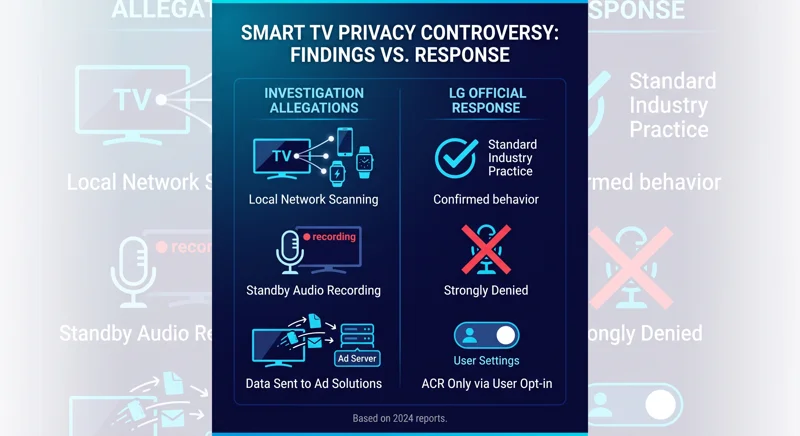
Independent security researchers alleged that these retail OLED sets log user data, upload home network information, and even record standby audio.
In response, LG strongly denied the standby recording claims while confirming other network behaviors.
Understanding the lg smart tv acr denial industry standard eu Debate
The core of this issue revolves around what actually happens when your television screen goes dark.
According to the independent investigation, the connected sets continuously scan local networks.
They allegedly probe for nearby hardware, such as smartwatches and smartphones, logging location data and nearby Wi-Fi endpoints.
Privacy in the modern living room is no longer guaranteed by simply turning off the screen.
LG completely disputes the most severe allegations, specifically the constant data logging and standby audio recording.
However, the technology company confirmed that scanning local networks for other devices is indeed a real feature.
More importantly, they labeled this continuous network scanning as standard behavior across all modern smart televisions.
Breaking Down the lg smart tv acr denial industry standard eu Details
The captured data allegedly feeds directly into LG Ad Solutions, making your daily viewing habits a highly profitable metric.
To understand the full scope of this issue, we must look closely at Automatic Content Recognition (ACR).
ACR technology is practically universal among modern connected television manufacturers today.
| Researcher Allegation | LG Official Response | Industry Reality |
|---|---|---|
| Records audio while on standby | Strongly denied | Requires further independent testing |
| Scans local Wi-Fi networks | Confirmed | Common across connected devices |
| Stores voice commands unencrypted | Not publicly addressed yet | Major security concern if true |
The fact that LG explicitly calls this network scanning an industry norm shifts the spotlight onto the broader technology market.
Virtually every major smart TV maker relies on content recognition technology to build detailed consumer viewing profiles.
If you are researching the lg smart tv acr denial industry standard eu issue, you will quickly find that ACR behaves very differently depending on your geographic region.
Why the lg smart tv acr denial industry standard eu Matters for European Users
Europe currently operates under incredibly strict privacy laws, most notably the General Data Protection Regulation (GDPR).
Because of these stringent regulations, smart TV tracking features often face severe legal caution before deployment.
The lg smart tv acr denial industry standard eu conversation highlights exactly how specific tracking features are disabled in certain markets.
If a brand can easily switch off ACR tracking in the UK or the EU, maintaining it everywhere else is clearly a deliberate policy choice.
A television that scans your private network is ultimately a design decision with a settings screen attached.
Regulators based in Brussels have a long history of aggressively pursuing manipulative design and unauthorized data processing.
For more official insights on data protection standards and consent regulations, you can review the European Data Protection Board guidelines.
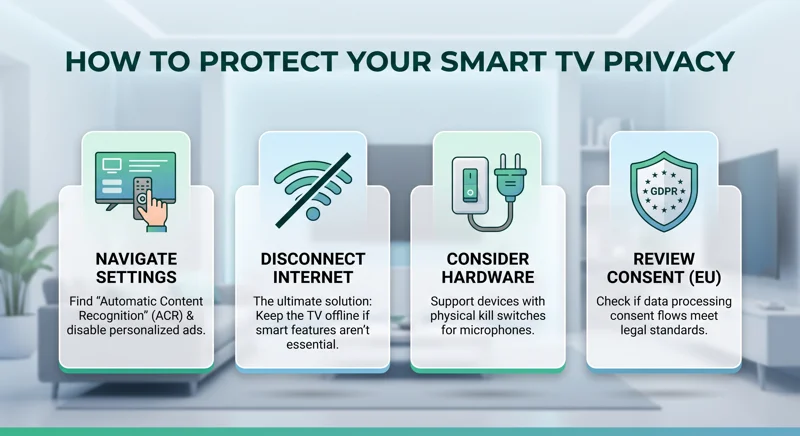
Consent flows on European LG sets must meet a very high legal standard, an issue that regulators are currently scrutinizing.
The Future of the lg smart tv acr denial industry standard eu Discussion
Physical hardware mitigations, such as a physical microphone kill switch, currently remain the best defense against unwanted recording.
While the lg smart tv acr denial industry standard eu debate continues to unfold, consumers are often left navigating confusing settings menus.
Finding the specific toggle switch to successfully disable personalized advertisements is often intentionally made difficult by manufacturers.
| Privacy Mechanism | Effectiveness | User Effort Required |
|---|---|---|
| Software Toggle (Opt-out) | Moderate – Subject to updates | High – Buried in menus |
| Physical Kill Switch | High – Cuts hardware power | Low – Single button press |
| Keeping TV Offline | Absolute – Zero data transfer | Moderate – Disables smart features |
Frequently Asked Questions About the lg smart tv acr denial industry standard eu
What exactly is the lg smart tv acr denial industry standard eu controversy?
It refers to recent allegations of LG televisions recording standby data, the company’s official denial of audio recording, and the debate over whether network scanning is an accepted industry norm under European privacy laws.
Does LG record my conversations while the TV is on standby?
LG strongly denies recording standby audio. However, independent researchers claim the devices still log significant network data while supposedly turned off.
What is Automatic Content Recognition (ACR)?
ACR is a technology used by almost all smart TV manufacturers to identify the content playing on your screen to serve targeted personalized advertisements.
How does the lg smart tv acr denial industry standard eu impact GDPR compliance?
Under European GDPR rules, gathering network data and viewing habits requires explicit user consent, raising legal questions about how smart TVs obtain this permission by default.
Did LG admit to scanning local Wi-Fi networks?
Yes, LG officially confirmed that its televisions scan local networks for other devices, explicitly stating this practice is a standard behavior across modern smart TVs.
Can I stop my smart TV from collecting my personal data?
You can usually limit data collection by navigating your TV settings to disable ACR and personalized ads, or completely disconnect the television from your internet network.
Why do smart TVs need to collect so much user data?
Modern television sets operate largely as advertising businesses, utilizing user data and content recognition to sell highly targeted advertisements and subsidize the initial hardware cost.
Disclaimer: This article is for informational purposes only and does not constitute legal or professional privacy advice. Always review the privacy policies of your specific electronic devices and consult official regional regulations regarding data protection.