in

The Hidden 4K Tax: Why Tech Giants Are Secretly Killing HEVC Support on Your New PCs

It is an undeniable reality in 2026 that lawsuits licensing and royalties are complicating 4k video support in gadgets. For years, consumers have enjoyed the luxury of streaming ultra-high-definition video content without giving a second thought to the underlying technology making it possible. You buy a premium laptop, boot it up, and expect Netflix, Apple TV+, and your own smartphone recordings to play flawlessly. But when corporate giants clash over the rights to essential technologies like the HEVC/H.265 codec, the illusion that modern technology “just works” shatters completely.
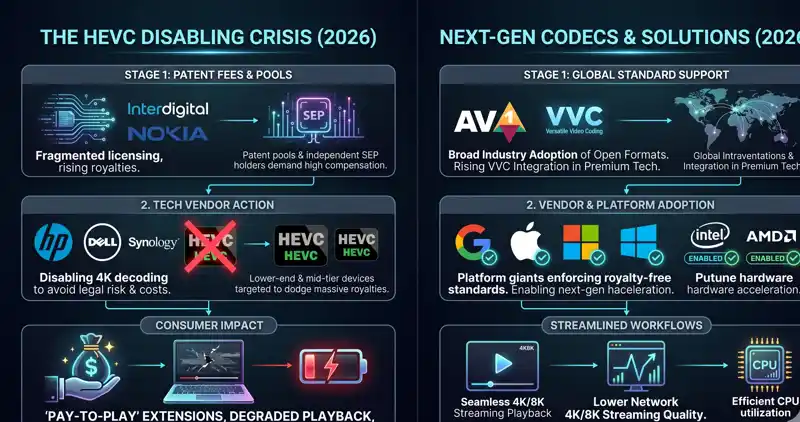
Infographic flowchart showing the HEVC disabling crisis in 2026, illustrating how high patent fees and rising royalties force tech vendors to disable built-in 4K hardware decoding, resulting in degraded playback, battery drain, and forced pay-to-play software extensions for consumers.
A visual breakdown of why major PC and NAS vendors are disabling hardware-level HEVC support to avoid massive royalty fees, directly impacting the consumer 4K streaming experience.

Recently, a disturbing trend has emerged across the consumer electronics landscape. Major PC manufacturers and network-attached storage (NAS) vendors are actively disabling HEVC support that is already physically built into third-party hardware components like Intel and AMD processors. This silent removal raises an uncomfortable

nfographic flowchart showing the HEVC disabling crisis in 2026, illustrating how high patent fees and rising royalties force tech vendors to disable built-in 4K hardware decoding, resulting in degraded playback, battery drain, and forced pay-to-play software extensions for consumers.
A visual breakdown of why major PC and NAS vendors are disabling hardware-level HEVC support to avoid massive royalty fees, directly impacting the consumer 4K streaming experience.

Why would tech vendors intentionally cripple a computer’s ability to play high-resolution video? The answer lies in a deeply convoluted web of patent licensing, aggressive litigation, and skyrocketing royalty fees. The Crushing Weight of HEVC Patent Pool Licensing Fees Implementing modern video codecs requires navigating an intricate maze of technical and legal requirements built atop a heavily fragmented patent system. The High-Efficiency Video Coding (HEVC) standard, also known as H.265, is practically mandatory for 4K HDR streaming compatibility. Streaming giants and smartphone manufacturers rely on it because it compresses video far more efficiently than its predecessor, AVC/H.264, saving massive amounts of bandwidth while preserving incredible image quality. However, the technologies required for HEVC decoding and encoding are patented by a multitude of telecommunications and tech companies, including Ericsson, InterDigital, and Nokia. For a manufacturer to legally sell a product that uses HEVC, they must pay licensing fees and royalties to these patent holders. Because there are thousands of patents involved, third-party organizations known as patent pools aggregate these patents and license them out in packages. Patent Pool / Entity Role in HEVC Licensing Market Impact Access Advance Administers pools covering \~80% of global HEVC patents. Sets standard royalty rates for vendors; recently increased rates. Velos Media Previously administered a smaller pool of \~450 patents. Ended its HEVC patent pool in 2023, complicating B2B licensing. Independent Licensors (e.g., Nokia) Holders of Standard Essential Patents (SEPs) operating outside pools. Often pursue aggressive litigation to secure independent royalties. The problem is that HEVC patent pool licensing fees are becoming increasingly prohibitive for original equipment manufacturers (OEMs). Access Advance, the primary administrator for HEVC licenses in the US, recently restructured its agreements, pushing up royalty rates by as much as 20 percent for renewals. Furthermore, chipmakers like Intel and AMD do not pay these pool royalties on behalf of the OEMs. If HP puts an Intel chip in a laptop, HP is solely responsible for paying the HEVC tax for the entire device. Faced with these mounting costs, many vendors simply decide that lower-end and mid-tier devices do not justify the expense. There is a conscious decision being made by tech vendors to worsen the consumer experience by taking this functionality out in a way that evades massive corporate royalties. Why Tech Vendors Are Pulling the Plug In recent years, several massive tech companies have killed HEVC functionality in devices that were originally engineered to support the codec. Dell and HP, for example, have disabled H.265 hardware decoding acceleration that has been inherently present in CPU architecture since 2015. When questioned, representatives have admitted that HEVC support is now largely reserved for “premium systems” boasting discrete graphics cards, integrated 4K displays, or high-end Blu-ray software. The server and networking space is suffering a similar fate. In 2024, Synology completely removed HEVC, AVC, and VC-1 transcoding support from its DiskStation Manager (DSM) operating system. Synology cited that most users handle transcoding on their client devices (like phones or smart TVs) rather than the server. However, they also openly admitted that avoiding excessive patent licensing costs was a massive driver for the removal. Hardware Vendor Action Taken Regarding HEVC Stated or Implied Reason HP Disabled HEVC hardware decoding on 200/400/600 Series laptops. Devices not intended for high-res workloads; cost savings. Dell Restricted HEVC to “premium” systems only. Avoiding blanket royalty fees across budget product lines. Synology Removed server-side HEVC transcoding from NAS devices. Server optimization and dodging heavy licensing costs. Tech Vendor Codec Royalty Lawsuits Beyond the guaranteed fees paid to patent pools, vendors face an even darker threat: unpredictable litigation. The tech vendor codec royalty lawsuits have created a chilling effect across the industry. Standard Essential Patents (SEPs) are supposed to be licensed openly under Fair, Reasonable, and Non-Discriminatory (FRAND) terms. However, what constitutes “fair” is highly subjective. Nokia, a major holder of HEVC SEPs, has sued HP, Amazon, Hisense, and even major studios like Warner Bros. Discovery over HEVC usage. In a landmark case, Acer and Asus were completely prohibited from selling PCs in Germany after a Munich Regional Court ruled that their computers infringed on Nokia’s patents. When the threat of an entire product line being banned from a country is on the table, disabling the codec entirely becomes a very attractive risk management strategy for OEMs. Litigation is always a last resort, but sometimes it is the only way to respond to companies who choose not to play by the rules followed and respected by many others. The Consumer Impact: Paying the “4K Tax” When multi-billion-dollar corporations decide to play legal chicken, the consumer is inevitably the one who loses. When a company disables hardware-based HEVC encoding and decoding, standard computer functionality breaks down. Suddenly, 4K and HDR streams on services like Netflix fail to load in desktop apps. Videos shot in the high-efficiency format on modern iPhones refuse to open in default media players. Instead of the CPU’s dedicated media engine handling the video seamlessly, the playback is forced onto software decoding. This means the primary CPU cores have to brute-force the video playback, leading to massive battery drain, overheating laptops, and stuttering frame rates. Background blurring in video conference apps lags heavily because the system performance is unnecessarily degraded. To restore this artificially locked functionality, users are often forced to pay for it themselves out of pocket. Microsoft, for example, currently sells the HEVC Video Extension in its store for a nominal fee. While $1 might not seem like much, it is a deeply frustrating “4K tax” to pay just to unlock hardware capabilities you already purchased inside your Intel or AMD processor. Decoding Method System Performance Battery Impact Hardware Decoding (Enabled) Smooth 4K HDR playback; low CPU utilization. Highly efficient; excellent battery life. Software Decoding (Disabled) Stuttering, dropped frames; CPU maxed out. Severe battery drain; overheating risk. AV1: The “Free” Alternative with Its Own Baggage As the HEVC ecosystem becomes increasingly hostile, the tech industry has been desperately trying to pivot to an alternative. Enter the AV1 royalty-free video codec. Created by the Alliance for Open Media (AOMedia)—a consortium including heavyweights like Amazon, Apple, Google, Microsoft, and Netflix—AV1 was designed specifically to bypass the patent madness surrounding HEVC. AV1 is highly attractive because it boasts up to a 30 percent efficiency gain over HEVC, making it incredible for 4K streaming. Furthermore, its reference implementations use a permissive, open-source software license. You can read more about their mission and standards directly at the Alliance for Open Media (AOMedia) official website. However, AV1 is not a magic bullet. Because its algorithms are so complex and aggressively compress data, AV1 demands immensely powerful hardware for decoding. In earlier years, adopting AV1 hardware decoders would have driven up the prices of budget smartphones and lower-end PCs significantly. Only recently have major chip manufacturers integrated robust AV1 hardware decoding universally across their product stacks. AOMedia believes that its royalty-free patent policy helps bring next-generation media experiences to more people faster, but legal realities often challenge this utopian vision. Will AV1 Face the Same Legal Fate? Despite being labeled as “royalty-free,” AV1 is currently experiencing its own barrage of legal challenges. Entities outside of the AOMedia consortium claim that AV1 inherently relies on patented coding tools that they own, and they never agreed to give them away for free. The Sisvel Group and Access Advance have attempted to form their own patent pools targeting AV1 adopters. Worse still, direct lawsuits are already flying. Dolby Laboratories recently sued Snap Inc., claiming that implementing AV1 in Snapchat infringes on Dolby’s patents. Similarly, InterDigital has taken Amazon to court over AV1 support in its Fire streaming hardware. If the courts rule in favor of these patent holders, the supposedly “free” AV1 codec could end up heavily taxed, throwing the entire digital video ecosystem back into chaos. Video Codec Licensing Model Current Legal Status in 2026 HEVC (H.265) Heavy patent pools; individual SEPs. Plagued by active lawsuits and rising royalty fees. AV1 Intended to be fully royalty-free. Facing lawsuits from non-AOMedia patent holders (e.g., Dolby). As 4K resolution becomes the absolute baseline standard for displays, the battle over video codecs proves that software and licensing are just as critical as the silicon itself. Until a truly universal, legally untouchable standard emerges, consumers will likely continue to face sudden feature removals and unexpected software paywalls. Frequently Asked Questions Question: Why can’t my new laptop play 4K HEVC videos smoothly?

Why would tech vendors intentionally cripple a computer’s ability to play high-resolution video? The answer lies in a deeply convoluted web of patent licensing, aggressive litigation, and skyrocketing royalty fees. The Crushing Weight of HEVC Patent Pool Licensing Fees Implementing modern video codecs requires navigating an intricate maze of technical and legal requirements built atop a heavily fragmented patent system. The High-Efficiency Video Coding (HEVC) standard, also known as H.265, is practically mandatory for 4K HDR streaming compatibility. Streaming giants and smartphone manufacturers rely on it because it compresses video far more efficiently than its predecessor, AVC/H.264, saving massive amounts of bandwidth while preserving incredible image quality. However, the technologies required for HEVC decoding and encoding are patented by a multitude of telecommunications and tech companies, including Ericsson, InterDigital, and Nokia. For a manufacturer to legally sell a product that uses HEVC, they must pay licensing fees and royalties to these patent holders. Because there are thousands of patents involved, third-party organizations known as patent pools aggregate these patents and license them out in packages. Patent Pool / Entity Role in HEVC Licensing Market Impact Access Advance Administers pools covering \~80% of global HEVC patents. Sets standard royalty rates for vendors; recently increased rates. Velos Media Previously administered a smaller pool of \~450 patents. Ended its HEVC patent pool in 2023, complicating B2B licensing. Independent Licensors (e.g., Nokia) Holders of Standard Essential Patents (SEPs) operating outside pools. Often pursue aggressive litigation to secure independent royalties. The problem is that HEVC patent pool licensing fees are becoming increasingly prohibitive for original equipment manufacturers (OEMs). Access Advance, the primary administrator for HEVC licenses in the US, recently restructured its agreements, pushing up royalty rates by as much as 20 percent for renewals. Furthermore, chipmakers like Intel and AMD do not pay these pool royalties on behalf of the OEMs. If HP puts an Intel chip in a laptop, HP is solely responsible for paying the HEVC tax for the entire device. Faced with these mounting costs, many vendors simply decide that lower-end and mid-tier devices do not justify the expense. There is a conscious decision being made by tech vendors to worsen the consumer experience by taking this functionality out in a way that evades massive corporate royalties. Why Tech Vendors Are Pulling the Plug In recent years, several massive tech companies have killed HEVC functionality in devices that were originally engineered to support the codec. Dell and HP, for example, have disabled H.265 hardware decoding acceleration that has been inherently present in CPU architecture since 2015. When questioned, representatives have admitted that HEVC support is now largely reserved for “premium systems” boasting discrete graphics cards, integrated 4K displays, or high-end Blu-ray software. The server and networking space is suffering a similar fate. In 2024, Synology completely removed HEVC, AVC, and VC-1 transcoding support from its DiskStation Manager (DSM) operating system. Synology cited that most users handle transcoding on their client devices (like phones or smart TVs) rather than the server. However, they also openly admitted that avoiding excessive patent licensing costs was a massive driver for the removal. Hardware Vendor Action Taken Regarding HEVC Stated or Implied Reason HP Disabled HEVC hardware decoding on 200/400/600 Series laptops. Devices not intended for high-res workloads; cost savings. Dell Restricted HEVC to “premium” systems only. Avoiding blanket royalty fees across budget product lines. Synology Removed server-side HEVC transcoding from NAS devices. Server optimization and dodging heavy licensing costs. Tech Vendor Codec Royalty Lawsuits Beyond the guaranteed fees paid to patent pools, vendors face an even darker threat: unpredictable litigation. The tech vendor codec royalty lawsuits have created a chilling effect across the industry. Standard Essential Patents (SEPs) are supposed to be licensed openly under Fair, Reasonable, and Non-Discriminatory (FRAND) terms. However, what constitutes “fair” is highly subjective. Nokia, a major holder of HEVC SEPs, has sued HP, Amazon, Hisense, and even major studios like Warner Bros. Discovery over HEVC usage. In a landmark case, Acer and Asus were completely prohibited from selling PCs in Germany after a Munich Regional Court ruled that their computers infringed on Nokia’s patents. When the threat of an entire product line being banned from a country is on the table, disabling the codec entirely becomes a very attractive risk management strategy for OEMs. Litigation is always a last resort, but sometimes it is the only way to respond to companies who choose not to play by the rules followed and respected by many others. The Consumer Impact: Paying the “4K Tax” When multi-billion-dollar corporations decide to play legal chicken, the consumer is inevitably the one who loses. When a company disables hardware-based HEVC encoding and decoding, standard computer functionality breaks down. Suddenly, 4K and HDR streams on services like Netflix fail to load in desktop apps. Videos shot in the high-efficiency format on modern iPhones refuse to open in default media players. Instead of the CPU’s dedicated media engine handling the video seamlessly, the playback is forced onto software decoding. This means the primary CPU cores have to brute-force the video playback, leading to massive battery drain, overheating laptops, and stuttering frame rates. Background blurring in video conference apps lags heavily because the system performance is unnecessarily degraded. To restore this artificially locked functionality, users are often forced to pay for it themselves out of pocket. Microsoft, for example, currently sells the HEVC Video Extension in its store for a nominal fee. While $1 might not seem like much, it is a deeply frustrating “4K tax” to pay just to unlock hardware capabilities you already purchased inside your Intel or AMD processor. Decoding Method System Performance Battery Impact Hardware Decoding (Enabled) Smooth 4K HDR playback; low CPU utilization. Highly efficient; excellent battery life. Software Decoding (Disabled) Stuttering, dropped frames; CPU maxed out. Severe battery drain; overheating risk. AV1: The “Free” Alternative with Its Own Baggage As the HEVC ecosystem becomes increasingly hostile, the tech industry has been desperately trying to pivot to an alternative. Enter the AV1 royalty-free video codec. Created by the Alliance for Open Media (AOMedia)—a consortium including heavyweights like Amazon, Apple, Google, Microsoft, and Netflix—AV1 was designed specifically to bypass the patent madness surrounding HEVC. AV1 is highly attractive because it boasts up to a 30 percent efficiency gain over HEVC, making it incredible for 4K streaming. Furthermore, its reference implementations use a permissive, open-source software license. You can read more about their mission and standards directly at the Alliance for Open Media (AOMedia) official website. However, AV1 is not a magic bullet. Because its algorithms are so complex and aggressively compress data, AV1 demands immensely powerful hardware for decoding. In earlier years, adopting AV1 hardware decoders would have driven up the prices of budget smartphones and lower-end PCs significantly. Only recently have major chip manufacturers integrated robust AV1 hardware decoding universally across their product stacks. AOMedia believes that its royalty-free patent policy helps bring next-generation media experiences to more people faster, but legal realities often challenge this utopian vision. Will AV1 Face the Same Legal Fate? Despite being labeled as “royalty-free,” AV1 is currently experiencing its own barrage of legal challenges. Entities outside of the AOMedia consortium claim that AV1 inherently relies on patented coding tools that they own, and they never agreed to give them away for free. The Sisvel Group and Access Advance have attempted to form their own patent pools targeting AV1 adopters. Worse still, direct lawsuits are already flying. Dolby Laboratories recently sued Snap Inc., claiming that implementing AV1 in Snapchat infringes on Dolby’s patents. Similarly, InterDigital has taken Amazon to court over AV1 support in its Fire streaming hardware. If the courts rule in favor of these patent holders, the supposedly “free” AV1 codec could end up heavily taxed, throwing the entire digital video ecosystem back into chaos. Video Codec Licensing Model Current Legal Status in 2026 HEVC (H.265) Heavy patent pools; individual SEPs. Plagued by active lawsuits and rising royalty fees. AV1 Intended to be fully royalty-free. Facing lawsuits from non-AOMedia patent holders (e.g., Dolby). As 4K resolution becomes the absolute baseline standard for displays, the battle over video codecs proves that software and licensing are just as critical as the silicon itself. Until a truly universal, legally untouchable standard emerges, consumers will likely continue to face sudden feature removals and unexpected software paywalls. Frequently Asked Questions Question: Why can’t my new laptop play 4K HEVC videos smoothly?

Many PC vendors like HP and Dell have disabled the HEVC hardware decoding built into the computer’s CPU to avoid paying exorbitant patent licensing fees, forcing your laptop to use slower software decoding.

Do I have to pay to watch HEVC/H.265 videos?

If your PC manufacturer disabled native support, you may need to purchase an HEVC video extension from your operating system’s app store (like Microsoft Store) or use a third-party player like VLC to view the files.

What is a patent pool?

A patent pool is an agreement between multiple patent owners to aggregate their patents and license them as a single package to third parties, simplifying the process but often driving up total royalty costs.

Why did Synology remove HEVC transcoding from its NAS devices?

Synology removed server-side HEVC transcoding to avoid heavy licensing costs and because they found most modern client devices (phones, TVs) are capable of handling the transcoding locally.

What is the AV1 codec?

AV1 is an open, royalty-free video codec developed by an alliance of major tech companies (AOMedia) designed to be highly efficient for 4K streaming without the complex licensing fees associated with HEVC.

Is AV1 completely free from lawsuits?

No. Despite its royalty-free intentions, several outside companies claim AV1 infringes on their patents and have initiated lawsuits against tech giants using the codec to demand royalties.

Why doesn’t Intel or AMD just pay the HEVC fees for the PCs?

Current licensing models dictate that the final product manufacturer (the OEM, like Dell or HP) must hold the license for the consumer device, not the third-party chipmaker supplying the components.


Disclaimer: This article is for informational purposes only. Patent laws, licensing rates, and ongoing litigation are subject to change. The actions of the corporations mentioned are based on industry reports and legal filings available as of 2026.
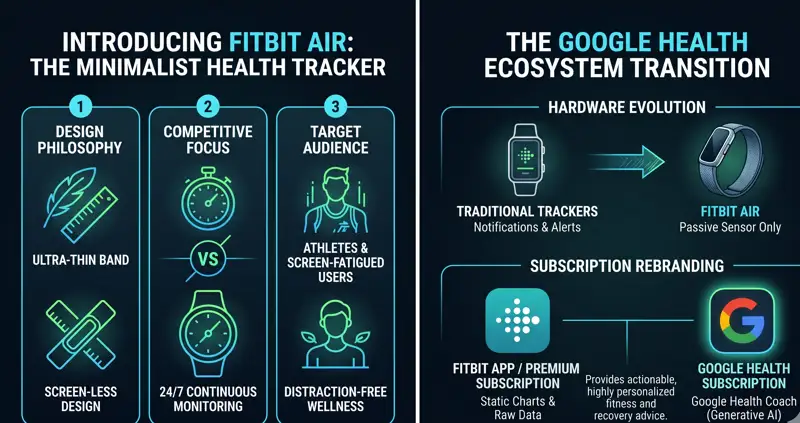
Infographic detailing the core features of the 2026 Fitbit Air, highlighting its ultra-thin screen-less design, 24/7 continuous monitoring, and its positioning as a distraction-free Whoop rival for athletes.

Fitbit Air Revealed: Google’s Screen-Less Whoop Rival Drops With Huge ‘Google Health’ Rebrand!

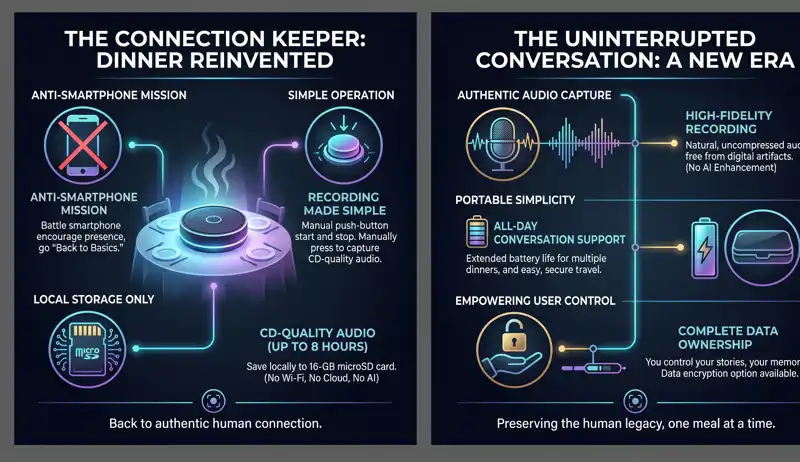
Infographic detailing the Prego Connection Keeper, a screen-free dinner recording device featuring manual push-button operation, local microSD storage, and zero AI or Wi-Fi connectivity.

Why Prego Built a Gadget to Record Your Family Dinners (No, It’s Not a Joke!)