
Every living organism on our planet, from the microscopic bacteria in the soil to the magnificent blue whales in the ocean, traces its lineage back to the Last Universal Common Ancestor, commonly referred to as LUCA. For decades, the true timeline regarding the origin of life on Earth has been a subject of intense scientific debate. While the famous Cambrian Explosion kickstarted complex life around 530 million years ago in a spectacular evolutionary burst, the roots of life stretch much further back into the deep, dark history of our planet. Recent breakthroughs in genetic analysis have fundamentally shifted our understanding of this timeline, revealing that our oldest known ancestor lived in an unimaginably hostile environment.
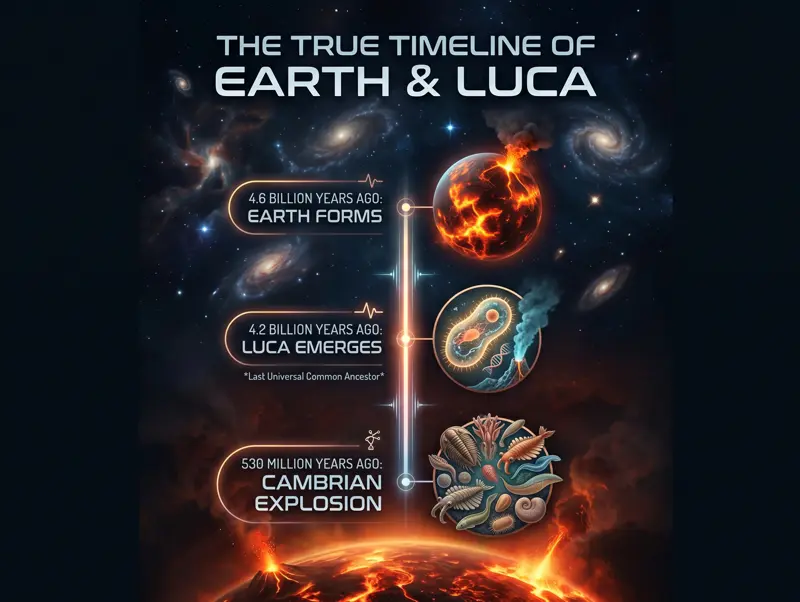
For a long time, researchers estimated that this foundational organism likely appeared around 4 billion years ago. However, a groundbreaking 2024 study published by an international team of scientists has pushed that timeline back even further. We now believe LUCA was thriving some 4.2 billion years ago, placing its existence a mere 400 million years after the very formation of the planet itself. This discovery not only rewrites textbooks but also provides fascinating insights into the incredible resilience of early life forms.
The True Age of LUCA: Decoding the Genetic Clock
To pinpoint exactly when LUCA existed, scientists had to work backward through billions of years of biological history. First, researchers compared the genes in currently living species, carefully counting the specific mutations that have occurred since these species shared a common ancestor with LUCA. By utilizing a mathematical genetic equation based on the time of separation between different species, the team concluded that LUCA 4.2 billion years ago was already a thriving organism. This places our ultimate ancestor squarely in the middle of the Hadean Eon—a hellish geologic nightmare characterized by constant meteorite bombardments and oceans of volatile magma.
| Geological / Biological Event | Estimated Timeframe | Significance in Earth’s History |
|---|---|---|
| Formation of Earth | ~4.6 Billion Years Ago | The planet coalesces from the solar nebula. |
| Existence of LUCA | 4.2 Billion Years Ago | First common ancestor of all living domains emerges. |
| Cambrian Explosion | ~530 Million Years Ago | Rapid diversification of complex, macroscopic life. |
Tracing the evolutionary history of genes is no simple task. It requires massive computational power and deep biological understanding. As organisms evolve, they don’t just pass genes down vertically; sometimes, genetic material is swapped horizontally between different lineages, muddying the ancestral waters.
“The evolutionary history of genes is complicated by their exchange between lineages. We have to use complex evolutionary models to reconcile the evolutionary history of genes with the genealogy of species.”
A Surprisingly Complex Survivor in the Hadean Eon
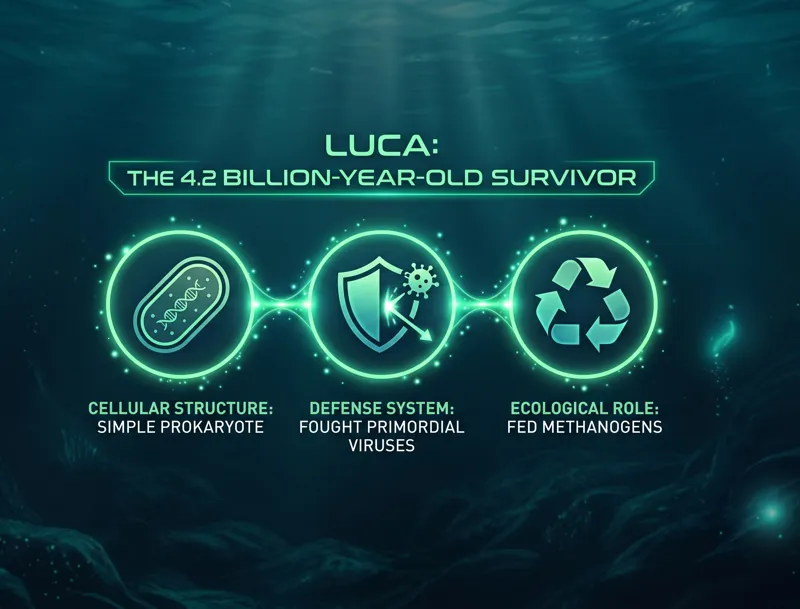
Not satisfied with merely determining LUCA’s age, researchers took their analysis a step further by retracing the physiological characteristics of living species. They wanted to understand what this ancient organism actually looked like and how it behaved. The results were astounding. While LUCA was a simple prokaryote (a single-celled organism lacking a distinct nucleus), it was remarkably complex in its biological functions.
Most surprisingly, scientists estimate that LUCA likely possessed an early form of an immune system. This means that even 4.2 billion years ago, life was already engaged in an evolutionary arms race. LUCA was actively fighting off primordial viruses, proving that viral entities have been a part of the Earth’s biological landscape since the very beginning. For deeper reading on evolutionary studies, you can visit the Nature Ecology & Evolution Journal.
| Physiological Trait | Description | Evolutionary Importance |
|---|---|---|
| Cellular Structure | Prokaryote | Simple structure but foundational for all modern cells. |
| Defense Mechanism | Early Immune System | Allowed survival against ancient primordial viruses. |
| Ecological Impact | Waste Production | Provided nutrients for methanogens, driving early ecosystems. |
Furthermore, LUCA was not an isolated hermit in a sterile ocean. It was an active participant in a vibrant Hadean Eon ecosystem. As it consumed energy and exploited its harsh environment, LUCA produced biological waste. This waste, rather than being toxic, served as a crucial food source for other surrounding microbes, such as methanogens.
“It’s clear that LUCA was exploiting and changing its environment, but it is unlikely to have lived alone. Its waste would have been food for other microbes, like methanogens, that would have helped to create a recycling ecosystem.”
While LUCA is the oldest common ancestor we have firmly identified, it is important to note that it was likely not the absolute first living thing. There is still a massive gap in our knowledge regarding how the very first sparks of biological chemistry evolved into the complex community of microbes that LUCA belonged to. Future studies will need to dive even deeper into the primordial history of our planet to uncover exactly how the intricate web of life, connecting you, me, and every living creature, first began.
Frequently Asked Questions
What exactly does LUCA stand for?
LUCA stands for the Last Universal Common Ancestor. It is the hypothetical most recent common ancestor of all current life on Earth, from bacteria to plants and animals.
When did LUCA live on Earth?
Recent scientific studies using advanced genetic modeling suggest that LUCA lived approximately 4.2 billion years ago, which is only 400 million years after Earth formed.
How did scientists determine the age of LUCA?
Scientists determined LUCA’s age by comparing the genetic codes of living species today and counting the mutations that have occurred over time, working backward like a molecular clock.
Did LUCA have an immune system?
Yes, genetic retracing indicates that LUCA likely possessed an early form of an immune system, which it used to fight off primordial viruses in its environment.
Was LUCA the first living organism on Earth?
Not necessarily. While LUCA is the common ancestor of all life currently on Earth, it was likely part of an already established early microbial community. Earlier, simpler life forms preceded it.
What kind of environment did LUCA live in?
LUCA lived during the Hadean Eon, an incredibly hostile period in Earth’s history characterized by extreme temperatures, volcanic activity, and frequent meteorite impacts.
Yes. Because LUCA is the universal ancestor, every single living organism on Earth today, including humans, shares a distant evolutionary lineage with this ancient single-celled organism.
Disclaimer: This article is for informational purposes only. The scientific concepts and timelines discussed are based on recent genetic studies and evolutionary models as of 2026, which are subject to further refinement as the field of evolutionary biology advances.