If you have been following hardware security in 2026, you know that trying to Laser Your Way Into Debug Mode On The RP2350 is currently the most fascinating topic in the cybersecurity space. The RP2350 microcontroller was designed to be incredibly secure. It features robust defenses that make traditional hardware hacking methods practically obsolete. However, determined researchers always find a backdoor.
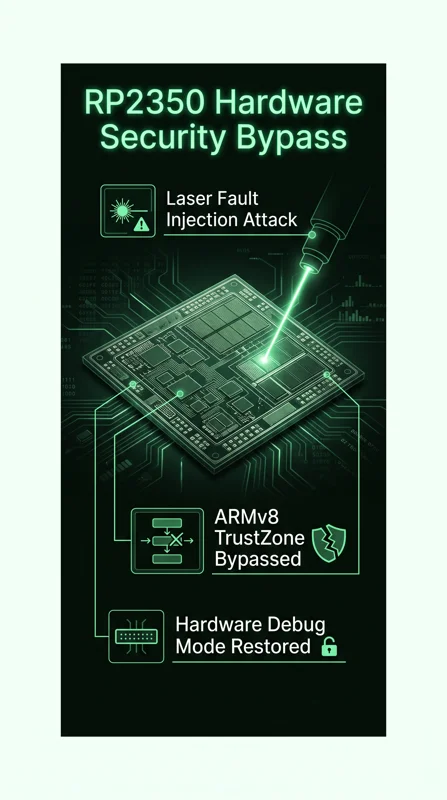
The Raspberry Pi Foundation built this chip with exceptional safeguards. It includes a highly restrictive secure boot process and relies on ARMv8 TrustZone glitch detection to strictly separate secure and non-secure execution environments. You can even permanently disable debug access at the hardware level. This means the traditional method of zapping the chip with voltage until it obeys your commands is completely blocked by native glitch detection algorithms.
Why Hackers Decide to Laser Your Way Into Debug Mode On The RP2350
To successfully execute an Laser Your Way Into Debug Mode On The RP2350 operation, security experts had to think outside the box. Because standard electrical glitching fails, the renowned Ledger Donjon security team opted for a highly sophisticated, physical approach. They realized that to achieve a successful hardware security debug mode bypass, they needed to directly manipulate the silicon.
This led them to deploy a laser fault injection attack. By targeting the exact microscopic register that controls the microcontroller’s debugging features, they bypassed the chip’s logical defenses entirely. It requires extreme precision and highly specialized laboratory equipment.
The Ledger Donjon security team essentially went full Bond Villain, strapping the microcontroller to a table and targeting it with a slowly approaching laser beam.
The Tools Required to Laser Your Way Into Debug Mode On The RP2350
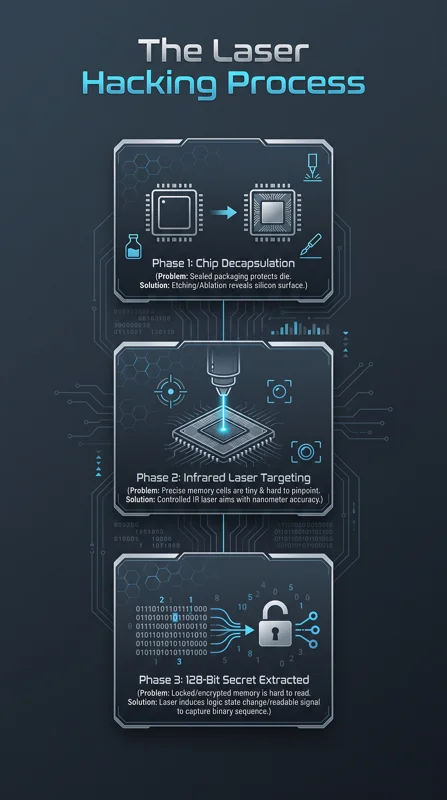
Before you can successfully Laser Your Way Into Debug Mode On The RP2350, you must understand the hardware layout. The process starts with a meticulous Ledger Donjon chip decapsulation. This means physically removing the protective outer layers of the microcontroller to expose the delicate silicon wafer underneath.
Once decapsulated, the researchers used photon-emission electron microscopy to examine the die. They specifically targeted the chip from the back side, allowing infrared (IR) light to shine directly through the silicon without being obstructed by the top-layer metal routing.
| RP2350 Defense Mechanism | Hacker Bypass Technique |
|---|---|
| ARMv8 TrustZone Glitch Detection | Bypassed using targeted optical interference (lasers). |
| Permanently Disabled Debug Mode | IR laser flipped the physical register bit back to ‘enabled’. |
| Physical Silicon Shielding | Ledger Donjon chip decapsulation from the rear side. |
The Step-by-Step Process to Laser Your Way Into Debug Mode On The RP2350
The actual execution of an Laser Your Way Into Debug Mode On The RP2350 attack requires extensive trial and error. The security researchers must figure out exactly where on the silicon die they need to fire the laser. The goal is to hit a specific spot adjacent to the debug register to temporarily flip its bits via optical interference.
Once the laser flips those crucial bits, the debugger’s access to the secure execution zone is instantly restored. After resetting the compromised chip, the Ledger team successfully read the 128-bit secret that the Pi Foundation explicitly hid in memory for their 2350 hacking challenge.
It is a long-accepted reality that once highly skilled hackers have physical access to your hardware, they will inevitably find a way inside.
Implications Once You Laser Your Way Into Debug Mode On The RP2350
Knowing that researchers can Laser Your Way Into Debug Mode On The RP2350 changes how we view physical cybersecurity. The effort it takes to break into this simple microcontroller is incredibly impressive, highlighting the relentless advancement of RP2350 microcontroller hacking.
Ironically, the hardware security community has frequently used Pi Pico-powered devices to perform electrical glitching attacks on other chips. Now, the Raspberry Pi hardware itself has fallen victim to an advanced laser fault injection attack. For more official details on hardware specifications, you can review the official Raspberry Pi documentation.
| Hacking Phase | Tools Utilized | Objective Achieved |
|---|---|---|
| Phase 1: Preparation | Chemical solvents, Precision milling | Exposed the rear side of the silicon die. |
| Phase 2: Mapping | Photon-emission electron microscopy | Located the exact coordinates of the debug register. |
| Phase 3: Execution | Infrared (IR) Laser Emitter | Flipped the bits to enable full debug access. |
Frequently Asked Questions
What does it mean to Laser Your Way Into Debug Mode On The RP2350?
It refers to a sophisticated hardware hack where researchers use a focused infrared laser to flip microscopic bits inside the RP2350 microcontroller, forcefully re-enabling its disabled debug mode.
Why can’t hackers just use standard electrical glitching on this chip?
The RP2350 utilizes advanced ARMv8 TrustZone glitch detection that actively monitors for voltage spikes or drops, shutting down the processor before an electrical glitch can succeed.
Who originally performed this laser fault injection attack?
The Ledger Donjon security team successfully executed this complex attack as part of a hardware hacking challenge designed to test the microcontroller’s limits.
What is chip decapsulation?
Chip decapsulation is the physical or chemical process of removing the protective plastic or ceramic casing around a microcontroller to expose the raw silicon die for microscopic analysis.
Why did the researchers use infrared (IR) lasers?
Because they decapsulated the chip from the back side, they needed to use an IR laser, which can pass directly through the silicon wafer to hit the target registers without being blocked.
Does this mean the RP2350 is inherently insecure?
Not at all. The RP2350 remains a highly secure chip for its class. This specific attack requires hundreds of thousands of dollars in specialized laboratory equipment and extreme technical expertise.
What did the hackers steal after bypassing the security?
Once they restored the debugger’s access to the secure execution zone, the researchers successfully extracted a secret 128-bit key hidden in the memory by the Pi Foundation.
Disclaimer: This article is for informational purposes only. Discussing hardware vulnerabilities is strictly for educational awareness and advancing the field of physical cybersecurity.