I Tested All 4 of Microsoft’s New AI Models. Here’s the Brutal Truth: they are not quite ready to dominate the market. Microsoft says its new MAI models revealed at Build 2026 are the future of tech.
After testing them extensively, I am not entirely convinced they are ready for that massive spotlight. Microsoft unveiled a splashy vision for Windows that is nearly unrecognizable.
Toward the end of its keynote, the tech giant debuted new AI models for image generation, reasoning, transcription, and voice. These experimental tools are currently available for free.
I put them through their paces, and frankly, I was left underwhelmed. Below is everything you need to know about the fresh lineup of Microsoft AI (MAI) models.
Understanding MAI: I Tested All 4 of Microsoft’s New AI Models. Here’s the Brutal Truth
The first question most users ask revolves around the MAI vs Copilot differences. Yes, MAI and Copilot are completely different AI products from Microsoft.
Copilot is Microsoft’s popular AI chatbot that runs primarily on OpenAI technology. Microsoft’s MAI (pronounced like FBI) models rely strictly on in-house large language models.
| MAI Model Name | Primary Function | Current Status |
|---|---|---|
| MAI-Thinking-1 | Complex Reasoning | Early Access |
| MAI-Image-2.5 | Image Generation | Limited Preview |
| MAI-Transcribe-1.5 | Audio to Text | Limited Preview |
| MAI-Voice-2 | Text-to-Speech | Limited Preview |
Microsoft describes these models as being in a “limited preview” state. Do not expect a fully polished consumer product right out of the gate.
Reasoning Deficits: I Tested All 4 of Microsoft’s New AI Models. Here’s the Brutal Truth
MAI-Thinking-1 is Microsoft’s first-ever reasoning model. It aims to tackle highly complex prompts, coding logic, and advanced conversational topics.
Microsoft claims users prefer it over Claude’s Sonnet model in blind testing. However, my personal AI reasoning models comparison tells a different story entirely.
In my rigorous testing, Sonnet proved significantly more useful than MAI-Thinking-1. The most glaring flaw is that Microsoft’s model currently cannot access the internet.
“MAI-Thinking-1 isn’t dumb by any means, but its lack of web access and overall average performance don’t make a compelling case for using it over competitors.”
Whether I asked about complex database structuring or niche video game mechanics, it offered no meaningful improvements in accuracy or speed.
Graphics and Art: I Tested All 4 of Microsoft’s New AI Models. Here’s the Brutal Truth
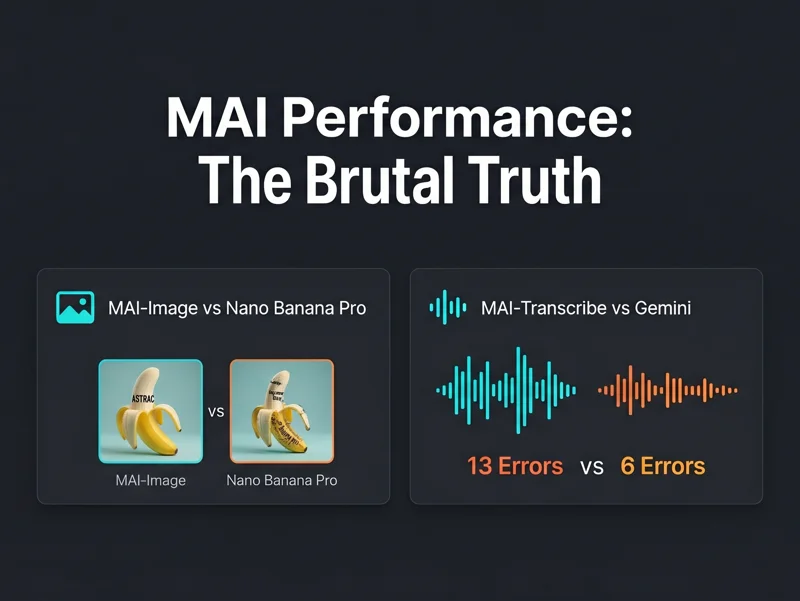
When looking at visuals, the MAI-Image-2.5 vs Nano Banana Pro debate is incredibly one-sided. MAI-Image has indeed improved since late 2025.
Unfortunately, it remains a step behind industry leaders. Nano Banana Pro consistently outputs sharper, more coherent graphics.
During testing, MAI-Image-2.5 struggled heavily with rendering text inside images. Comic strips and diagrams were filled with distorted, illegible characters.
| Image Generator | Visual Sharpness | Text Rendering Quality |
|---|---|---|
| MAI-Image-2.5 | Moderate | Poor (Distorted) |
| Nano Banana Pro | Excellent | High Clarity |
If MAI-Image-2.5 is your absolute only option, it can get basic jobs done. But I cannot recommend it as your primary visual generator right now.
Audio Failures: I Tested All 4 of Microsoft’s New AI Models. Here’s the Brutal Truth
Let us shift to AI audio transcription tools. MAI-Transcribe-1.5 works fine but completely fails to stand out in a crowded market.
In a transcription test comparing it against Google’s Gemini, MAI-Transcribe-1.5 made 13 mistakes, whereas Gemini only committed six.
When tasked with transcribing complex song lyrics, Microsoft’s tool unexpectedly cut off before the audio file even finished playing.
This is highly problematic considering Google does not even aggressively market Gemini as a dedicated transcription service.
| Audio Model | Test Error Count | Overall Voice Quality |
|---|---|---|
| MAI-Transcribe-1.5 | 13 Errors | N/A (Input Only) |
| Google Gemini | 6 Errors | N/A (Input Only) |
| MAI-Voice-2 | N/A | Robotic & Unnatural |
Things get worse with MAI-Voice-2. Despite offering various languages and styles, the output consistently sounds robotic and firmly stuck in the uncanny valley.
“The combination of its audio quality, breathiness, cadence, and intonation just hits me as squarely inhuman.”
For official statements and future patch notes regarding these experimental models, you can visit the Official Microsoft Blog.
Final Verdict: I Tested All 4 of Microsoft’s New AI Models. Here’s the Brutal Truth
Ultimately, these new tools are overwhelmingly unexceptional. While enterprise environments might find niche applications, consumers will be disappointed.
If Microsoft’s rapid iteration of image tech is any indicator, these models will improve. For now, however, stick to your current preferred AI platforms.
Frequently Asked Questions
What is the main difference between MAI and Copilot?
Copilot primarily utilizes OpenAI technology, while the MAI lineup is built entirely on Microsoft’s in-house Large Language Models.
Is MAI-Thinking-1 better than Claude Sonnet?
Based on consumer testing, Sonnet is more useful. MAI-Thinking-1 currently lacks internet access, which heavily restricts its real-world utility.
How does MAI-Image-2.5 compare to Nano Banana Pro?
Nano Banana Pro is superior, offering sharper images and significantly better text rendering inside generated graphics.
Are the new Microsoft AI models free to use?
Yes, the models that are currently in limited preview can be accessed for free via Microsoft’s developer Playground site.
Can MAI-Transcribe-1.5 perfectly transcribe songs?
No. In testing, it made multiple errors and even cut off early when trying to process complex, heavy audio tracks.
Does MAI-Voice-2 sound like a real human?
Unfortunately, no. Despite having multiple customization options, the resulting audio still sounds highly robotic and unnatural.
When were these four MAI models announced?
Microsoft officially unveiled this new in-house AI lineup during their developer-focused Build 2026 conference.
Disclaimer: This article is for informational purposes only. The performance metrics and opinions are based on experimental preview versions of the software available in 2026 and may not reflect the final retail products.