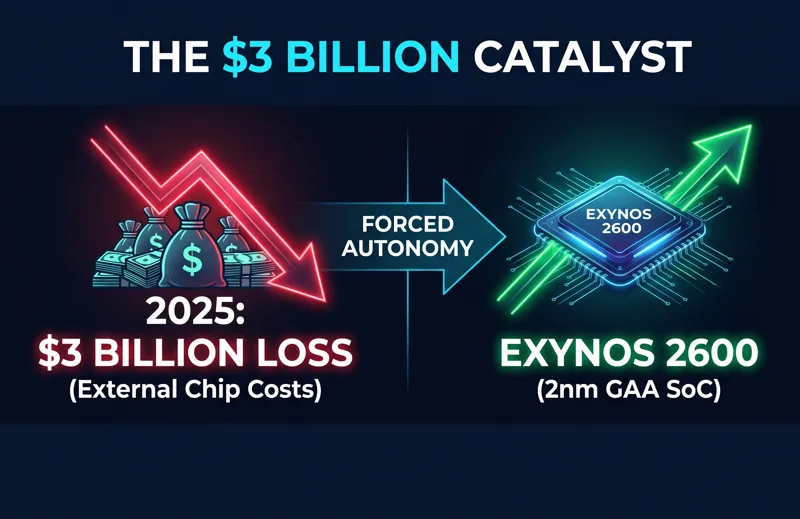
It is an open secret in the tech industry that the exynos 2600 was only made because samsung lost 3 billion in 2025. This staggering financial blow was not a mere accounting error, but a direct consequence of an over-reliance on third-party silicon. When Samsung was forced to equip its Galaxy S25 series with expensive competitor chips, the financial toll was catastrophic. The Korean tech giant essentially paid a heavy tax that eroded profit margins and put its mobile division in a precarious position. The race for complete chipset autonomy was no longer just about engineering pride; it quickly became a matter of sheer corporate survival.
The $3 Billion Wake-Up Call
For years, Samsung has danced a delicate tango with its suppliers, balancing the use of its in-house Exynos chips with external processors depending on the region. However, last year’s strategy proved disastrously expensive. By purchasing an immense volume of Snapdragon 8 Elite shipments for the flagship lineup to cover manufacturing shortfalls, Samsung recorded a jaw-dropping $3 billion loss in the form of a component expense.
If the company had repeated this strategy for the current year, assuming exclusive use of Qualcomm’s Snapdragon 8 Elite Gen 5 in the Galaxy S26 series, the outcomes would have been grim. We would either witness the company’s profit margins becoming razor-thin, or customers being forced to pay an unprecedented premium. Neither scenario was acceptable for a brand fighting to maintain its dominance in the flagship smartphone market. It wasn’t going to be a great look for the brand had they not course-corrected immediately.
| Smartphone Generation | Primary Chipset Supplier | Financial & Market Impact |
|---|---|---|
| Galaxy S25 Series (2025) | Exclusive 3rd Party | $3 Billion Expense Loss |
| Galaxy S26 Series (2026) | Mixed (Exynos 2600 / Snapdragon) | Stabilized Margins, Autonomy Begins |
| Galaxy S27 Series (2027) | 50% Exynos 2700 Adoption | Projected Massive Cost Reductions |
The Cost of Relying on External Silicon
The smartphone industry operates on notoriously tight margins. When a single external component dictates the pricing structure of an entire flagship series, the manufacturer loses control over its own product roadmap. This lack of control is precisely what the Korean giant wanted to eliminate through its renewed semiconductor efforts.
The staggering $3 billion expense was the ultimate catalyst, proving that achieving complete chipset autonomy is no longer optional for Samsung’s long-term profitability.
Exynos 2600 vs Snapdragon 8 Elite: A Necessary Rivalry
The realization of these massive losses jumpstarted Samsung’s silicon division. The result is the Exynos 2600, a processor born out of absolute necessity. Found in various Galaxy S26 and Galaxy S26+ models, this chip represents a monumental leap forward as the company’s first 2nm GAA (Gate-All-Around) SoC. It showcases exceptional power efficiency and thermal management that rivals the industry’s best.
While it is true that the top-end offering for this year, the Galaxy S26 Ultra, continues to ship with the Snapdragon 8 Elite Gen 5 (remaining the most popular handset from the trio), the successful deployment of the Samsung Galaxy S26 processor in the base and plus models has successfully stopped the financial bleeding. To understand the broader impact of this technological shift and hardware innovations, enthusiasts often monitor announcements directly from the Samsung Global Newsroom.
The 2nm Savior and Future Strategy
The Exynos 2600 is just the beginning of a much larger, aggressive strategy. Because the price for not using its own chipsets was undeniably steep, Samsung is not resting on its laurels. The momentum generated by the 2nm GAA SoC technology is paving the way for the next generation of processors.
While the journey toward true silicon independence is fraught with engineering hurdles, it is significantly less painful than surrendering billions in operating losses year after year.
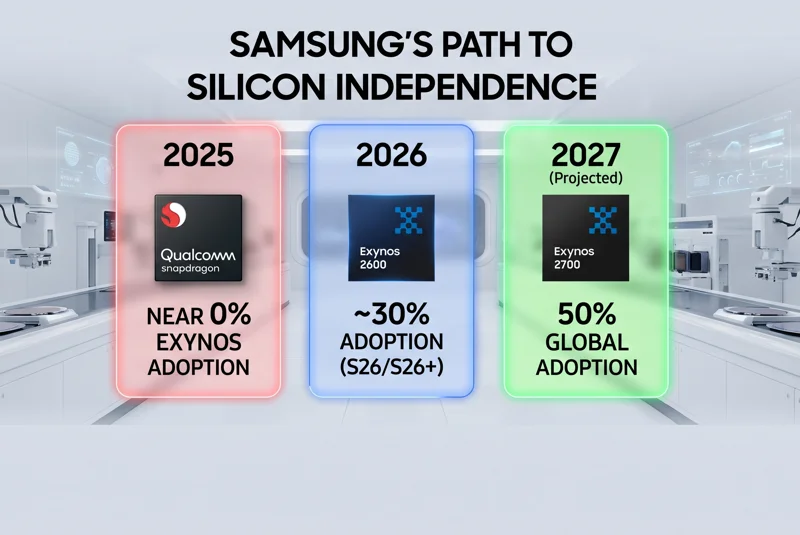
Industry insiders report that Galaxy S27 Exynos 2700 adoption is dramatically increasing. Instead of playing second fiddle, the Exynos 2700 has been reported to be found in 50 percent of all Galaxy S27 shipments. This strategic scaling allows Samsung to drastically reduce its burden of having to rely on external partners, effectively hedging its bets and securing its supply chain.
| Strategic Metric | 2025 Flagships | 2026 Flagships | 2027 Flagships (Projected) |
|---|---|---|---|
| In-House Silicon Adoption | Near 0% | \~30% (Base/Plus Models) | 50% Across Lineup |
| Core Manufacturing Tech | Outsourced Nodes | 2nm GAA SoC | Next-Gen Enhanced GAA |
A Painful but Profitable Journey
Developing cutting-edge semiconductor technology requires billions in research and development. It is definitely going to be a painful and complex journey for the Korean technology behemoth to catch up and surpass its rivals. However, the alternative—forking over billions in losses each year—is no longer a viable business model. The Samsung chipset autonomy strategy has successfully laid the groundwork for a future where the company controls its own destiny.
Frequently Asked Questions
Why did Samsung create the Exynos 2600?
Samsung developed the Exynos 2600 to reduce reliance on third-party suppliers after suffering a massive $3 billion loss in 2025 from purchasing external chipsets for its flagship phones.
Which phones use the Exynos 2600?
The Exynos 2600 is primarily found in various models of the standard Galaxy S26 and the Galaxy S26+.
Does the Galaxy S26 Ultra use an Exynos processor?
No, the top-tier Galaxy S26 Ultra continues to ship exclusively with the Snapdragon 8 Elite Gen 5 processor.
What makes the Exynos 2600 technologically significant?
It is Samsung’s first proprietary 2nm GAA (Gate-All-Around) System on a Chip (SoC), offering massive improvements in power efficiency and processing speed.
How much did Samsung lose by not using Exynos in 2025?
Samsung reported a steep $3 billion loss in the form of component expenses due to exclusive reliance on external chip shipments for the Galaxy S25 series.
What is Samsung’s plan for the Galaxy S27 series?
Samsung plans to significantly increase its internal chipset usage, with reports indicating that the upcoming Exynos 2700 will be adopted in 50% of all Galaxy S27 shipments.
Will Samsung ever completely stop using Snapdragon chips?
While Samsung is aggressively pushing for chipset autonomy to protect its profit margins, it is likely they will maintain a dual-sourcing strategy for the foreseeable future to ensure top-tier performance across all regions.
Disclaimer: This article is for informational purposes only. The financial figures, strategic plans, and hardware specifications discussed are based on industry reports, tech sector analysis, and current market trends as of 2026.