In a surprising twist for the music industry in 2026, the volume of deezer ai music daily uploads has reached a tipping point, nearly overtaking tracks produced by human artists. The popular music streaming platform recently announced that a staggering 44 percent of all daily song uploads are now created with artificial intelligence. This digital flood represents a massive shift in how music is created, distributed, and consumed, prompting platforms to take unprecedented measures to protect human artists and maintain audio quality.
The Staggering Surge of AI-Generated Songs
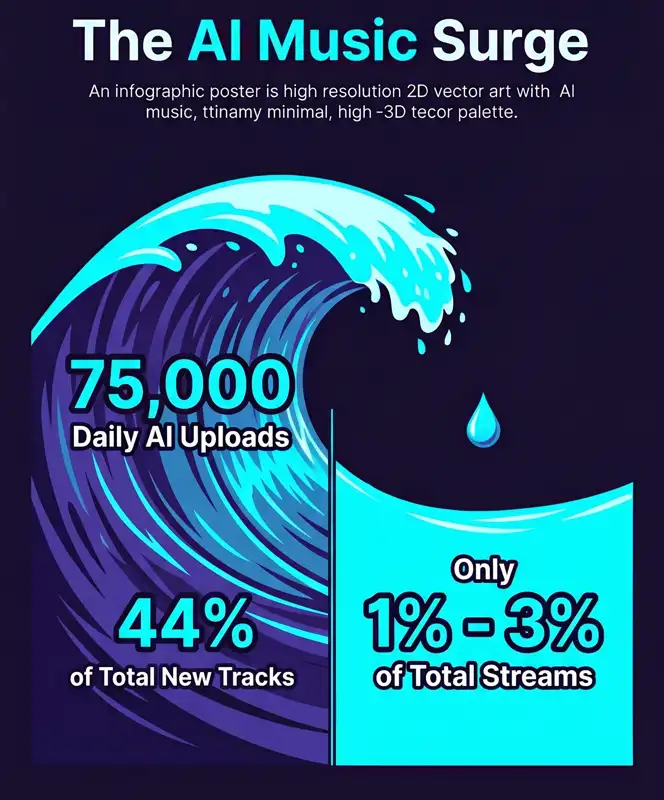
The sheer scale of synthetic music flooding streaming services is difficult to comprehend. Deezer reports that it currently receives nearly 75,000 AI-generated song submissions to its platform every single day. This exponential growth is largely driven by the increasing accessibility and sophistication of AI music generators. Since January 2025, the daily influx of artificial tracks has skyrocketed from a mere 10,000 to the current 75,000, creating severe logistical and qualitative challenges for curation algorithms.
| Timeframe | Daily AI Uploads | Percentage of Total Uploads |
|---|---|---|
| January 2025 | 10,000 | Estimated < 10% |
| Current (2026) | 75,000 | 44% |
Despite this massive increase in what platforms often label as “fraudulent” or spam uploads, listener behavior paints a very different picture. The consumption of these AI songs makes up only around 1 to 3 percent of total streams. To maintain user experience, Deezer continually updates its recommendation engine to filter out AI-generated music, ensuring that human musicians remain at the forefront of listener discovery.
Setting the Industry Standard: Detection and Demonetization
To combat this wave, Deezer has positioned itself as a pioneer, setting what it calls an “industry standard.” Currently, it claims to be the only major music streaming service that actively tags AI-generated tracks so listeners know exactly what they are hearing. Beyond mere labeling, the service takes aggressive financial action: it demonetizes AI-generated songs entirely and refuses to store high-resolution audio versions of them on its servers. This news aligns with broader industry investigations, as noted by TechCrunch in their earlier coverage of streaming fraud.
“AI-generated music is now far from a marginal phenomenon and as daily deliveries keep increasing, we hope the whole music ecosystem will join us in taking action to help safeguard artist’s rights and promote transparency for fans.”
This statement from Deezer CEO Alexis Lanternier underscores the urgent need for a unified approach across the digital music ecosystem to protect the livelihood of traditional artists.
How Competing Platforms Are Reacting
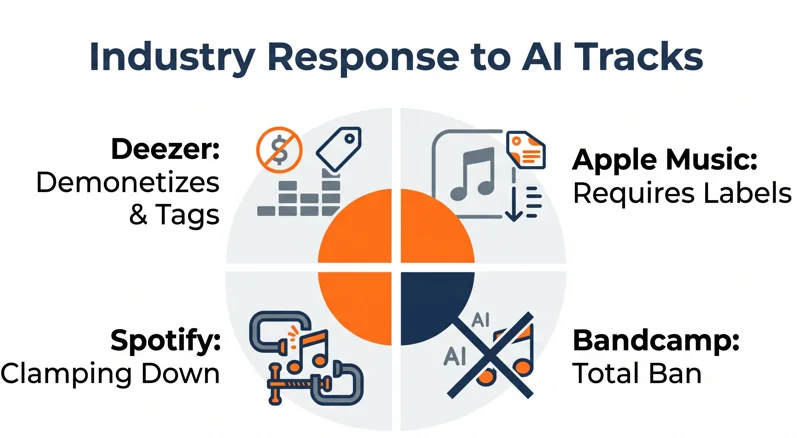
As powerful AI-powered song-making tools like Suno and Udio become household names for creators, every major streaming service is forced to adapt. While Deezer focuses on tagging and demonetization, others have taken different routes.
| Streaming Platform | Stance / Policy on AI Music |
|---|---|
| Deezer | Tags tracks, demonetizes, removes from recommendations. |
| Spotify | Implemented new policies to clamp down on AI spam. |
| Apple Music | Requires artists and labels to manually label AI content. |
| Bandcamp | Completely banned all AI-generated music. |
| Qobuz | Automatically detects and labels AI music. |
The Power of AI Tools and Licensing Detection Tech
The rapid evolution of generative models is the root of this content explosion. Deezer’s internal tracking explicitly identifies tracks generated by leading models like Udio and Suno. However, the platform isn’t just protecting its own borders; it is turning its defense mechanism into a new business vertical. Deezer has started allowing other companies to license its proprietary AI song-detecting tool.
“…with the possibility to add detection capabilities for practically any other similar tool as long as there’s access to relevant data examples.”
In a bid to stay ahead of the curve, Deezer is also developing next-generation detection methods that can identify synthetic audio signatures without requiring a pre-existing dataset to train on. This zero-shot detection capability could be revolutionary for copyright enforcement.
It is vital to understand the gap between creation and consumption. Despite the massive influx of synthetic tracks, human ears still prefer human art.
| Metric | Data Point (2026) |
|---|---|
| AI Share of Daily Uploads | 44% |
| AI Share of Total Streams | 1% – 3% |
| Growth since Jan 2025 | 650% Increase |
As we navigate this new era of digital music production, platforms must strike a delicate balance between technological innovation and preserving the authentic human connection that makes music resonate globally.
Frequently Asked Questions
How many AI songs are uploaded to Deezer daily?
Deezer currently receives approximately 75,000 AI-generated song submissions each day.
What percentage of Deezer’s new uploads are AI-generated?
AI tracks now account for about 44 percent of all daily uploads on the platform.
Does Deezer pay royalties for AI-generated music?
No, Deezer actively demonetizes AI-generated songs to protect human artists and the royalty pool.
Are people actually listening to all these AI tracks?
Despite making up 44% of uploads, AI music only accounts for roughly 1 to 3 percent of total streams.
How do other platforms like Bandcamp handle AI music?
Bandcamp has taken a zero-tolerance approach and completely banned AI music from its platform.
What AI tools are primarily responsible for this surge?
Popular AI-powered song-making tools like Suno and Udio are the primary drivers behind the massive increase in uploads.
Can other companies use Deezer’s AI detection tool?
Yes, Deezer has begun allowing third-party companies to license its AI song-detecting technology.
Disclaimer: This article is for informational purposes only. The statistics and policies mentioned are based on industry reports as of 2026 and are subject to change as platform guidelines evolve.