Welcome to our definitive bose lifestyle collection first listen. Last Thursday, nestled within a meticulously staged midcentury-modern apartment on the Upper West Side of Manhattan, I found myself sitting on a plush, low-slung couch. Positioned directly in front of me, resting elegantly on an arched storage cabinet, was a compact, beige-colored smart speaker flanked by two tall, curved white acoustic screens. This unassuming device was about to deliver an auditory experience that could dramatically shift the balance of power in the premium home audio market. As we dive into the hardware, software, and overall acoustic performance, it becomes clear that Bose is taking a massive, calculated swing at industry titan Sonos.
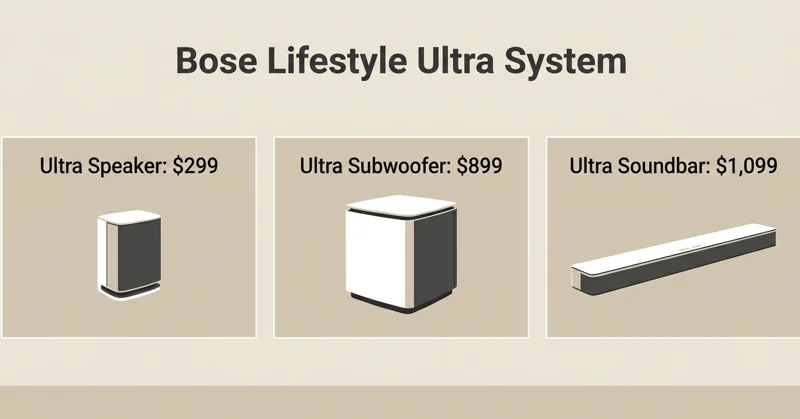
The speaker in question is the brand-new $299 Lifestyle Ultra, the crown jewel of Bose’s newly announced home audio ecosystem. Alongside a massive $1,099 Ultra Soundbar and an $899 Ultra Subwoofer, this trio constitutes a direct assault on Sonos’s market dominance. But what makes this launch truly revolutionary isn’t just the pristine audio fidelity; it is a radical departure from the restrictive, app-heavy ecosystems that have frustrated consumers for years. Bose has chosen an open, “app-less” path, and based on this initial hands-on test, it might be the smartest move the company has made in a decade.
The Lifestyle Ultra Smart Speaker: A Formidable Sonos Era 100 Alternative
The $299 Lifestyle Ultra Speaker immediately stands out as the most distinctive and visually compelling unit of the new lineup. Designed to seamlessly blend into modern home decor, it ditches the harsh industrial grills of the past for a softer, more refined aesthetic. But underneath its elegant exterior lies a highly sophisticated acoustic architecture. Unlike many competitors in its price bracket, the Lifestyle Ultra features a front-firing woofer, a crisp tweeter, and a dedicated up-firing driver, all complemented by a rear bass port.
Interestingly, for standard two-channel music playback, Bose relies on its proprietary spatial processing rather than native Dolby Atmos to utilize that upward-firing sound, creating a remarkably wide and tall soundstage. During the listening session, the vocal clarity was astounding. When playing Olivia Dean’s “Man I Need,” the audio sounded so vast and multi-directional that I instinctively checked behind the curved white screens, assuming hidden surround speakers were aiding the performance. The harsh high-frequency distortion that occasionally plagued older models like the SoundLink Plus is entirely absent here.
The Lifestyle Ultra smart speaker produces an impressively massive soundstage, delivering pristine vocal clarity that easily fills a large living space without breaking a sweat.
Control is handled gracefully via a capacitive touch panel located on the top of the unit, nestled just behind the up-firing driver. This interface features a recessed circular depression for volume control, allowing users to intuitively trace their finger clockwise to turn it up or counterclockwise to lower it. It also includes standard buttons for power, Bluetooth pairing, microphone muting, and play/pause functionality, alongside full support for Alexa Plus voice commands.
| Feature | Bose Lifestyle Ultra Speaker | Sonos Era 100 |
|---|---|---|
| Price | $299 | $249 |
| Driver Configuration | Front woofer/tweeter, Up-firing driver | Dual angled tweeters, mid-woofer |
| Control Ecosystem | App-less (Native OS casting) | Proprietary Sonos App |
| Spatial Audio processing | Proprietary Bose up-mixing | Stereo separation |
The App-Less Revolution: Apple AirPlay and Google Cast Integration
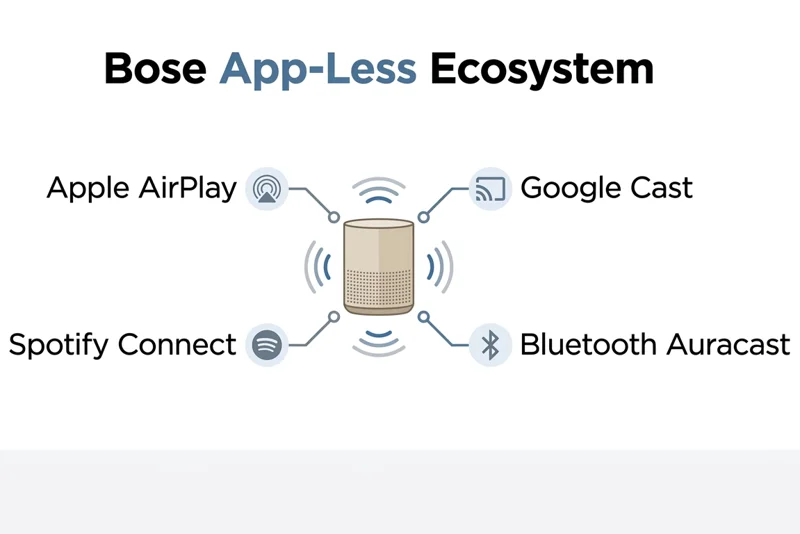
Perhaps the most shocking, and welcome, revelation from this launch is Bose’s software philosophy. While Sonos forces users into its proprietary application—a strategy that has recently drawn immense consumer backlash due to buggy updates and lost functionality—Bose is tearing down the walled garden. They are leaning heavily into the grouping and playback functionalities of the apps you already know and love.
The Lifestyle Ultra series supports seamless multi-room wireless audio over Wi-Fi via Apple AirPlay and Google Cast, as well as Spotify Connect. This means you do not need to open a dedicated Bose app to group speakers together. You can effortlessly mix and match the Bose Ultra with non-Bose speakers on your network. If you want to group your new Bose speaker with a Google Nest hub in the kitchen and an older AirPlay-compatible receiver in the garage, you can do so directly from the control center of your smartphone.
“We deliberately are trying to be more open and app-less in our experience,” stated Raza Haider, Bose president of premium consumer audio, signaling a consumer-first approach to connectivity.
For times when Wi-Fi is unreliable, the speakers feature robust Bluetooth fallback. Furthermore, the hardware is completely Auracast capable. While it won’t be enabled on the May 15 launch day, Haider confirmed that the feature will be activated via a firmware update once the broader broadcast audio ecosystem matures. To understand more about how this next-generation Bluetooth broadcast technology works, you can read the official specifications on the Bluetooth SIG Auracast technology page.
| Streaming Protocol | Compatibility Status | Multi-Brand Grouping |
|---|---|---|
| Apple AirPlay | Native Support (Launch) | Yes, via iOS |
| Google Cast | Native Support (Launch) | Yes, via Google Home |
| Spotify Connect | Native Support (Launch) | Yes, via Spotify App |
| Auracast (Bluetooth) | Hardware Ready (Future Update) | Yes, via Auracast sources |
Testing the Cinematic Dolby Atmos Soundbar Setup
Moving upstairs to a larger demonstration room, I was introduced to the $1,099 Ultra Soundbar. This unit represents Bose’s first major architectural soundbar redesign in several years. It is an imposing piece of hardware, boasting two up-firing drivers for Atmos height channels, two wide-set directional drivers for the extreme left and right, and two proprietary Bose PhaseGuide drivers designed to beam sound off your side walls. Finally, two additional drivers flank a dedicated center tweeter to anchor dialogue to the screen.
We initiated the sound test with the intense spice harvester evacuation sequence from Denis Villeneuve’s Dune. As a standard benchmark for testing a Dolby Atmos soundbar setup, this scene is notoriously demanding. The standalone Ultra Soundbar delivered a massive, room-filling soundscape. The width was exceptional, and the vocal clarity from the center tweeter ensured that dialogue cut through the chaotic mix of roaring engines and swirling sand. The Atmos height effects were also deeply immersive.
However, running the soundbar completely on its own revealed a noticeable flaw: a distinct lack of presence in the upper bass and lower midrange frequencies. While I could feel sub-bass rumbling through the floorboards, there was an audible “hole” where the roaring engines should have felt thick and textured. The sound leaned slightly toward the hollow side.
This is where the $899 Ultra Subwoofer comes into play. Once activated, the system transformed entirely. Testing Jacob Collier’s heavily layered track “Mi Corazón,” the subwoofer seamlessly filled that frequency gap. The bass went from a disconnected rumble to a punchy, warm, and highly supportive foundation that elevated the entire performance. The caveat, of course, is that achieving this perfectly balanced cinematic sound turns a $1,099 soundbar into a $2,000 investment—placing it exactly toe-to-toe with a Sonos Arc Ultra and Sub combo.
Building the Ultimate 7.1.4 Home Theater
For the uncompromising audiophile, the true magic happens when you combine the ecosystem. By taking two of the $299 Lifestyle Ultra smart speakers and assigning them as dedicated rear surround channels, you create a massive, enveloping 7.1.4 Dolby Atmos configuration.
When properly configured with rear channels and a subwoofer, the Bose Lifestyle Ultra system delivers a breathtaking, cinema-quality 7.1.4 Dolby Atmos experience right in your living room.
To test this full rig, Bose queued up the iconic Live Aid concert scene from the film Bohemian Rhapsody. The result was nothing short of spectacular. The crowd noise wrapped around the listening position, and the echoing acoustics of Wembley Stadium felt incredibly authentic. The Atmos height channels successfully recreated the vertical scale of the stadium. My only minor critique is that the spatial placement of overhead sounds was occasionally a bit indistinct, which may have been a byproduct of the room’s acoustic treatments or my specific seating position.
It is worth noting that while the standalone Ultra Speaker does not utilize room calibration technology, the complete home theater system relies on Bose’s proprietary room-tuning software to optimize the crossover frequencies and delay timings between the soundbar, the subwoofer, and the rear surrounds.
| System Configuration | Components Required | Total Cost (USD) |
|---|---|---|
| Standalone Cinematic | 1x Ultra Soundbar | $1,099 |
| Bass-Heavy Theater | 1x Ultra Soundbar, 1x Ultra Subwoofer | $1,998 |
| Full 7.1.4 Immersion | 1x Soundbar, 1x Sub, 2x Ultra Speakers | $2,596 |
The Future of Bose Premium Audio
Based on this initial listening session, the potential for the new Lifestyle Collection is staggering. By offering premium hardware that frees users from restrictive companion apps, Bose is positioned to capture a massive segment of frustrated wireless audio consumers. The ability to integrate these high-fidelity units into existing Google Cast or Apple AirPlay networks without friction is a masterstroke in user experience design.
And Bose isn’t stopping here. When pressed about the future of the line, Raza Haider made it clear that this is just the foundation. “There’s lots more to come. This is the start of the new platform of the Lifestyle series,” he noted, hinting that larger, more powerful standalone units are already in development. For now, the Lifestyle Ultra collection proves that when a legacy audio company fully embraces open connectivity, the results are spectacularly loud and clear.
Frequently Asked Questions
What is the price of the new Bose Lifestyle Ultra speaker?
The standalone Bose Lifestyle Ultra smart speaker retails for $299.
Do I need to use a specific Bose app to stream music?
No. Unlike Sonos, Bose has adopted an “app-less” strategy, allowing you to stream directly via Apple AirPlay, Google Cast, and Spotify Connect without opening a dedicated Bose application.
Can the Bose Lifestyle Ultra connect to non-Bose speakers?
Yes, because it supports Apple AirPlay and Google Cast, you can group the Ultra speaker with any other compatible speakers on your Wi-Fi network, regardless of the brand.
Is the Lifestyle Ultra soundbar compatible with Dolby Atmos?
Yes, the $1,099 Ultra Soundbar features dedicated up-firing drivers specifically designed to decode and project Dolby Atmos height channels.
Does the Bose soundbar require a subwoofer?
While the soundbar functions on its own, our testing revealed a noticeable gap in the upper-bass frequencies. We highly recommend pairing it with the $899 Ultra Subwoofer for a complete, full-bodied cinematic sound.
How do you control the volume on the Lifestyle Ultra speaker?
The top of the speaker features a unique circular depression with capacitive touch controls. You simply trace your finger clockwise or counterclockwise along the circle to adjust the volume.
Will these new speakers support Bluetooth Auracast?
The speakers have the hardware capability for Auracast built-in. While it will not be active on launch day, Bose has confirmed it will be enabled via a future software update.
Disclaimer: This article is for informational purposes only. Prices, features, and release dates are based on manufacturer announcements and early hands-on review sessions and are subject to change without notice.