Understanding the Primary Area Codes in Xenia
Finding the exact area code xenia ohio uses is the first step to ensuring seamless communication with residents and businesses in this historic Greene County city.
As of 2026, Xenia is served by two primary area codes: the legacy 937 and the newer overlay 326. Understanding how these two codes interact is crucial for anyone moving to the area or trying to reach a local contact.
Because the telecommunications landscape has grown rapidly, the North
American Numbering Plan (NANP) had to adapt to the increasing demand for cell phones, smart devices, and business lines in southwestern Ohio.
For decades, a single code was sufficient. However, technological advancements necessitated a broader numbering pool to accommodate the growing population of Greene County and the greater Dayton metropolitan area.
The History of the 937 and 326 Codes
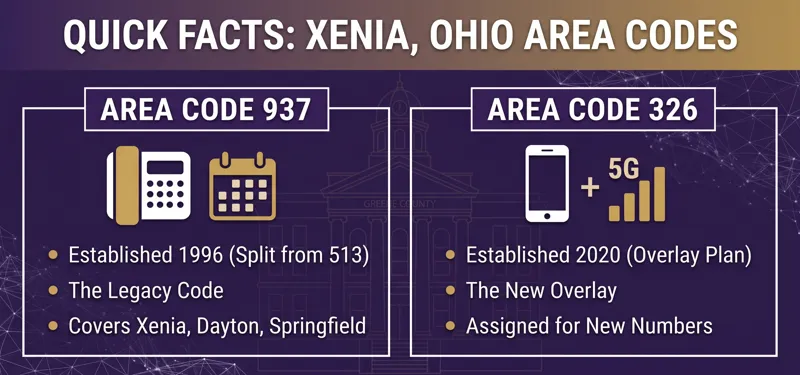
The original area code for the entire southwestern portion of Ohio was 513. However, in September 1996, the 937 code was created as a split from 513 to serve Xenia, Dayton, and the surrounding rural communities.
For over twenty years, 937 was the sole identifier for Xenia phone numbers. As the exhaustion of available 937 numbers approached, the Public Utilities Commission of Ohio approved an overlay plan.
In March 2020, the 326 area code was officially introduced as an all-services overlay. This meant that no existing customers had to change their phone numbers, but new phone lines could be assigned the 326 prefix.
“The implementation of the 326 overlay ensured that the growing population in Greene County and Xenia would never run out of available telephone numbers.”
| Area Code | Year Established | Type of Code |
|---|---|---|
| 937 | 1996 | Primary (Split from 513) |
| 326 | 2020 | Overlay (Shares same region) |
Mandatory 10-Digit Dialing Rules
The introduction of an overlay code fundamentally changes how people dial their phones locally.
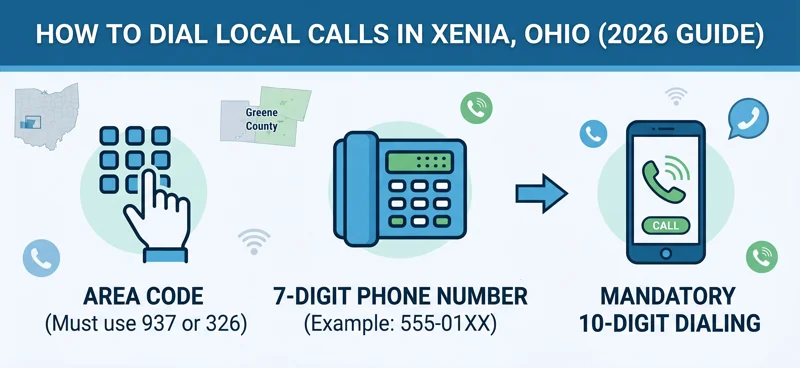
Before the 326 overlay, residents of Xenia could simply dial seven digits to reach their neighbors. Today, mandatory 10-digit dialing is enforced across the entire region.
This means that even if you have a 937 number and are calling the business next door that also has a 937 number, you must dial the area code first.
Failure to use 10-digit dialing will result in an automated recording instructing you to hang up and try your call again with the proper prefix.
| Type of Call | Dialing Pattern | Example Format |
|---|---|---|
| Local Call (Within Xenia) | 10 Digits | 937-555-1234 |
| Long Distance (Outside OH) | 1 + 10 Digits | 1-937-555-1234 |
| Toll-Free Services | 1 + Toll-Free Code | 1-800-555-1234 |
Geographic Coverage of the Greene County Codes
While Xenia is the county seat of Greene County, the 937 and 326 codes stretch far beyond its borders.
These codes cover a massive footprint in southwestern Ohio, reaching up to the rural counties north of Dayton and stretching toward the Indiana border.
If you are receiving a call from a 937 or 326 number, the caller could be in Xenia, but they could also be located in Beavercreek, Fairborn, Springfield, or Dayton.
Knowing the geographic distribution helps local businesses target their marketing efforts and assists residents in identifying legitimate local phone calls.
| City | County | Primary Codes Used |
|---|---|---|
| Xenia | Greene | 937, 326 |
| Dayton | Montgomery | 937, 326 |
| Springfield | Clark | 937, 326 |
| Beavercreek | Greene | 937, 326 |
Avoiding Scam Calls in the Xenia Region
With the rise of caller ID spoofing, scammers frequently use local area codes to trick residents into answering their phones.
A scammer might manipulate their caller ID to display a 937 or 326 prefix, making it appear as though a neighbor or local Xenia business is calling.
To protect yourself, never provide personal or financial information to an unsolicited caller, even if the area code matches your own.
“Always remember that 10-digit dialing is mandatory for all local calls within the Xenia region, but a local caller ID is never a guarantee of the caller’s true identity.”
If you suspect a call is fraudulent, it is best to hang up immediately and report the number. You can learn more about protecting yourself from telecommunications fraud by visiting the official Federal Communications Commission website.
Frequently Asked Questions
What is the primary area code for Xenia, Ohio?
The primary and most recognized area code for Xenia is 937, though the 326 overlay code is also currently in use for new numbers.
Do I have to dial the area code for local calls in Xenia?
Yes, due to the implementation of the 326 overlay, mandatory 10-digit dialing is required for all local calls within the region.
What time zone is Xenia, Ohio located in?
Xenia, along with the rest of Ohio, is located in the Eastern Time Zone (EST/EDT) and observes Daylight Saving Time.
When was the 326 area code introduced to Greene County?
The 326 overlay was officially activated in March 2020 to relieve the exhaustion of available 937 phone numbers.
Are 937 and 326 toll-free numbers?
No, both 937 and 326 are standard geographic area codes. Standard local or long-distance rates apply depending on your phone carrier plan.
Can I keep my 937 number if I move across Xenia?
Yes, you can generally keep your 937 number as long as you remain within the same local calling area and transfer service with your provider.
Major surrounding cities that share the 937 and 326 area codes include Dayton, Springfield, Beavercreek, and Fairborn.
Disclaimer: This article is for informational purposes only. Telecommunications regulations, dialing procedures, and area code boundaries are subject to change based on guidelines set by the North American Numbering Plan Administrator and the FCC.