A computer should be yours Framework CEO calls out MacBook Neo design, and this powerful statement has ignited a massive debate across the tech industry in 2026. When Apple released the highly anticipated $599 MacBook Neo, it was aggressively marketed as the ultimate budget-friendly gateway into the macOS ecosystem, aimed squarely at students and light everyday users. However, a recent, highly publicized 33-minute teardown video by Framework founder and CEO Nirav Patel has completely reframed the conversation. By placing the MacBook Neo side-by-side with the similarly priced Framework Laptop 12 on his workbench, Patel systematically dismantled not just the hardware, but the underlying corporate philosophy of Apple’s latest offering, exposing what he describes as a calculated trap for consumers.
The $599 Budget Battle: Opposing Hardware Philosophies
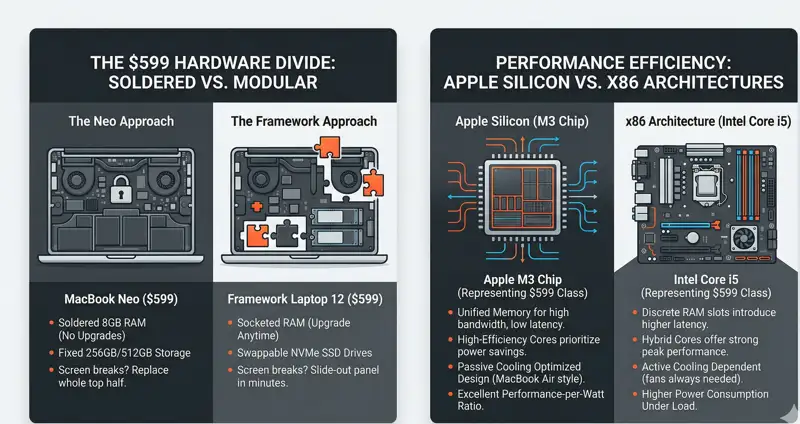
The sub-$1,000 laptop market is a fierce battleground. Consumers in this bracket demand longevity, reliability, and value for their hard-earned money. Apple’s MacBook Neo, priced competitively at $599, shocked many tech analysts by achieving an iFixit repairability rating of 6 out of 10. For a company historically notorious for gluing and soldering its machines shut, this was hailed as Apple’s most repairable laptop in 14 years. But as Patel’s teardown revealed, surface-level repairability does not equate to true hardware ownership.
Patel purchased a MacBook Neo directly from an Apple Store specifically to conduct this independent teardown. He contrasted it with Framework’s 12.2-inch convertible touchscreen laptop, a machine born from a radically different ideology. Framework’s mission is built on the premise that hardware should be modular, upgradable, and fully controlled by the user. The teardown video vividly illustrated how these two laptops, despite targeting the exact same demographic, represent completely opposite trajectories for the future of personal computing.
| Feature Focus | Apple MacBook Neo ($599) | Framework Laptop 12 ($599) |
|---|---|---|
| Core Design Philosophy | Closed ecosystem, planned obsolescence | Modular, fully upgradable, open ecosystem |
| RAM & Storage | Soldered to motherboard (Non-upgradable) | Socketed, user-replaceable in minutes |
| Display Replacement | Requires replacing entire top chassis | Slide-out mechanism, swapped easily |
| Keyboard Repair | Requires removing tape and 41 screws | Single modular unit, quick swap |
| iFixit Rating (Est.) | 6 / 10 | 10 / 10 |
The Illusion of Repairability: Apple’s Soldered Trap
To be fair, Patel did not entirely dismiss Apple’s engineering efforts. During the teardown, he acknowledged that the MacBook Neo provides surprisingly easy access to certain consumable components like the touchpad, battery, and speakers. Furthermore, the input/output ports can be replaced without catastrophic effort. This is a step up from previous generations of MacBooks. However, the praise ended abruptly when Patel reached the core computing components.
The fatal flaw of the MacBook Neo—and the crux of Patel’s argument—lies in its memory and storage. Buyers are permanently locked into the configuration they purchase at checkout. With a baseline of just 8 GB of RAM and fixed storage options of either 256 GB or 512 GB soldered directly to the motherboard, the laptop possesses a hard expiration date. In an era where operating systems and web browsers are incredibly resource-heavy, 8 GB of RAM is barely sufficient today, let alone three or four years into the future.
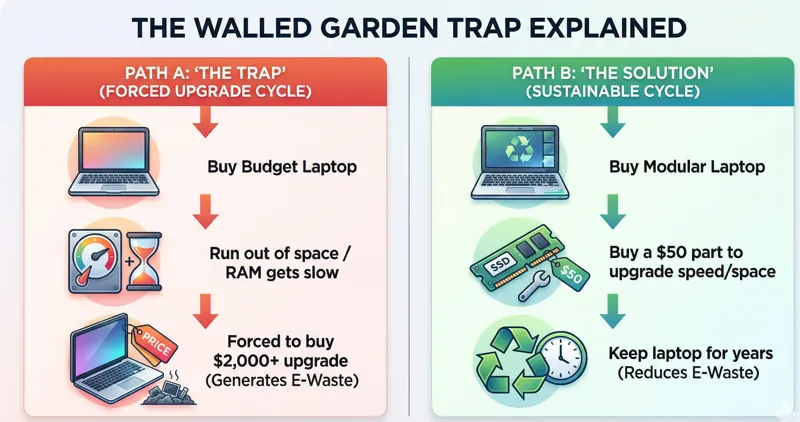
“A big part of the MacBook Neo is to get new MacBook users right from the start and then bring them into the walled garden that Apple has created for them. Once you’re a MacBook Neo owner, you run out of storage space, it gets a bit too slow, you need more ports, and you’re in the macOS world. Maybe you’ll buy that MacBook Pro or that MacBook Air at that $1,000, $2,000, or $3,000 price point.”
The Right to Repair vs. The Apple Way
When a component breaks on the MacBook Neo, the repair process is punishingly expensive and complex. Take the keyboard, for example. To replace a single sticky key or a failing keyboard deck, a technician (or a very brave user) must meticulously peel off a delicate layer of adhesive tape and painstakingly unscrew 41 tiny Phillips screws. Worse still is the display. If a student drops their backpack and cracks the screen, they cannot simply replace the glass or the LCD panel. Apple’s design dictates that the entire top chassis must be swapped out, turning a common accident into an economically devastating repair bill.
While Apple does offer avenues for repair through programs like Apple’s Self Service Repair, the proprietary nature of the parts and the sheer complexity of accessing them often drive consumers back to the Genius Bar, where out-of-warranty repairs frequently cost nearly as much as buying a new machine.
Framework’s Modular Vision: Combating E-Waste
In stark contrast, the Framework Laptop 12 is an engineering marvel of accessibility. During the video, Patel demonstrated how every internal component is clearly labeled with QR codes leading directly to repair guides and part purchasing pages. Using simple POGO pins, magnetic attachments, and standardized screws, almost anyone can disassemble the machine.
Want to upgrade your RAM? Pop off the cover and snap in a new stick. Need more storage for video editing? Insert a larger NVMe SSD in seconds. Did you crack your screen? The Framework’s display simply slides out of its rails and can be swapped for a new one in mere minutes, without replacing the aluminum lid. Even the cooling solution and the main motherboard can be swapped out when faster processors hit the market years down the line.
| Repair Scenario | MacBook Neo User Experience | Framework 12 User Experience |
|---|---|---|
| Upgrading RAM | Impossible (Must buy a new laptop) | Takes 2 minutes, buy standard RAM stick |
| Cracked Screen | Replace entire top half (Very Expensive) | Slide out old panel, slide in new panel (Cheap) |
| Spill on Keyboard | Remove 41 screws, complex disassembly | Pop off input deck, replace instantly |
| Need different ports | Must carry dongles and adapters | Swap out modular expansion cards on the fly |
The “Walled Garden” Strategy Exposed
Patel’s critique goes far beyond mere hardware schematics; it delves into the economics of the tech industry. The MacBook Neo is a loss-leader or a low-margin entry point designed specifically to capture users early—especially in the education sector. It is a stepping stone. Apple knows that 256 GB of storage will fill up quickly with photos, apps, and school projects. They know that 8 GB of RAM will eventually choke under the weight of future macOS updates.
When that inevitably happens, the consumer cannot simply buy a $50 storage drive to fix the problem. The machine is functionally obsolete, generating unnecessary electronic waste. The user, now firmly entrenched in the Apple ecosystem (iCloud, iMessage, Mac-specific software), is highly likely to purchase another, more expensive Apple computer. The $599 entry fee was just the bait.
“We want to eliminate that e-waste by making the product easy to use for as long as you want to. And of course, we don’t want this to be a stepping stone on the path to other computers. If you’ve got a Framework Laptop, we want you to be able to continue to upgrade it so that it works well for you for as long as you need it. That’s our entire philosophy.”
Why True Ownership Matters in 2026
As we navigate 2026, the environmental impact of disposable technology is a global crisis. Millions of tons of e-waste are generated annually because perfectly good aluminum chassis, functioning screens, and capable batteries are thrown away simply because a single soldered chip failed or became outdated. Framework is proving that a laptop does not have to be a sealed black box rented to you by a megacorporation.
Patel emphasized that schools, in particular, need genuine repairability. Educational institutions operate on tight budgets and cannot afford to replace entire fleets of laptops every three years. They need machines that IT departments can quickly fix with spare parts. They need modularity. Ultimately, the battle between the MacBook Neo and the Framework Laptop 12 is a battle for consumer rights. When you spend hundreds of dollars on a device, you should have the right to open it, fix it, and upgrade it. A computer should be yours.
Frequently Asked Questions
What is the price of the Apple MacBook Neo?
The Apple MacBook Neo launched with a budget-friendly starting price of $599, targeting students and light users.
Can I upgrade the RAM or storage on the MacBook Neo?
No. Both the RAM (memory) and the storage (SSD) are permanently soldered directly to the motherboard on the MacBook Neo, making post-purchase upgrades impossible.
What was the iFixit repairability score for the MacBook Neo?
The MacBook Neo received a repairability score of 6 out of 10 from iFixit, which is considered high for modern Apple laptops but still highlights severe limitations regarding core component upgrades.
How does the Framework Laptop 12 differ from the MacBook Neo?
The Framework Laptop 12 is built entirely around modularity. Users can easily open the device to upgrade RAM, swap storage, replace the screen, and even upgrade the main motherboard without buying a whole new laptop.
What did Nirav Patel mean by Apple’s “walled garden”?
He was referring to Apple’s business strategy of offering a cheap entry-level laptop that cannot be upgraded. Once the laptop becomes too slow or runs out of space, the user, now used to Apple’s software, is forced to buy a much more expensive MacBook Pro or Air.
Is it hard to replace the keyboard on the MacBook Neo?
Yes. According to the teardown, replacing the keyboard requires peeling off adhesive tape and unscrewing 41 separate Phillips screws, making it a tedious and frustrating repair.
How does Framework’s design help the environment?
By allowing users to replace only the broken or outdated parts (like a single memory stick or a cracked screen), Framework drastically reduces the amount of electronic waste (e-waste) ending up in landfills.
Disclaimer: This article is for informational purposes only. The opinions and teardown analyses discussed are attributed to Framework CEO Nirav Patel and independent repair advocates. Pricing and hardware specifications are based on 2026 market data and are subject to change.