
Will the Exynos 2600 save the unwanted flagship Samsung Galaxy S26 review units currently circulating among tech critics? This is the central question dominating the conversation surrounding Samsung’s latest high-end release. Launching at a steep starting price of $1,249 (or €1,249 in European markets), the Galaxy S26+ arrives under a cloud of speculation. Industry whispers and supply chain leaks strongly suggest that this particular model was a last-minute addition to the 2026 lineup, rushed into production only after the highly anticipated Galaxy S26 Edge was unceremoniously canceled late in its development cycle. Consequently, the resulting device feels less like a triumphant leap forward and more like a necessary placeholder.
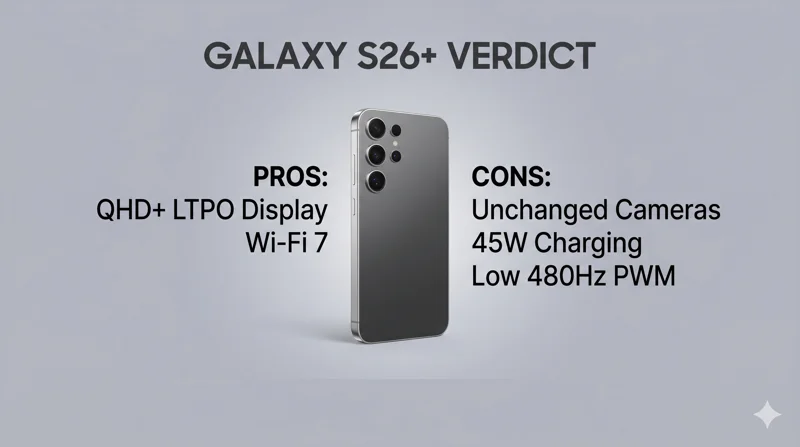
In our comprehensive Samsung Galaxy S26 Plus review, we must separate the impressive core technology from the overarching feeling of stagnation. While the phone undeniably boasts top-tier specifications, including a vibrant screen and a brand-new proprietary chipset, it simultaneously suffers from an identity crisis. It lacks the ultra-premium materials of the S26 Ultra and the compact appeal of the base S26. Let us dive deep into the hardware, thermal performance, and camera capabilities to see if this “accidental” flagship can truly stand on its own in a fiercely competitive market.
The “Accidental” Flagship & Hardware Stagnation
From a purely visual and tactile perspective, the Samsung Galaxy S26+ is practically indistinguishable from the Galaxy S25+ that came before it. The dimensions, the weight (190 grams), and the overall chassis design have been recycled almost entirely. While the build quality remains undeniably excellent, featuring a robust IP68 waterproof rating and a sleek aluminum frame, the lack of innovation is palpable. Consumers spending over a thousand dollars in 2026 expect at least a slight aesthetic evolution.
| Specification | Samsung Galaxy S26+ Details |
|---|---|
| Dimensions / Weight | Identical to S25+ / 190g (6.7 oz) |
| Build Materials | Aluminum frame, Gorilla Glass Victus 2 |
| Water & Dust Resistance | IP68 Certified |
| Base Storage / RAM | 256 GB UFS 4.0 / 12 GB LPDDR5x |
One of the most glaring omissions is the absence of Gorilla Armor glass. While the more expensive Ultra variant benefits from the incredible anti-reflective properties and enhanced scratch resistance of frosted Gorilla Armor, the S26+ is left using the older Gorilla Glass Victus 2. Furthermore, despite possessing a massive screen that begs for productivity tools, there is still no stylus support. These omissions make it increasingly difficult to justify the device’s existence as anything other than a middle-child compromise.
A Stunning, Yet Flawed, QHD+ LTPO AMOLED Display
If there is one area where Samsung rarely falters, it is display technology. The Galaxy S26+ is equipped with a gorgeous 6.7-inch QHD+ LTPO AMOLED display. Boasting a resolution of 3120 x 1440 pixels, the panel achieves an incredibly sharp pixel density of 513 PPI. The LTPO technology ensures that the refresh rate dynamically scales between a battery-saving 1 Hz and a buttery-smooth 120 Hz, depending on the content being viewed.
While the QHD+ LTPO AMOLED panel is undeniably vibrant and razor-sharp, Samsung’s stubborn refusal to adopt high-frequency PWM dimming leaves sensitive users out in the cold.
However, despite the excellent peak brightness and brilliant HDR rendering, the display has a significant Achilles’ heel: its PWM (Pulse-Width Modulation) dimming rate. Samsung continues to utilize a relatively low 480 Hz PWM dimming frequency to control screen brightness at lower levels. In stark contrast, competing Chinese flagships from brands like Xiaomi, Vivo, and Oppo are now offering PWM frequencies approaching 4,000 Hz. For users sensitive to screen flicker, which can cause eye strain and headaches, the S26+ is noticeably inferior to its overseas rivals.
| Display Feature | Technical Metric |
|---|---|
| Screen Size & Type | 6.7-inch LTPO-AMOLED (19.5:9 ratio) |
| Resolution | 3120 x 1440 pixels (QHD+) |
| Refresh Rate | Dynamic 1 Hz to 120 Hz |
| PWM Dimming Frequency | 480 Hz (Low compared to competitors) |
Exynos 2600 Performance & Thermal Reality
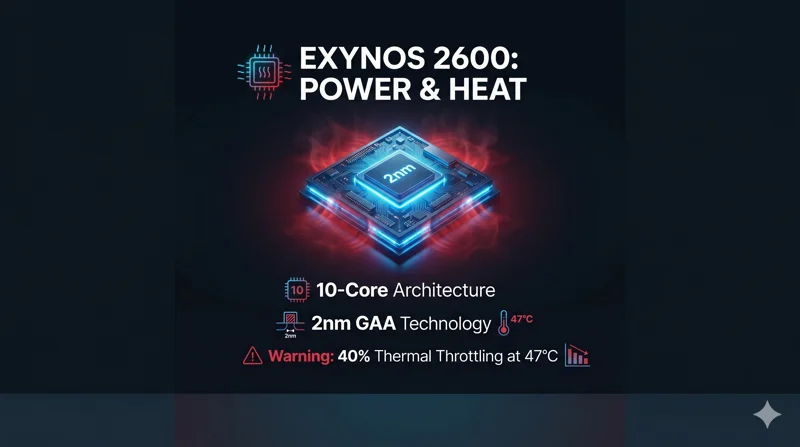
The most significant, and arguably the only meaningful, upgrade in the S26+ is its processing heart. With this generation, Samsung has once again aggressively pushed its in-house silicon, equipping the European and international variants of the phone with the highly anticipated Exynos 2600. This marks a pivotal moment, as the Exynos 2600 is a cutting-edge 2nm GAA smartphone processor. Featuring a complex 10-core architecture, it is spearheaded by a blazing-fast ARM C1-Ultra core clocked at 3.8 GHz.
When analyzing the Exynos 2600 vs Snapdragon 8 Elite debate, the results are fascinating. In single-core benchmark tests, the Exynos chip sometimes trails behind the absolute top-tier Snapdragon equivalents. However, thanks to its 10-core setup, the Exynos 2600 pulls ahead in multi-core workloads and shows exceptional prowess in AI-driven tasks, dominating the Geekbench AI metrics. The integration of the Samsung Xclipse 960 graphics adapter ensures that high-end gaming and ray-tracing capabilities are fully supported.
| Processor Details | Exynos 2600 Specifications |
|---|---|
| Manufacturing Node | 2nm GAA (Gate-All-Around) |
| Core Configuration | 10 Cores (1x 3.8 GHz C1-Ultra, 3x 3.3 GHz C1-Pro, 6x 2.8 GHz C1-Pro) |
| GPU | Samsung Xclipse 960 |
| AI Performance | Class-leading Geekbench AI scores |
However, raw power comes at a thermal cost. In our rigorous 3DMark stress tests, we recorded surface temperatures reaching up to 47 °C under sustained heavy loads. The 2nm GAA smartphone processor is undeniably powerful, but the cooling constraints of the S26+ chassis force the system to throttle performance by up to 40 percent during prolonged gaming sessions. While not dangerous, it indicates that the chip’s theoretical maximums cannot be maintained indefinitely in this specific hardware environment.
The 2nm Exynos 2600 is a marvel of multi-core engineering, but its aggressive performance ceiling is ultimately restricted by unavoidable thermal throttling during sustained workloads.
Camera System: Not Quite State-of-the-Art
If you are upgrading for a better photography experience, you will be sorely disappointed. The camera array on the Galaxy S26+ is virtually untouched from previous iterations. The triple-camera setup features a capable main sensor, but it is accompanied by a rather underwhelming 12 MP ultra-wide lens and a 10 MP telephoto lens. Because these secondary sensors lack high resolutions, they cannot utilize advanced pixel-binning techniques to improve low-light performance.
| Camera Sensor | Resolution & Capability |
|---|---|
| Main Wide Camera | 50 MP (Good daylight, artificial sharpening) |
| Ultra-Wide Angle | 12 MP (No pixel binning) |
| Telephoto Lens | 10 MP (Solid optical zoom, poor low-light) |
| Front Selfie Camera | 12 MP |
While daylight shots are vivid and boast Samsung’s signature excellent color reproduction, the system relies heavily on artificial software sharpening. In low-light environments, image details quickly become muddy. When positioned next to photography powerhouses like the Vivo X300 Pro or the Oppo Find X9 Pro, the Galaxy S26+ feels distinctly last-generation. The hardware simply no longer justifies the $1,249 price tag in 2026.
Galaxy S26+ Battery Life and Charging Limitations
Evaluating the Galaxy S26+ battery life and charging speeds reveals another area where Samsung played it entirely too safe. The device retains a 4,900 mAh battery capacity, which critics have begun referring to as a “mini battery” given the power demands of modern 10-core processors and massive QHD+ displays.
In our standardized Wi-Fi browsing tests (conducted at 150 cd/m² display brightness), the S26+ managed a respectable 18 hours. However, this is actually a regression; the previous year’s Snapdragon-equipped model lasted nearly two hours longer under the exact same conditions. Charging speeds are similarly uninspired. Capped at 45 watts wired and 15 watts wirelessly, the phone takes over an hour to reach a full charge—a glaring weakness when competitors are offering 100W+ charging solutions that top up devices in under 30 minutes.
| Power & Connectivity | Specifications |
|---|---|
| Battery Capacity | 4,900 mAh |
| Charging Speeds | 45W Wired / 15W Wireless |
| Wi-Fi Standard | Wi-Fi 7 (Including 6 GHz band) |
| Wired Data Transfer | USB 3.2 Gen 1 (OTG, Wired image output) |
Despite these hardware gripes, the software and connectivity experience is flawless. Shipping with One UI 8.5 over Android 16, Samsung guarantees an industry-leading seven years of software and security updates. Furthermore, the inclusion of ultra-fast Wi-Fi 7, UWB (Ultra-Wideband), and USB 3.2 Gen 1 ensures that the phone is highly capable of interfacing with next-generation networking equipment and storage devices. For a deeper dive into the latest mobile networking standards that power these speeds, check the resources provided by the Wi-Fi Alliance.
The Samsung Galaxy S26+ is a fundamentally good smartphone trapped by its own lack of ambition. It relies entirely on the prowess of the Exynos 2600 to justify an otherwise stagnant spec sheet.
Frequently Asked Questions (FAQs)
Why is the Samsung Galaxy S26+ considered an “unwanted” flagship?
Industry rumors suggest the Galaxy S26+ was essentially a last-minute replacement for a canceled “Galaxy S26 Edge” model, resulting in a device that recycles heavily from the previous year’s design without introducing major new hardware features outside of the processor.
How does the Exynos 2600 compare to the Snapdragon 8 Elite?
The Exynos 2600 is a 2nm, 10-core processor that excels in multi-core and AI benchmarks, often beating the Snapdragon 8 Elite in those specific areas. However, it trails slightly in single-core speeds and exhibits more thermal throttling under heavy, sustained load.
Does the Galaxy S26+ have Gorilla Armor glass like the Ultra?
No, the Galaxy S26+ utilizes the older Gorilla Glass Victus 2, missing out on the superior anti-reflective properties of the Ultra’s Gorilla Armor.
What is the battery capacity and charging speed of the S26+?
The phone features a 4,900 mAh battery. It supports 45W wired fast charging and 15W wireless charging, which is considered slow compared to modern Chinese flagship alternatives.
Does the Exynos 2600 negatively impact battery life?
Based on standardized tests, the Exynos 2600-powered S26+ yielded about 18 hours of Wi-Fi web browsing, which is roughly two hours less than its direct Snapdragon-powered predecessor, indicating slightly worse power efficiency.
Are the cameras on the Galaxy S26+ upgraded from last year?
No, the camera hardware is virtually identical to the S25+. It features a 50MP main, 12MP ultra-wide, and 10MP telephoto lens. While good in daylight, it struggles with low-light detail compared to competitors.
Does the Galaxy S26+ display suffer from PWM flickering?
Yes. Despite being a brilliant QHD+ LTPO AMOLED panel, it uses a relatively low 480 Hz PWM dimming frequency. This may cause discomfort or eye strain for users who are sensitive to screen flicker.
Disclaimer: This article is for informational purposes only. Device performance metrics, battery life, and thermal results are based on independent benchmark testing and review unit analysis. Actual consumer experience may vary based on individual usage patterns and future software updates.